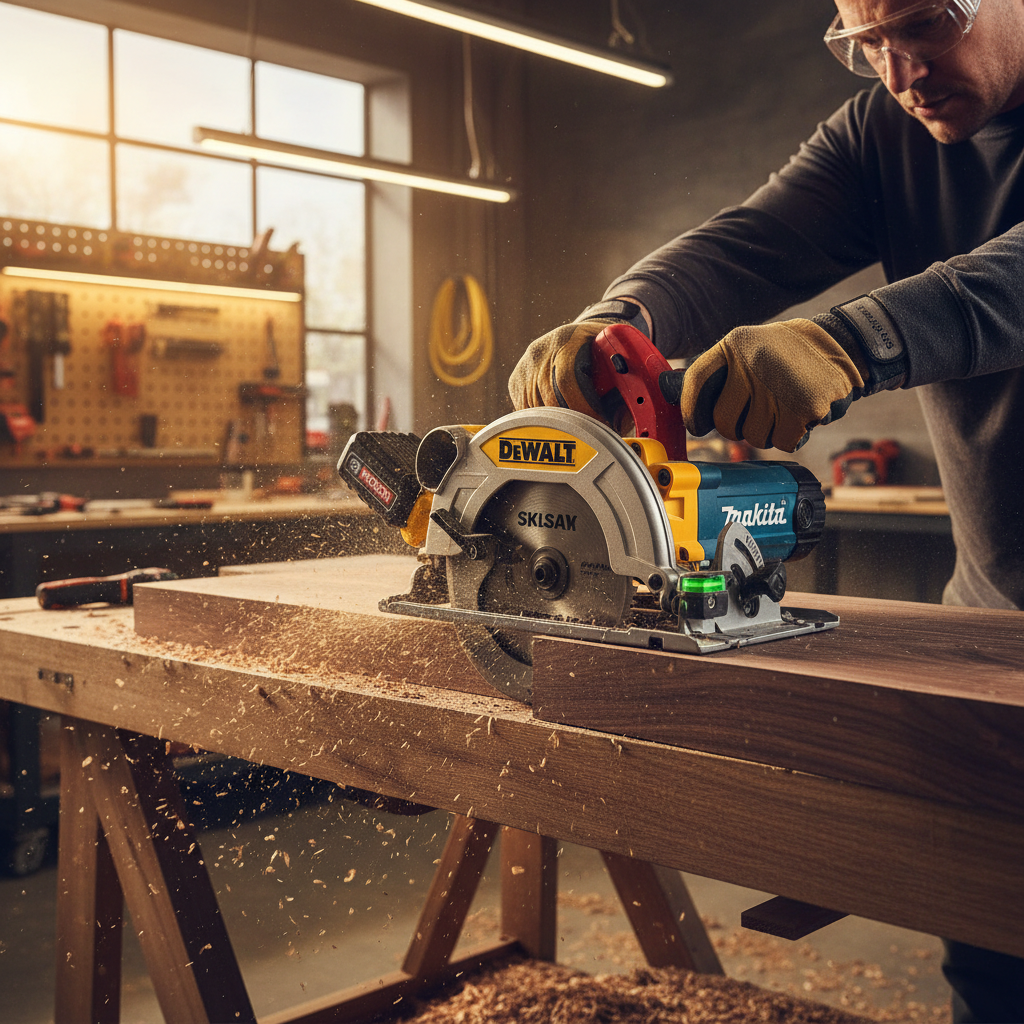
The Complete Guide to Circular Saws (2026)
A circular saw is the most versatile portable power saw in any workshop or job site. Featuring a toothed blade that spins at high RPM, it rips through lumber, plywood, and sheet goods with speed and precision. Available in sidewinder and worm-drive configurations, circular saws handle crosscuts, rip cuts, bevel cuts, and even plunge cuts when equipped with the right blade.
Key Takeaways
- A circular saw is the most versatile portable power saw in any workshop or job site.
- Featuring a toothed blade that spins at high RPM, it rips through lumber, plywood, and sheet goods with speed and precision.
- Available in sidewinder and worm-drive configurations, circular saws handle crosscuts, rip cuts, bevel cuts, and even plunge cuts when equipped with the right blade.
- Circular saws are used for crosscutting lumber to length, ripping plywood and sheet goods, making bevel and miter cuts on framing lumber, cutting deck boards, trimming door jambs, and rough-cutting dimensional lumber on job sites.
- They are essential for framing, decking, fencing, and general carpentry.
What It's Used For
Circular saws are used for crosscutting lumber to length, ripping plywood and sheet goods, making bevel and miter cuts on framing lumber, cutting deck boards, trimming door jambs, and rough-cutting dimensional lumber on job sites. They are essential for framing, decking, fencing, and general carpentry.
Types & Variations
Sidewinder (inline motor, lighter weight, most common for DIY), Worm-Drive (rear motor, more torque, preferred by framers), Hypoid (sealed gear system, maintenance-free), Compact/Mini circular saws (4-1/2 inch blade for lighter tasks), Cordless (battery-powered 18V-60V for portability), and Track-compatible models that accept guide rails for straight cuts.
Key Features to Look For
- Blade diameter (7-1/4 inch standard)
- motor power (15 amps corded or 20V-60V cordless)
- RPM (5
- 000-5
- 800 no-load)
- bevel capacity (0-56 degrees)
- depth of cut at 90 degrees (2-7/16 inch typical)
- electric brake
- spindle lock for blade changes
- dust port
- LED cut-line indicator
- magnesium or aluminum shoe for durability
- and rafter hook for overhead work.
How to Use
1) Mark your cut line on the material. 2) Set blade depth to about 1/4 inch past the material thickness. 3) Clamp the workpiece securely or support it on sawhorses. 4) Align the blade guide notch on the shoe plate with your cut line. 5) Start the saw and let it reach full speed before contacting the material. 6) Push the saw steadily through the cut without forcing it. 7) Let the cutoff piece fall freely — never bind the blade. 8) Release the trigger and wait for the blade to stop before setting the saw down.
⚠️ Safety Tips
Always wear safety glasses and hearing protection. Never remove or pin back the blade guard. Support material so the cutoff piece falls away freely to prevent kickback. Keep the cord behind you and away from the blade path. Use sharp blades — dull blades cause binding and kickback. Never reach under the material while the blade is spinning. Disconnect power before changing blades.
Maintenance
Clean sawdust from the motor vents and guard mechanism after each use. Check the blade guard spring and retraction regularly. Inspect the power cord for damage. Keep the shoe plate flat — replace if bent. Lubricate the depth and bevel adjustment mechanisms periodically. Replace carbon brushes when worn. Store in a dry location with the blade guard fully closed.
Price Range & Recommendations
Price Range: $50-$150 for entry-level corded, $100-$200 for mid-range corded, $150-$350 for premium cordless, $200-$500+ for professional worm-drive or track-compatible models.
Beginners should start with a lightweight 7-1/4 inch sidewinder with an electric brake and LED guide — the DeWalt DWE575SB or Makita 5007MGA are excellent choices under $150. Pros will prefer a worm-drive like the SKILSAW SPT77WML-01 for framing work, or a premium cordless like the Milwaukee M18 FUEL 2732 or DeWalt FLEXVOLT DCS578 for maximum portability on job sites.
Top Brands
Related Tools
Frequently Asked Questions
Related Guides
Band Saw
Learn how to choose and use a band saw for resawing, curves & joinery. Compare Jet, Rikon & Grizzly
Read guideChainsaw
Find the right chainsaw for your needs. Compare gas, electric & battery models from Stihl, Husqvarna
Read guideJigsaw
Discover how to choose and master a jigsaw for curves, cutouts & scroll work. Compare Bosch, DeWalt
Read guideMiter Saw
Master miter saw selection and technique. Compare sliding vs compound models from DeWalt, Bosch & Ma
Read guide