The Complete Guide to Band Saws (2026)
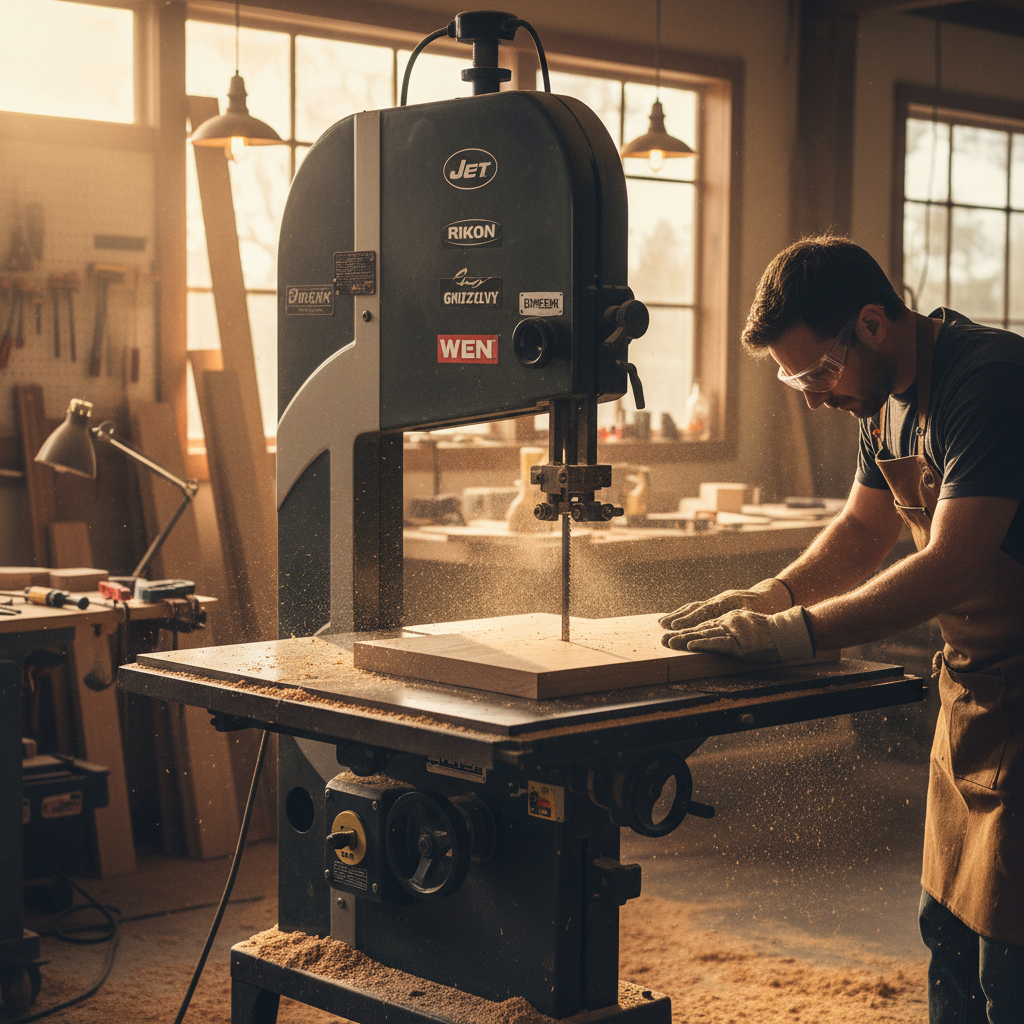
A band saw uses a continuous loop blade running over two or three wheels to make precise curved cuts, resaw thick lumber into thinner boards, and handle a wide range of woodworking tasks. Its narrow blade kerf wastes less material than a table saw, and it can cut stock that is too thick for most other saws. A well-tuned band saw is one of the safest and most versatile stationary tools in any workshop.
Key Takeaways
- A band saw uses a continuous loop blade running over two or three wheels to make precise curved cuts, resaw thick lumber into thinner boards, and handle a wide range of woodworking tasks.
- Its narrow blade kerf wastes less material than a table saw, and it can cut stock that is too thick for most other saws.
- A well-tuned band saw is one of the safest and most versatile stationary tools in any workshop.
- Band saws are used for resawing lumber into thinner boards and veneers, cutting curves and irregular shapes in thick stock, ripping rough lumber, cutting tenons, making veneers from expensive hardwoods, slicing logs into planks, cutting metal (with the right blade), and shaping cabriole legs and other furniture components.
- Throat capacity (distance from blade to frame), resaw height (maximum stock thickness), motor power (1/3 HP to 3 HP), blade size range (widths the saw accepts), blade guides (ball-bearing vs ceramic vs cool blocks), table size and tilt, dust collection port (4 inch preferred), cast-iron table and wheels, fence quality, and quick-release blade tension lever.
What It's Used For
Band saws are used for resawing lumber into thinner boards and veneers, cutting curves and irregular shapes in thick stock, ripping rough lumber, cutting tenons, making veneers from expensive hardwoods, slicing logs into planks, cutting metal (with the right blade), and shaping cabriole legs and other furniture components.
Types & Variations
Benchtop (9-10 inch, light-duty curves), Floor-Standing 14-inch (most popular home shop size), 17-18 inch (serious resawing capability), and Industrial 20-24 inch (production shops). Also available: Portable Band Saws for cutting metal pipe on job sites, and Meat Band Saws (food-grade).
Key Features to Look For
- Throat capacity (distance from blade to frame)
- resaw height (maximum stock thickness)
- motor power (1/3 HP to 3 HP)
- blade size range (widths the saw accepts)
- blade guides (ball-bearing vs ceramic vs cool blocks)
- table size and tilt
- dust collection port (4 inch preferred)
- cast-iron table and wheels
- fence quality
- and quick-release blade tension lever.
How to Use
1) Select the correct blade width — narrow for tight curves, wide for resawing and straight cuts. 2) Set proper blade tension using the built-in gauge or by deflecting the blade 1/4 inch with finger pressure. 3) Adjust the upper blade guide to within 1/4 inch of the material. 4) Set the blade tracking so the blade rides in the center of the tires. 5) Turn on the saw and feed the material steadily. 6) For curves, cut relief notches to remove waste and reduce binding. 7) Use a fence or point fence for resawing. 8) Never back the material out while the blade is moving — this pulls the blade off the wheels.
⚠️ Safety Tips
Keep your fingers well away from the blade path. Adjust the upper guide as close to the workpiece as possible. Never back out of a cut with the blade running. Use a push stick for small pieces. Wear safety glasses. Do not wear loose clothing or gloves that could catch the blade. If the blade breaks, step back immediately and turn off the saw. Stand slightly to the side of the blade.
Maintenance
Replace blade guide blocks or bearings when worn. Clean tire surfaces with a crepe rubber cleaning stick. Check blade tension before each use. Inspect blades for cracks, dull teeth, or missing teeth. Clean sawdust from the lower cabinet and dust port. Wax the table surface. Align the blade tracking and guides after changing blades. Lubricate the table tilt mechanism.
Price Range & Recommendations
Price Range: $150-$300 for benchtop models, $400-$800 for 14-inch floor-standing, $800-$1,500 for 17-inch models, $1,500-$3,500+ for industrial sizes.
Beginners should consider the WEN 3962 10-inch benchtop ($180 range) for basic curve cutting, or the Rikon 10-326 14-inch for a serious first band saw. Pros favor the Laguna 14|BX or 18|BX for resaw capacity and vibration-free operation, or the Jet JWBS-18QT for a rock-solid 18-inch workhorse.
Top Brands
Related Tools
Frequently Asked Questions
Related Guides
Chainsaw
Find the right chainsaw for your needs. Compare gas, electric & battery models from Stihl, Husqvarna
Read guideCircular Saw
Learn how to choose and use a circular saw. Compare top brands like DeWalt, Milwaukee & Makita. Tips
Read guideJigsaw
Discover how to choose and master a jigsaw for curves, cutouts & scroll work. Compare Bosch, DeWalt
Read guideMiter Saw
Master miter saw selection and technique. Compare sliding vs compound models from DeWalt, Bosch & Ma
Read guide