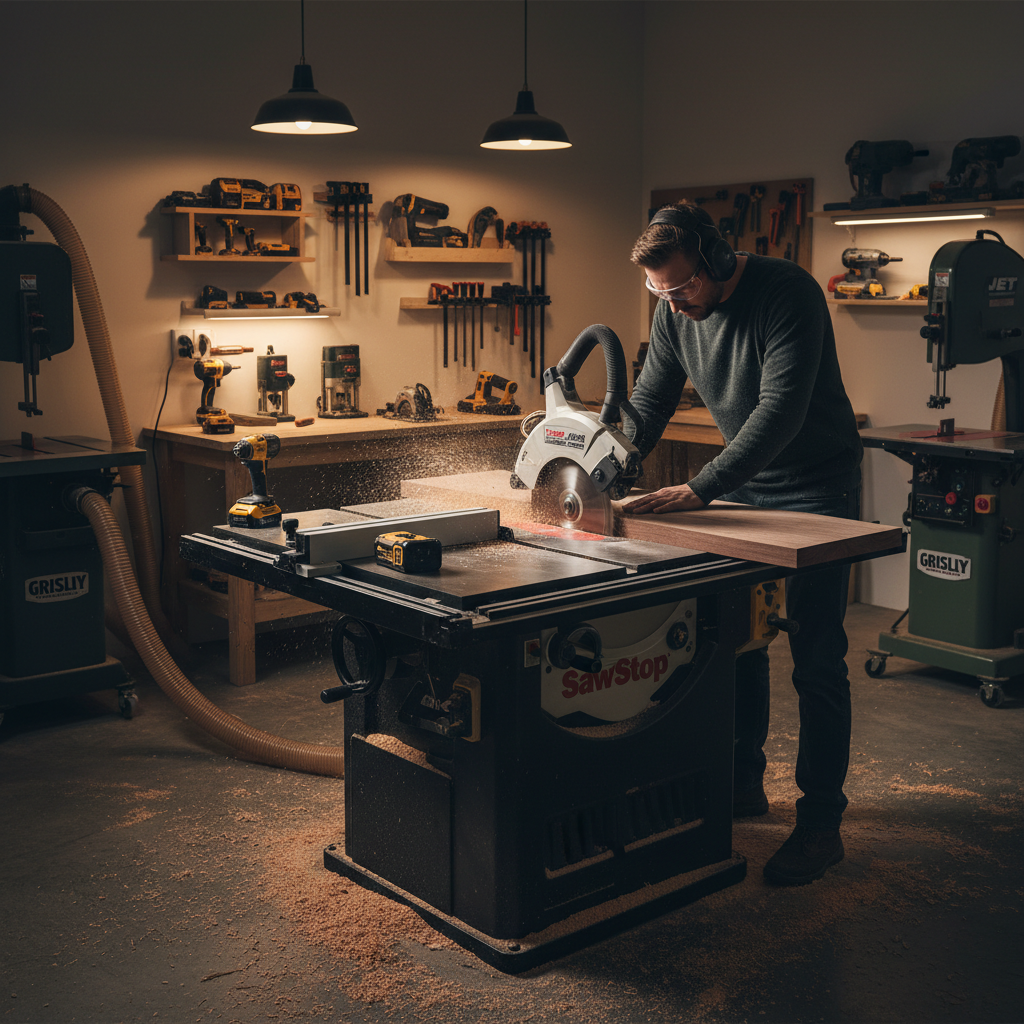
The Complete Guide to Table Saws (2026)
The table saw is the centerpiece of most woodworking shops, delivering unmatched accuracy for rip cuts, crosscuts, dados, rabbets, and joinery. A flat table with a protruding spinning blade allows you to feed material through at a consistent width using the rip fence or at precise angles using the miter gauge. From portable jobsite models to stationary cabinet saws, there is a table saw for every skill level and budget.
Key Takeaways
- The table saw is the centerpiece of most woodworking shops, delivering unmatched accuracy for rip cuts, crosscuts, dados, rabbets, and joinery.
- A flat table with a protruding spinning blade allows you to feed material through at a consistent width using the rip fence or at precise angles using the miter gauge.
- From portable jobsite models to stationary cabinet saws, there is a table saw for every skill level and budget.
- Table saws are used for ripping lumber and sheet goods to consistent widths, crosscutting with a miter gauge or sled, cutting dados and rabbets with stacked dado sets, making tenons and box joints, tapering legs, resawing thin stock, and virtually any straight-line cut in woodworking and construction.
- Motor power (15-amp or 1-3/4 to 5 HP), rip capacity (24-52 inches right of blade), blade size (10 inch standard), arbor size (5/8 inch), table flatness and material (cast iron preferred), fence accuracy and lock-down, miter gauge quality, dust collection port size (4 inch preferred), dado capacity, blade guard system, and flesh-detection safety (SawStop).
What It's Used For
Table saws are used for ripping lumber and sheet goods to consistent widths, crosscutting with a miter gauge or sled, cutting dados and rabbets with stacked dado sets, making tenons and box joints, tapering legs, resawing thin stock, and virtually any straight-line cut in woodworking and construction.
Types & Variations
Portable/Jobsite (compact, lightweight, 15-amp motors), Contractor (open-stand, belt-driven, more power), Hybrid (enclosed cabinet with contractor motor), Cabinet (heavy cast-iron, 3-5 HP, precision ground), and Sliding Table Saws (European-style with sliding crosscut table). SawStop models feature flesh-detecting blade brake technology.
Key Features to Look For
- Motor power (15-amp or 1-3/4 to 5 HP)
- rip capacity (24-52 inches right of blade)
- blade size (10 inch standard)
- arbor size (5/8 inch)
- table flatness and material (cast iron preferred)
- fence accuracy and lock-down
- miter gauge quality
- dust collection port size (4 inch preferred)
- dado capacity
- blade guard system
- and flesh-detection safety (SawStop).
How to Use
1) Set the blade height to about 1/4 inch above the material. 2) Adjust the rip fence to your desired width and lock it. 3) Stand to the side of the blade, not directly behind it. 4) Turn on the saw and let it reach full speed. 5) Feed the material steadily against the fence using push sticks for narrow cuts. 6) Use a push stick or push block when your hand would come within 6 inches of the blade. 7) Complete the cut and turn off the saw. 8) Never reach over a spinning blade to retrieve cutoffs.
⚠️ Safety Tips
Always use a riving knife or splitter to prevent kickback. Use push sticks for cuts narrower than 6 inches. Never stand directly behind the workpiece — stand to the side. Never freehand a rip cut; always use the fence. Do not use the rip fence and miter gauge simultaneously for crosscuts. Wear safety glasses and hearing protection. Consider investing in a SawStop saw for flesh-detecting brake technology.
Maintenance
Wax the table surface with paste wax for smooth feeding. Keep the riving knife and blade guard clean. Check blade alignment to the miter slot with a dial indicator and adjust as needed. Clean sawdust from the cabinet interior and motor. Inspect the belt on contractor models. Lubricate the fence rail and elevation/tilt mechanisms. Replace the throat plate when worn.
Price Range & Recommendations
Price Range: $250-$500 for portable jobsite saws, $500-$1,000 for contractor saws, $800-$1,500 for hybrid saws, $1,500-$4,000+ for cabinet saws, $1,700-$5,000+ for SawStop models.
Beginners should consider a portable jobsite saw like the DeWalt DWE7485 (compact, accurate, $350 range) or invest in a SawStop Jobsite Saw for unmatched safety. Pros will gravitate toward cabinet saws — the SawStop Professional Cabinet Saw, Powermatic PM2000, or Jet ProShop II deliver the mass, precision, and power needed for fine woodworking and daily production use.
Top Brands
Related Tools
Frequently Asked Questions
Related Guides
Band Saw
Learn how to choose and use a band saw for resawing, curves & joinery. Compare Jet, Rikon & Grizzly
Read guideChainsaw
Find the right chainsaw for your needs. Compare gas, electric & battery models from Stihl, Husqvarna
Read guideCircular Saw
Learn how to choose and use a circular saw. Compare top brands like DeWalt, Milwaukee & Makita. Tips
Read guideJigsaw
Discover how to choose and master a jigsaw for curves, cutouts & scroll work. Compare Bosch, DeWalt
Read guide