Is Rubberwood Good for a Dining Table? What to Check Before Buying
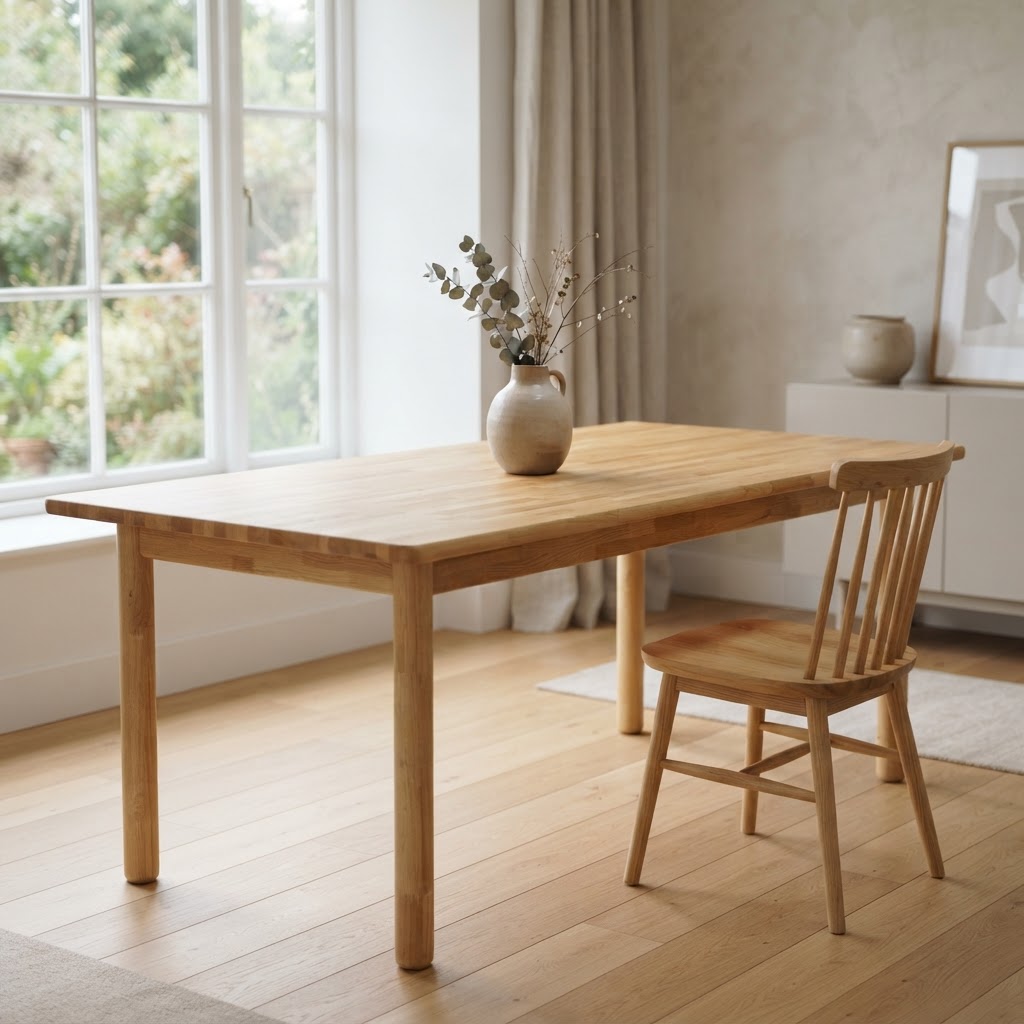
Rubberwood is real wood from Hevea brasiliensis, the tree cultivated for natural latex. It is also sold under names such as parawood. It is not a rubber-coated panel, and a rubberwood table is not automatically flexible, waterproof or maintenance-free.
For indoor dining furniture, the most useful question is whether the actual table is well constructed and suitable for the conditions in your home. The rubberwood species guide provides additional material and sourcing context.
Find out what “rubberwood table” actually means
The description may apply to the top, legs or only some visible parts. A table can combine solid timber, veneer and manufactured panels. Request a component-by-component description, especially for a product advertised as solid wood.
A solid top may be made from edge-glued strips. Some components may include finger joints. These are manufacturing details to assess, not automatic defects. By contrast, a thin rubberwood veneer over a panel is a different construction from a solid laminated top. The product listing should distinguish them.
Ask whether dimensions include an applied edge or whether the top is equally thick throughout. This affects the apparent heft of the furniture without necessarily indicating its strength.
Evaluate joints and support, not only the species
Check the leg-to-apron connections, underside supports and attachment of the top. For an extending table, look at the leaf alignment, locking mechanism and support when extended.
The grain direction of a solid top affects seasonal movement. Its attachment should accommodate the intended movement rather than rigidly restraining it across the grain. A buyer does not need to redesign the table, but can ask the manufacturer how the construction handles indoor humidity changes.
Inspect for open glue joints, loose fittings or movement in the base. A floor that is uneven can also make a sound table rock, so distinguish the setting from a loose connection.
Understand water and outdoor limits
Rubberwood has low natural decay resistance. Indoor furniture uses do not establish suitability for an exposed patio, a constantly wet surface or ground contact. A decorative coating alone does not turn an indoor table into an exterior-rated product.
Use coasters and suitable heat protection, wipe spills promptly and follow the actual finish manufacturer’s or furniture maker’s cleaning instructions. Avoid assuming that a cleaner recommended for one coating is compatible with every finish. Persistent condensation, leaks and hot cookware are different challenges from an occasional quickly cleaned spill.
For outdoor furniture, select a product expressly specified for that exposure rather than relying on the word hardwood.
Ask about drying and production treatment
The species description does not prove how the actual stock was dried, protected during processing or finished. Ask the supplier for the product’s intended use and any treatment information relevant to that use.
Do not infer that every rubberwood product has the same preservative history. Likewise, the tree’s association with latex does not establish the allergen status of a particular finished item. If you have a specific sensitivity or safety requirement, obtain product-specific information from the manufacturer rather than an assurance based solely on the wood name.
Compare value using equivalent construction
Imagine a $450 table with a manufactured-panel top and rubberwood legs, and a $600 table with a solid laminated rubberwood top. The $150 difference does not establish that the second seller is charging more for the same product.
First compare top construction, dimensions, extension hardware, finish, delivery and warranty. These prices are hypothetical examples, not a current rubberwood market range. Once the construction is equivalent, compare the terms and service offered.
A heavier or thicker-looking table is not automatically better. An applied edge can create that appearance, and excess weight may not suit your room or delivery access.
Do not treat a plantation story as a certificate
Rubberwood is commonly associated with plantation-grown latex trees, but that history does not establish every environmental claim on an individual purchase. Ask what the seller is actually documenting: species identity, harvest origin, a certification claim or another attribute.
If certified sourcing is a requirement, check the current certificate scope and sale documents. Read the sourcing evidence checklist before assuming that “plantation hardwood” and “certified furniture” mean the same thing.
A practical purchase checklist
- Identify the top, core, legs and aprons separately.
- Confirm assembled dimensions and delivery access.
- Inspect joints, supports and extension hardware.
- Obtain the finish and cleaning instructions.
- Confirm indoor or outdoor application limits.
- Keep warranty, sourcing and treatment documentation.
- Inspect the delivered furniture before discarding packaging.
Sources and scope
The Wood Database rubberwood reference identifies the species and discusses natural decay resistance. General moisture behavior is addressed by the USDA Wood Handbook. This article does not test or endorse a particular table.
The featured image is an AI-generated furniture illustration, not evidence of a product’s species, construction or sourcing.
Frequently Asked Questions
Lumberama Editorial Team
Source-based material and purchasing guidance
Contributor to Lumberama’s reference library. Read our editorial standards and source methodology.
Explore related resources
Where readers of this article usually go next.
Related Articles

How Much Is a Sheet of Plywood? Cost Factors by Type and Grade
A sheet of plywood can be a commodity sheathing panel or a premium cabinet panel. Here is what drives the price and how to compare panel quotes.

How Much Does a 2x4 Cost? What Actually Sets the Price
There is no single 2x4 price. Species, grade, length, treatment, quantity and delivery all move the number. Here is how to compare stud pricing like a buyer, not a browser.

How Much Lumber Does It Take to Build a House?
There is no fixed board-foot number for a house. Footprint, stories, roof design, framing method and engineered components all change the package. Here is how builders estimate it.