How to Straighten Warped Wood: Repair or Replace?
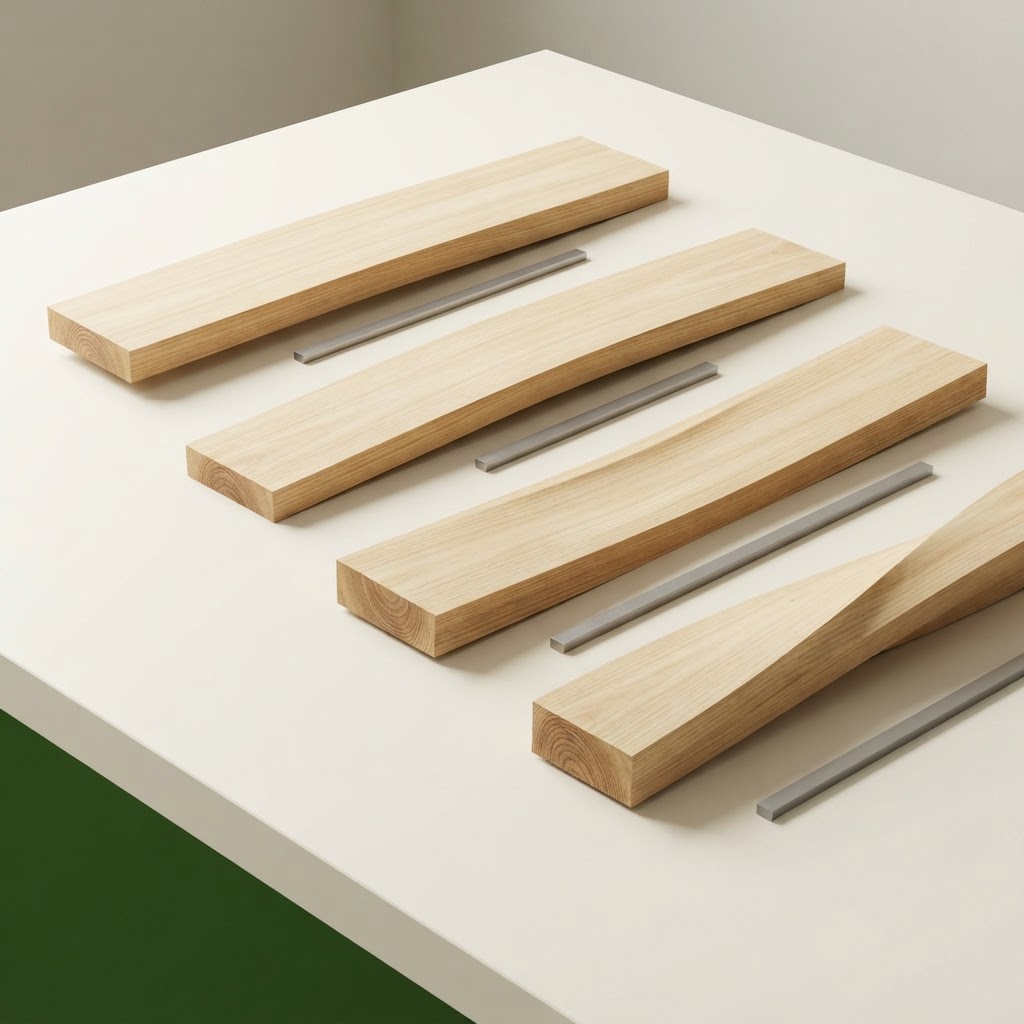
Quick answer: To straighten warped solid wood reliably, first correct the moisture or storage problem, then assess whether enough sound material remains to mill a flat board. Cutting a long board into shorter project parts can reduce how much material must be removed. Clamping, wet towels and sunlight are not dependable substitutes for stable moisture and proper milling.
The important question is not simply “Can this board be made flat?” It is “Will the resulting board still meet the finished size and intended use?” A repair that produces a thin, undersized or unstable part can be more expensive than replacement.
Hero graphic: AI-generated illustration of distortion types, not a measurement or construction detail.
Key takeaways
- Identify bow, crook, cup or twist before choosing a remedy.
- A thickness planer normally makes the opposite face parallel to an existing reference face; it does not automatically remove warp.
- Do not machine structural lumber below its required size or force damaged members into a load-bearing assembly.
Which type of warp does the board have?
| Distortion | How it appears | Useful next step |
|---|---|---|
| Bow | A curve along the board’s length when viewed from the side | Consider shorter parts, then assess flattening loss |
| Crook | A curve along the edge when viewed from above | Evaluate straightening the edge and the width remaining |
| Cup | A hollow or crown across the board’s width | Assess thickness loss or narrower glued-up parts |
| Twist | Corners do not lie in the same plane | Use winding sticks or a flat reference to assess the loss before milling |
Use a straightedge, a known-flat reference surface and winding sticks as appropriate. Also look for splits, loose knots, decay, embedded metal and damaged glue lines. A geometric correction does not repair these defects.
Start with moisture, not a clamp
The USDA Wood Handbook explains that wood exchanges moisture with surrounding air and changes dimension as its moisture changes. Uneven exposure and differences in shrinkage can contribute to distortion. Flattening wood while its moisture is still changing can remove useful thickness without producing a stable final part.
Move suitable solid stock to an environment representative of its intended use. Support it evenly, keep it out of direct wetting and allow air to reach both faces. Check moisture with an appropriate meter using its species and temperature corrections. There is no universal number of acclimation days that works for every thickness, species and climate.
For help with that decision, use the wood moisture and acclimation tool. A planning tool does not replace actual moisture measurements on the material.
A practical flattening workflow for solid lumber
- Mark the intended parts on the board. If the project permits shorter components, rough-cut with allowances for safe handling, final trimming and the tool manufacturer’s minimum workpiece length.
- Estimate the sound, flat thickness and width available after correcting the distortion. Reject a plan that cannot meet the finished specification.
- Establish one flat reference face with an appropriate guarded jointer, hand tools, or a properly designed flattening fixture operated within its instructions.
- Make the opposite face parallel to the flat reference, then establish a straight edge and bring the part to width.
- Check the board again before final sizing and joinery. If it continues moving substantially, reconsider its use instead of repeatedly chasing flatness.
This is a process overview, not machine-operating instruction. Use guards, suitable workpiece support, eye and hearing protection, and dust control. Stop if the stock cannot be held or fed safely. Never remove guards to accommodate a board or feed a rocking, unstable piece into a cutting operation.
Can a planer fix a warped board?
Not by itself in every case. Feed rollers can temporarily press a bowed or cupped board flatter while the cutter removes material. The piece may spring back afterward, now thinner but still distorted. A flat first face or a suitable fixture is what changes the result.
A planer sled can provide a reference if the board is securely supported without being forced into a temporary shape. Fixture dimensions, support and retention must fit the machine and workpiece. If you do not already understand that setup, have a milling shop flatten the board rather than experimenting with unsupported shims near a cutter.
When ripping and regluing makes sense
A wide cupped board may be more useful as narrower parts or a panel made from separately flattened strips. WOOD Magazine discusses ripping, face-jointing and regluing wide stock as an option. That approach changes the grain layout and consumes material in saw cuts and edge preparation.
It is appropriate only when the project allows glue lines and the remaining pieces meet their required dimensions. Do not transfer furniture-panel techniques to graded structural members or engineered products without the relevant design and manufacturer approval.
Do water, heat or heavy weights permanently unwarp wood?
They may change a board’s shape temporarily, but the result depends on moisture distribution, grain, internal stress and what happens after the weight is removed. Do not promise a permanent repair from an overnight clamp or a sunny afternoon. Uncontrolled wetting can add staining, checking or other damage.
Heat and moisture can also damage finishes, adhesives and veneers. Treat veneered furniture, plywood and laminated panels differently from unfinished solid stock. Sanding or planing through a veneer is not a repair to the core. See how plywood responds to moisture before treating a swollen panel like a cupped board.
When replacement is the better decision
- Correcting the distortion would make the board too thin or narrow.
- Deep splits, decay, loose defects or embedded metal make machining unsafe or the part unsuitable.
- The piece is a structural member and the proposed repair would change required dimensions or connections.
- The board repeatedly moves after reasonable moisture stabilization.
- The cost of safe milling exceeds the value of the usable material recovered.
For newly delivered stock, photograph the condition and check the supplier’s acceptance and return terms before cutting it. A clear order specification covering moisture condition, surfacing and finished dimensions is more useful than simply asking for “straight lumber.”
Prevent the next warped-board problem
Store boards on aligned supports with appropriate spacers, protected from water and uneven heat. Plan for wood movement in the finished project rather than locking a wide solid panel across its grain. Read the lumber storage guide and the rough-lumber milling workflow for the next steps.
Sources and scope
- USDA Forest Products Laboratory: moisture relations and physical properties.
- WOOD Magazine: wide-board flattening and rip-joint-reglue discussion.
This article does not certify structural repairs or replace tool-specific safety instructions.
Frequently Asked Questions
Lumberama Materials Team
Reference library
Contributor to Lumberama’s reference library. Read our editorial standards and source methodology.
Wood properties and behavior
Where readers of this article usually go next.
Related Articles

How Many Studs Do I Need? Wall Framing Formula and Chart
Start with wall length and the spacing required by the plan, then account for the details a simple calculator misses. Use a worked example and a separate list for full studs, short pieces and plates.

Can You Burn Pressure-Treated Wood? Safe Disposal Guide
Old deck boards and fence offcuts are not firewood. Use this sorting and disposal checklist to keep treated lumber out of fireplaces, fire pits, mulch and compost.

Fastening Dense Tropical Hardwoods Without Splitting or Staining
Ipe, cumaru and massaranduba punish the wrong fastener. Pre-drilling geometry, stainless grades, hidden clips and the tannin reaction that ruins a new deck.