Fastening Dense Tropical Hardwoods Without Splitting or Staining
Why dense hardwood is different
At 3,000+ lbf Janka and specific gravity well above 1.0, ipe and its neighbors behave less like wood and more like a soft mineral. Three consequences follow: fasteners will not drive without a pilot hole, the wood splits readily at board ends, and the extractives that make the wood rot-resistant are chemically aggressive toward common metals.
Every rule below comes from one of those three facts.
Pre-drilling is not optional
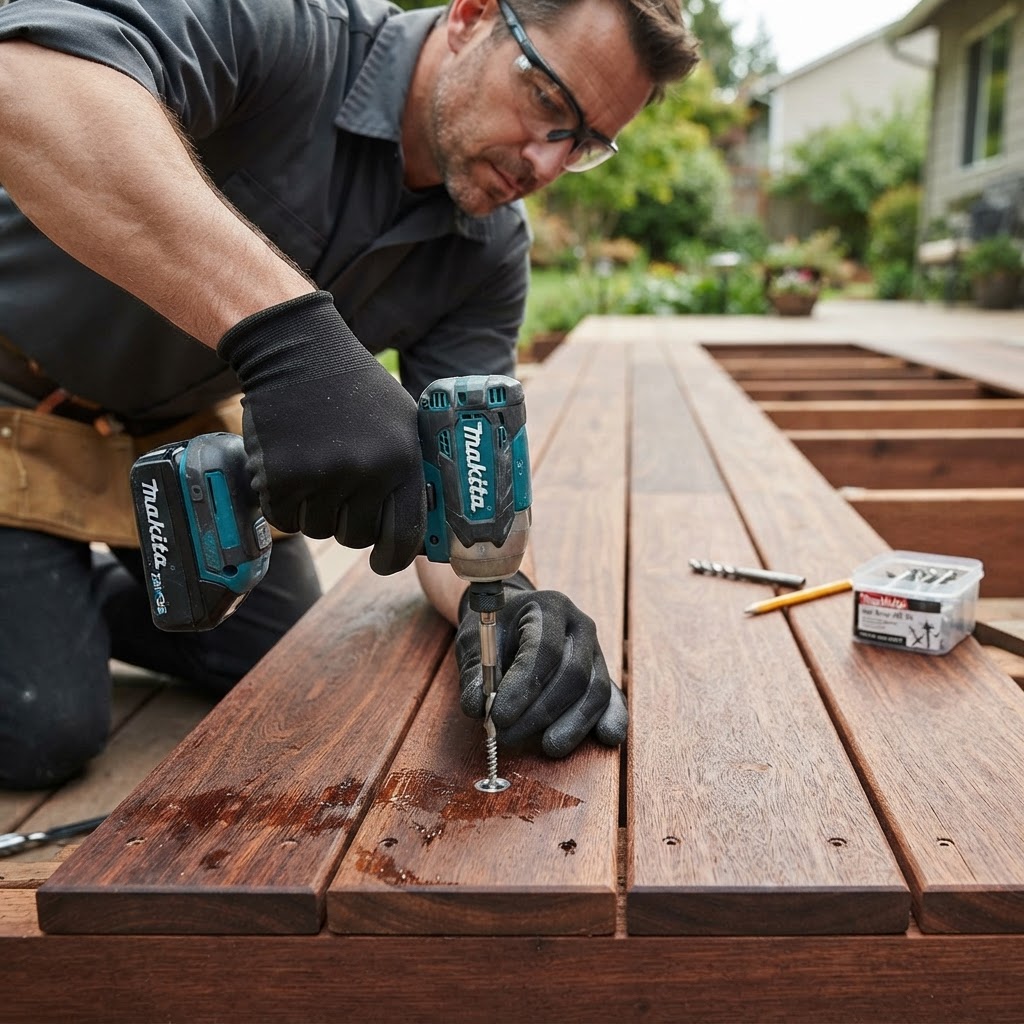
Driving a screw into dense tropical hardwood without a pilot hole will snap the screw, strip the head, or split the board — often all three.
Pilot diameter. Match the screw's shank diameter, not its thread diameter. Too small and the wood splits or the screw shears; too large and the threads have nothing to hold.
Depth. Drill the full depth of the fastener. A pilot that stops short concentrates all the stress at the bottom of the hole.
Countersink. Dense hardwood will not let a screw head pull itself flush. Countersink separately, or use a combination bit sized to the screw. A head sitting proud is a trip hazard; a head driven by force is a split.
Board ends. Keep fasteners at least 3/4" to 1" from ends and edges. End splits in ipe propagate along the grain and do not stop.
Expect to burn through bits. Carbide-tipped lasts meaningfully longer than HSS in this material.
Choose the metal deliberately
Tropical hardwood extractives are acidic and will react with the wrong metal, producing black or blue-black staining that bleeds into the surrounding wood and does not sand out easily.
Stainless steel is the standard. Type 316 for coastal, marine and pool environments where chlorides are present. Type 304 is acceptable inland. Both resist the tannin reaction.
Hot-dipped galvanized is common in pressure-treated work but a poor match here — the zinc reacts with extractives and the coating is easily scraped in a tight pilot hole, exposing bare steel.
Never use plain or coated carbon steel, aluminum, or electroplated fasteners. Aluminum in contact with wet tropical hardwood corrodes quickly.
Hidden systems, honestly
Side-groove clip systems give a clean face with no visible holes and set consistent spacing automatically. They are slower to install, cost more per square foot, require grooved stock or a biscuit cutter, and make single-board replacement harder later.
Face screwing with plugged or exposed stainless heads is faster, cheaper, holds better in high-wind and high-traffic settings, and is far easier to service. Neither choice is wrong; pick based on whether appearance or serviceability matters more.
Gapping and movement
Dense tropical decking still moves. Install with the gap the species and your climate call for, measured at the installed moisture content — not the gap that looks right on delivery day. Boards installed tight after shipping in a humid trailer will shrink apart; boards installed wide in a dry winter will close up in July.
A short pre-install checklist
Stainless grade matched to environment. Carbide bits on hand. Pilot and countersink sized to the actual screw. End distances marked. Gap decided from a moisture reading, not a guess. Boards acclimated under cover.
Use the fastener compatibility guide to match metal to species and exposure, and the deck fastener calculator to get your count right before you order.
Frequently Asked Questions
Lumberama Editorial
Hardwood Reference Team
Contributor to Lumberama’s reference library. Read our editorial standards and source methodology.
Continue researching decking
Where readers of this article usually go next.
Related Articles

Acclimating Hardwood Before Installation: A Practical Schedule
Most hardwood failures are moisture failures. Here is how to acclimate stock to your site's equilibrium moisture content, and how to know when it is actually ready.

How to Calculate Board Feet (And Why Your Lumber Bill Uses Them)
Board feet confuse almost everyone buying hardwood for the first time. The formula takes ten seconds — the part that trips people up is which dimensions to put into it.

How Long Should Pressure Treated Lumber Dry Before Staining?
Most failed deck stain jobs come down to one thing: staining pressure treated lumber before it is dry enough to absorb anything. Here is how long to wait and how to test it yourself.