Acclimating Hardwood Before Installation: A Practical Schedule
The failure mode
Cupped floors, gapped decking, mitre joints that open in February — almost all of it traces back to wood installed at the wrong moisture content. Wood shrinks and swells across the grain until it reaches equilibrium with the air around it. If you fasten it down before it gets there, it moves anyway, against the fasteners.
Acclimation is not a waiting ritual. It is bringing the wood to the moisture content it will live at.
Target the site, not a rule of thumb
The number you are aiming for is the equilibrium moisture content (EMC) of the installed environment, averaged across the year.
- Conditioned interiors in most of the US: roughly 6–9%
- Humid coastal and Gulf interiors: roughly 9–11%
- Arid Southwest and mountain interiors: roughly 4–7%
- Exterior decking, covered: roughly 12–16% depending on climate
Interior flooring should typically be within 2–4% of the subfloor's moisture content, and both should be near the site EMC. That subfloor check matters as much as the flooring check.
Prepare the space first
Acclimating to an unfinished, unconditioned building acclimates the wood to the wrong conditions. Before the wood arrives: the building should be dry-in, wet work (concrete, plaster, drywall mud, paint) complete and cured, and HVAC running at normal living temperature and humidity. Acclimating to a construction environment is worse than not acclimating.
How to stack
Break the bundles. Wood inside a strapped bundle barely exchanges moisture.
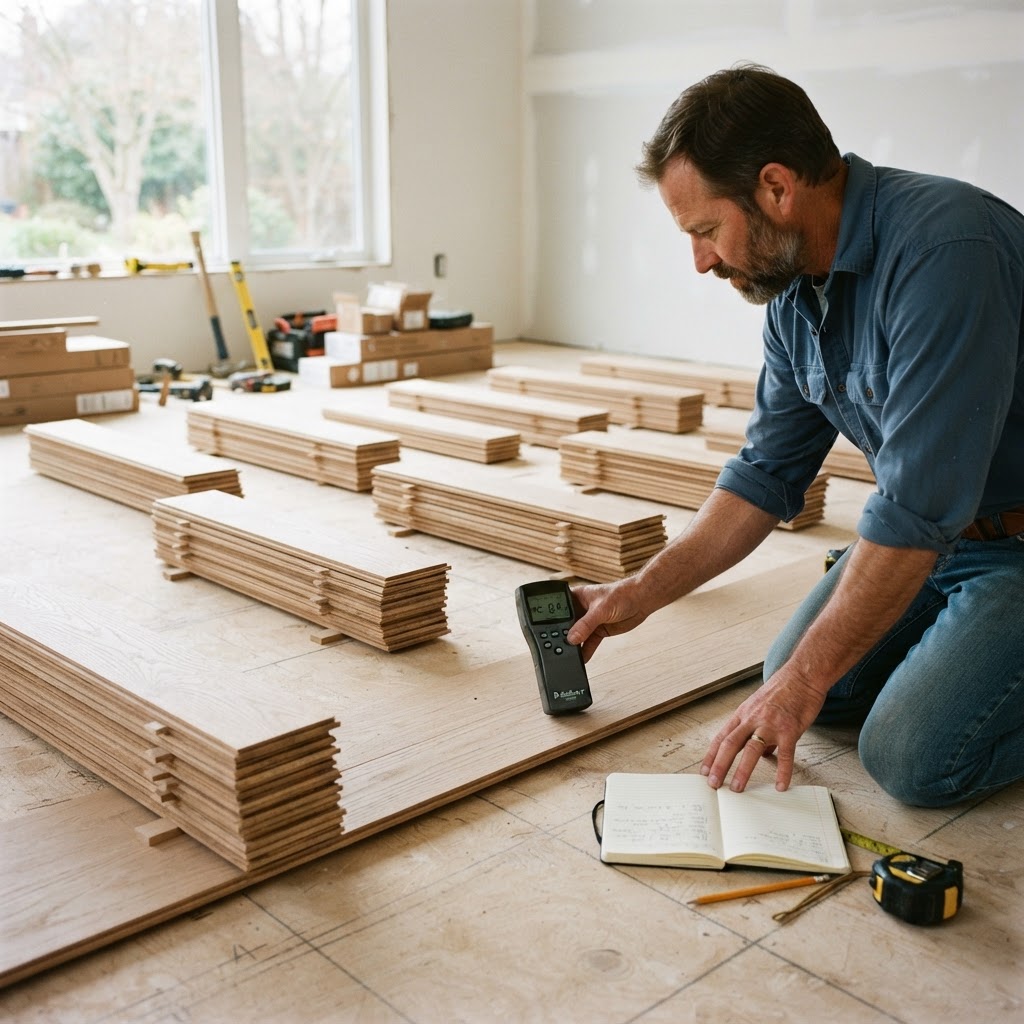
Sticker the boards — lay 3/4" strips every 16 to 24 inches, perpendicular to the boards, with the bottom course at least four inches off the slab. Keep air moving on all six sides. Stack away from exterior walls, direct sun and supply registers. For decking, sticker outdoors under cover, not in plastic.
Timeline
There is no fixed number of days, which is why the industry rule of thumb ranges from three days to three weeks. What actually governs it is species, thickness and the gap between delivered moisture content and target.
As a rough guide: 4/4 stock within 2% of target often settles in 3–7 days. A 4% gap can take two to three weeks. Thick stock (8/4 and up) and dense exotics move very slowly and can take a month or more. Kiln-dried stock arriving at 7% into a 7% environment may need only a few days to relieve surface conditions.
Verify, do not guess
Use a pin or pinless moisture meter with the species correction applied — density skews uncorrected readings significantly on exotics.
Take readings from the middle of boards, not ends, at several depths in the stack. Record them. When the readings stop changing over 48 hours and sit within range of your target and your subfloor, the wood is ready. A stable reading is the signal, not a calendar date.
Then gap correctly
Acclimation reduces movement; it does not eliminate it. Leave expansion space at walls, gap decking per the species' shrinkage behavior, and expect a tight summer floor to show hairline winter gaps. That is wood behaving normally.
Run your target numbers in the moisture and acclimation calculator, and check seasonal movement for a specific board width in the wood movement calculator.
Frequently Asked Questions
Lumberama Editorial
Hardwood Reference Team
Contributor to Lumberama’s reference library. Read our editorial standards and source methodology.
Wood properties and behavior
Where readers of this article usually go next.
Related Articles

Fastening Dense Tropical Hardwoods Without Splitting or Staining
Ipe, cumaru and massaranduba punish the wrong fastener. Pre-drilling geometry, stainless grades, hidden clips and the tannin reaction that ruins a new deck.

How to Calculate Board Feet (And Why Your Lumber Bill Uses Them)
Board feet confuse almost everyone buying hardwood for the first time. The formula takes ten seconds — the part that trips people up is which dimensions to put into it.

How Long Should Pressure Treated Lumber Dry Before Staining?
Most failed deck stain jobs come down to one thing: staining pressure treated lumber before it is dry enough to absorb anything. Here is how long to wait and how to test it yourself.