How Much Does a 2x4 Weigh? Weight Chart by Length
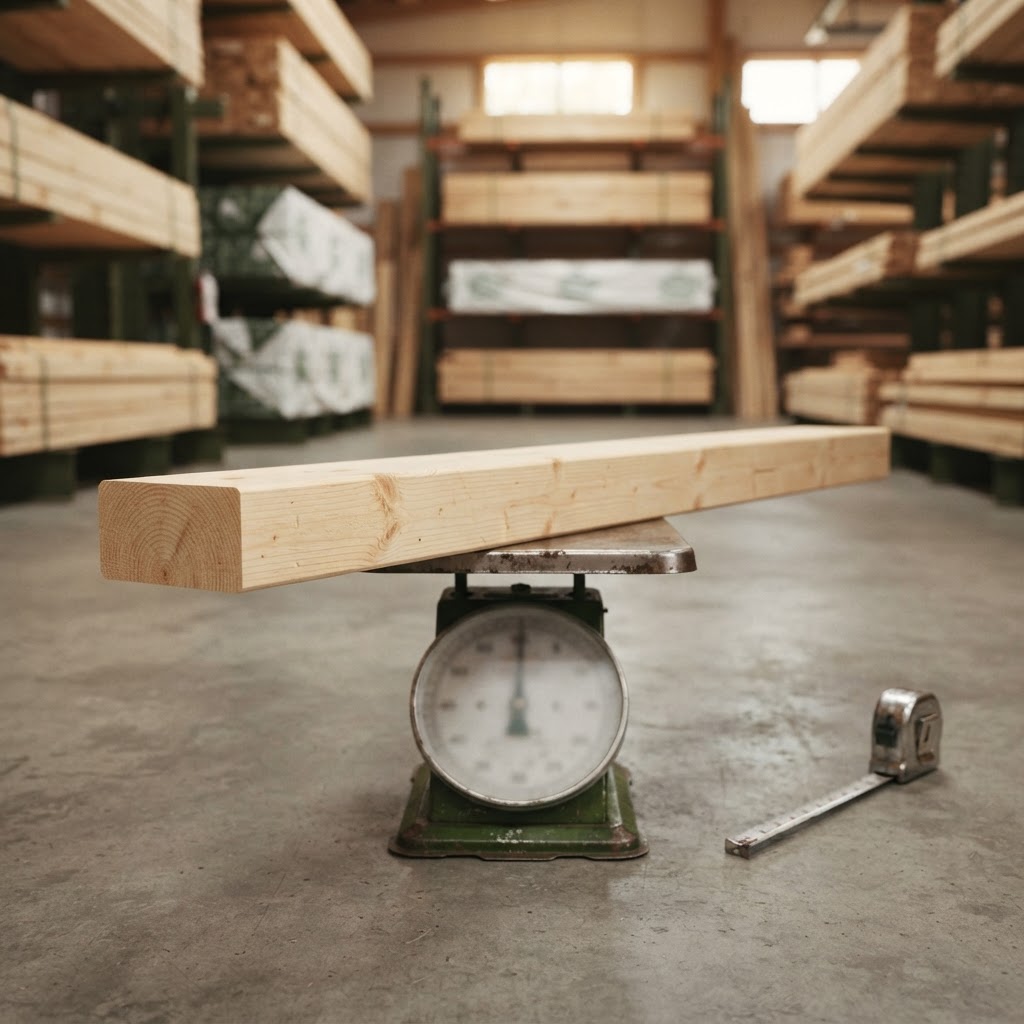
Quick answer: Using published average dried densities, an actual 1.5 × 3.5-inch, 8-foot 2x4 calculates to about 7.3 pounds in eastern white pine or 9.3 pounds in Douglas fir. These are worked estimates, not a guaranteed range for all 2x4s. Wet or recently pressure-treated lumber can weigh substantially more.
The size comes from ProWood’s nominal-to-actual dimension chart; the calculation uses The Wood Database’s average dried weights of 25 lb/ft³ for eastern white pine and 32 lb/ft³ for Douglas fir. We have not weighed a supplier’s current stock.
Hero graphic: AI-generated editorial illustration, not a photograph of a measured shipment.
Key takeaways
- Use the board’s actual cross-section, not its nominal name, when calculating physical volume.
- Species, moisture and treatment condition matter as much as length.
- Confirm shipment weight before using an estimate to make vehicle or handling decisions.
2x4 weight chart by length
| Board length | Eastern white pine at 25 lb/ft³ | Douglas fir at 32 lb/ft³ |
|---|---|---|
| 6 feet | 5.5 lb | 7.0 lb |
| 8 feet | 7.3 lb | 9.3 lb |
| 10 feet | 9.1 lb | 11.7 lb |
| 12 feet | 10.9 lb | 14.0 lb |
| 16 feet | 14.6 lb | 18.7 lb |
Values are calculated from the cited dimensions and densities, rounded to one decimal place. They exclude straps, pallets, dunnage and packaging. An SPF grade stamp identifies a species group, not a promise that every board has eastern white pine’s density. Do not use the pine column as a universal SPF specification.
How to calculate the weight of a 2x4
When thickness and width are in inches and length is in feet, use this relationship:
Weight in pounds = actual thickness × actual width × length ÷ 144 × density in pounds per cubic foot.
- Measure actual thickness, width and length. Rough lumber and specialty stock can differ from surfaced framing lumber.
- Choose a density appropriate to the species and moisture condition.
- Calculate volume: 1.5 × 3.5 × 8 ÷ 144 = approximately 0.2917 cubic feet.
- Multiply by the reference density: 0.2917 × 32 = approximately 9.3 pounds for the Douglas fir example.
- Multiply by quantity only after confirming that the boards share the same dimensions and condition.
Use the lumber weight calculator to organize estimates for mixed sizes. Keep each size and length on a separate line rather than applying one average to an entire order.
Why pressure-treated 2x4 weight is different
Pressure treatment commonly introduces water along with preservative. A board sold wet after treatment and a board dried after treatment are not equivalent shipping-weight cases. The preservative designation also does not tell you the board’s current moisture content.
The USDA explains that wood exchanges moisture with its surroundings in its Wood Handbook chapter on moisture relations. Rain during storage, drying conditions and differences between boards can therefore change the weight of an otherwise identical order. Do not apply a universal percentage increase to every treated board.
Ask whether the quoted material is kiln-dried after treatment, commonly abbreviated KDAT, or supplied wet. Even KDAT stock can become wet in storage. For a transport decision, a supplier’s measured shipment weight is more useful than a general internet weight chart.
Bundle-weight example: useful for planning, not a payload certificate
For an illustrative order of 50 eight-foot Douglas fir boards, the dry-density calculation is 50 × 0.2916667 × 32, or approximately 467 pounds. This is arithmetic using the same reference density, not a surveyed bundle weight. Packaging and any additional moisture are still outside that total.
Vehicle payload also includes occupants, tools and other cargo. A trailer’s permissible load is not the same as the tow vehicle’s towing limit, and hitch and axle limits matter separately. Check the relevant manufacturer ratings and secure the load correctly; if the margin is small, obtain a weighed load or arrange appropriate delivery.
Weight versus board feet: do not mix the two
Board feet describe a lumber volume or tally convention, not pounds. A supplier may tally framing or hardwood using dimensions that differ from the board’s finished cross-section. Multiplying a billed board-foot figure by a density without checking those conventions can produce a misleading physical weight.
For invoice quantities, read how to calculate board feet. For lifting and transport, return to actual dimensions and a suitable moisture-dependent density. For a wall takeoff, start with the stud-count formula and chart, then estimate the weight of the resulting material list.
What to confirm before pickup
- Species or species group and grade.
- Actual board dimensions and ordered lengths.
- Dry, green, wet-treated or KDAT condition.
- Quantity per bundle and whether quoted weight includes packaging.
- Loading equipment, vehicle access and unloading arrangements.
When requesting material, include these details rather than asking for “a truckload of 2x4s.” A sourcing request is subject to human review of specifications, service area and current availability; it is not a stock or delivery guarantee.
Sources and calculation method
- ProWood: nominal and actual lumber dimensions.
- The Wood Database: eastern white pine average dried density.
- The Wood Database: Douglas fir average dried density.
- USDA Forest Products Laboratory: moisture relations and physical properties.
All weights above are calculated examples, not live product measurements or freight quotes.
Frequently Asked Questions
Lumberama Materials Team
Reference library
Contributor to Lumberama’s reference library. Read our editorial standards and source methodology.
Specify and plan your framing lumber
Where readers of this article usually go next.
Related Articles

Is Plywood Waterproof? Exterior vs. Exposure 1 Explained
Water-resistant glue does not make an entire plywood sheet waterproof. Learn which panel markings matter and where coatings, drainage and assembly details still do the work.

How Much Does a 2x4 Cost? What Actually Sets the Price
There is no single 2x4 price. Species, grade, length, treatment, quantity and delivery all move the number. Here is how to compare stud pricing like a buyer, not a browser.

How Much Lumber Does It Take to Build a House?
There is no fixed board-foot number for a house. Footprint, stories, roof design, framing method and engineered components all change the package. Here is how builders estimate it.