The Complete Guide to Wood Routers (2026)
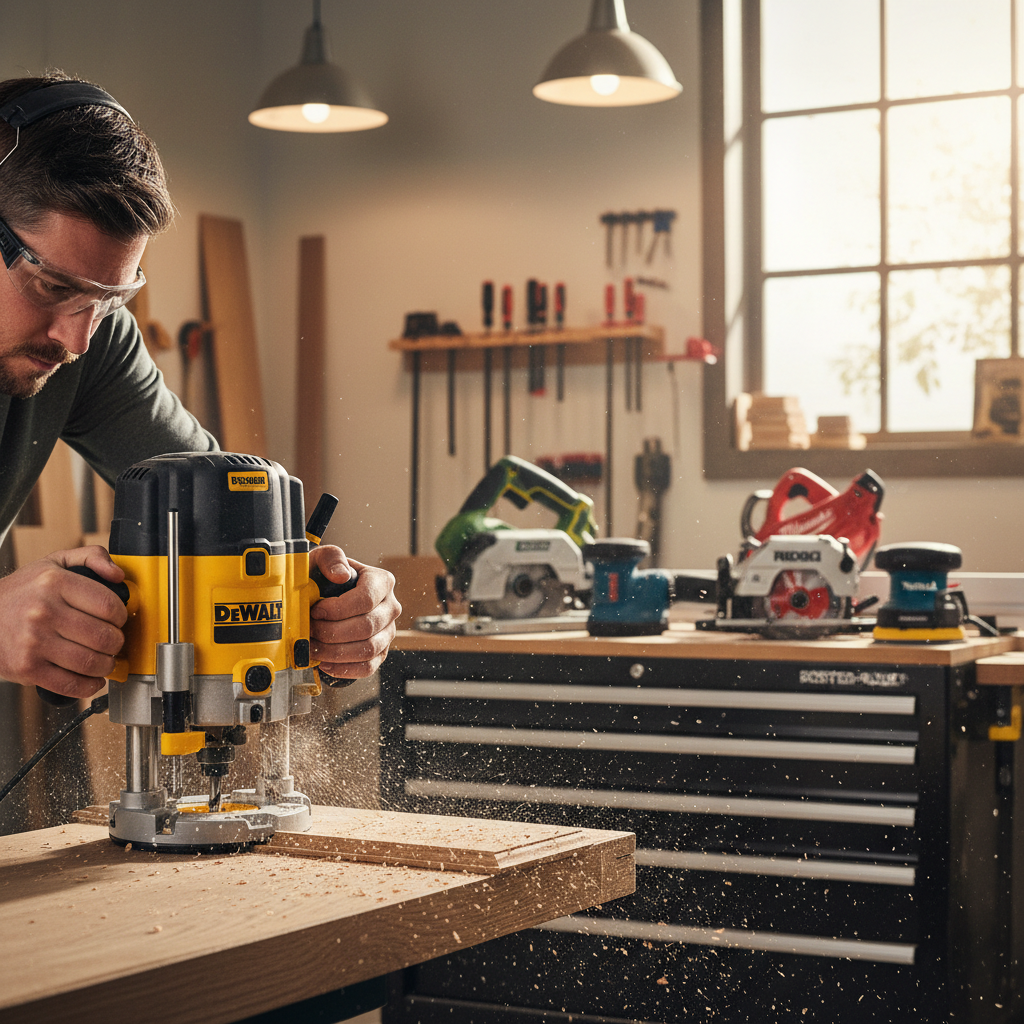
A wood router is one of the most versatile power tools in any workshop. It spins a shaped cutting bit at high speed to create edge profiles, dados, grooves, rabbets, mortises, inlays, and decorative patterns. From simple roundovers to complex joinery, a router can accomplish an astonishing range of tasks. Available in fixed-base and plunge configurations, routers are essential for furniture making, cabinetry, and trim work.
Key Takeaways
- A wood router is one of the most versatile power tools in any workshop.
- It spins a shaped cutting bit at high speed to create edge profiles, dados, grooves, rabbets, mortises, inlays, and decorative patterns.
- From simple roundovers to complex joinery, a router can accomplish an astonishing range of tasks.
- Wood routers are used for cutting decorative edge profiles (roundover, ogee, chamfer), routing dados and grooves, cutting rabbets, making mortises with a plunge base, trimming laminate, cutting dovetails and box joints with jigs, flush-trimming with a pattern bit, template routing, sign making, and routing hinge mortises.
- Motor power (HP and amps), variable speed control (8,000-25,000 RPM), collet size (1/4 and 1/2 inch), soft start, dust collection port, micro-depth adjustment, comfortable handles, above-the-table height adjustment (for router table use), and plunge lock mechanism.
What It's Used For
Wood routers are used for cutting decorative edge profiles (roundover, ogee, chamfer), routing dados and grooves, cutting rabbets, making mortises with a plunge base, trimming laminate, cutting dovetails and box joints with jigs, flush-trimming with a pattern bit, template routing, sign making, and routing hinge mortises.
Types & Variations
Fixed-Base (set depth, best for edge work and table mounting), Plunge Router (adjustable depth during cut, essential for mortises and interior cuts), Combo Kit (fixed + plunge bases on one motor), Compact/Trim Router (small, 1-1/4 HP, for edge work), Mid-Size (2-1/4 HP, most versatile), and Full-Size (3-1/4 HP, for heavy cuts and router tables).
Key Features to Look For
- Motor power (HP and amps)
- variable speed control (8
- 000-25
- 000 RPM)
- collet size (1/4 and 1/2 inch)
- soft start
- dust collection port
- micro-depth adjustment
- comfortable handles
- above-the-table height adjustment (for router table use)
- and plunge lock mechanism.
How to Use
1) Install the correct bit and tighten the collet securely. 2) Set the cutting depth — never remove more than 1/4 inch per pass. 3) Adjust the speed — slower for larger bits, faster for small bits. 4) Clamp the workpiece securely. 5) Move the router against the bit rotation direction (climb cutting is dangerous). 6) For edge profiling, move left to right along the edge. 7) For template routing, secure the template and use a pattern bit or guide bushing. 8) Take multiple passes for deep cuts.
⚠️ Safety Tips
Always wear safety glasses, hearing protection, and a dust mask. Never start the router with the bit contacting the workpiece. Maintain a firm two-handed grip. Feed against the bit rotation (left to right when facing the edge). Use featherboards in a router table. Never reach under a router table near the spinning bit. Disconnect power before changing bits. Large bits must run at slower speeds — check the speed chart.
Maintenance
Clean the collet and collet nut regularly — buildup causes runout. Blow dust from motor vents. Check the base plate for flatness. Lubricate the plunge mechanism with dry lubricant. Inspect bits for dullness, chips, and buildup — clean with oven cleaner. Replace collets when they no longer grip firmly. Store bits in a rack or case to protect edges.
Price Range & Recommendations
Price Range: $60-$120 for compact/trim routers, $120-$200 for mid-size fixed or plunge, $180-$300 for combo kits, $200-$400 for full-size, $400-$700+ for premium (Festool).
Beginners should start with a mid-size combo kit — the Bosch 1617EVSPK ($220 range) or DeWalt DW618PK ($200 range) include both fixed and plunge bases with variable speed. For a dedicated trim router, the DeWalt DWP611 is superb. Pros will invest in the Festool OF 1400 EQ for its unmatched dust extraction and precision, or the Bosch MRC23EVSK for maximum versatility in a professional combo kit.
Top Brands
Related Tools
Frequently Asked Questions
Related Guides
Biscuit Joiner
Align panels and reinforce joints with a biscuit joiner. Compare DeWalt, Makita & Porter-Cable plate
Read guideBrad Nailer
Drive 18-gauge brads with precision using a brad nailer. Compare DeWalt, Milwaukee & Ryobi models. P
Read guideDovetail Jig
Cut perfect dovetails every time with a dovetail jig. Compare Porter-Cable, Leigh & MLCS models. Thr
Read guideFinish Nailer
Install trim like a pro with a finish nailer. Compare DeWalt, Milwaukee & Metabo HPT 15 & 16 gauge m
Read guide