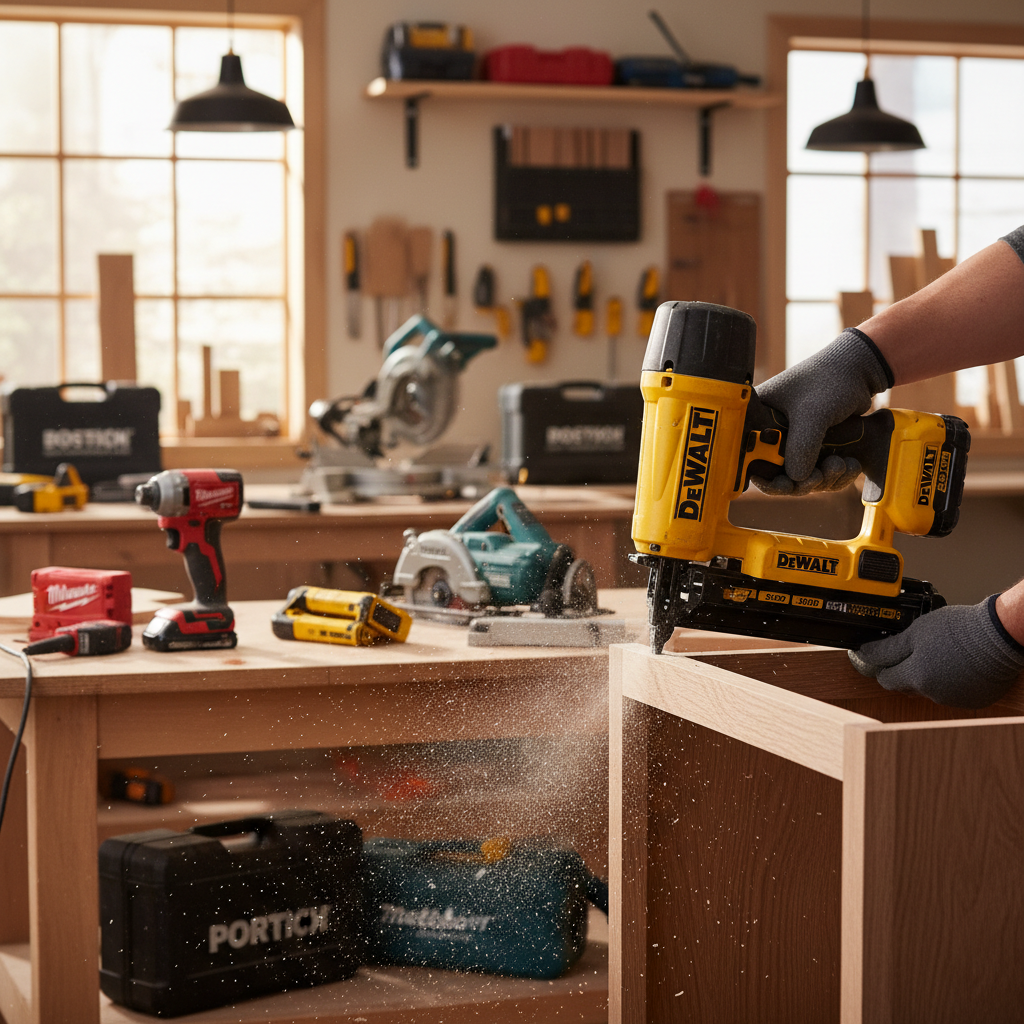
The Complete Guide to Finish Nailers (2026)
A finish nailer drives 15 or 16-gauge nails for installing baseboards, door casings, crown molding, chair rails, and other substantial trim. Heavier than brads but still leaving small, easily filled holes, finish nails provide the holding power needed for trim pieces that must stay tight against walls and ceilings for decades.
Key Takeaways
- A finish nailer drives 15 or 16-gauge nails for installing baseboards, door casings, crown molding, chair rails, and other substantial trim.
- Heavier than brads but still leaving small, easily filled holes, finish nails provide the holding power needed for trim pieces that must stay tight against walls and ceilings for decades.
- Finish nailers are used for installing baseboards and door/window casings, attaching crown molding and chair rails, securing stair treads and risers, nailing cabinet face frames to boxes, installing wainscoting and paneling, attaching door and window trim, securing shelf cleats, and any trim application requiring holding power beyond what a brad nailer provides.
- Nail gauge (15 or 16), nail length range (1 to 2-1/2 inches), angled vs straight magazine, depth adjustment, tool-free jam clearing, dry-fire lockout, sequential and contact trigger modes, no-mar tip, exhaust direction, magazine capacity, and air consumption (for pneumatic).
What It's Used For
Finish nailers are used for installing baseboards and door/window casings, attaching crown molding and chair rails, securing stair treads and risers, nailing cabinet face frames to boxes, installing wainscoting and paneling, attaching door and window trim, securing shelf cleats, and any trim application requiring holding power beyond what a brad nailer provides.
Types & Variations
15-Gauge Angled (angled magazine for tight corners, slightly thicker nail), 16-Gauge Straight (straight magazine, thinner nail, smaller hole), Pneumatic (lightest, requires compressor), Cordless/Battery (portable, no hose), and Combo Kits with brad nailer. Nail lengths: 1 to 2-1/2 inches.
Key Features to Look For
- Nail gauge (15 or 16)
- nail length range (1 to 2-1/2 inches)
- angled vs straight magazine
- depth adjustment
- tool-free jam clearing
- dry-fire lockout
- sequential and contact trigger modes
- no-mar tip
- exhaust direction
- magazine capacity
- and air consumption (for pneumatic).
How to Use
1) Load finish nails into the magazine. 2) Set air pressure (70-100 PSI for pneumatic) or charge the battery. 3) Adjust the depth wheel for proper nail countersink. 4) Position the no-mar tip at the nailing point. 5) Press firmly and pull the trigger. 6) Nail trim every 16 inches and at every stud. 7) For inside corners, nail close to the corner to close the miter. 8) For outside corners, nail through both miter faces. 9) Fill holes with color-matched putty.
⚠️ Safety Tips
Wear safety glasses at all times. Be aware that finish nails are long enough to penetrate through trim and into wiring behind walls — check for electrical before nailing near outlets. Use sequential trigger mode for precision placement. Never bypass the safety contact tip. Keep the nailer pointed away from people. Disconnect power source before clearing jams.
Maintenance
Apply pneumatic tool oil daily through the air inlet (pneumatic models). Clean the magazine feed mechanism. Clear jams promptly. Inspect and replace no-mar tips when worn. Check the depth adjustment for proper function. Clean the exhaust port. Store in the carrying case with the battery removed (cordless).
Price Range & Recommendations
Price Range: $60-$120 for pneumatic, $120-$200 for basic cordless, $200-$350 for premium cordless (DeWalt, Milwaukee), $250-$450 for professional kits.
Beginners should start with a pneumatic 16-gauge like the Metabo HPT NT65MA4 ($100) for affordable, reliable trim nailing. For cordless, the Ryobi ONE+ P325 ($130) delivers great value. Pros will choose the DeWalt DCN650D1 15-gauge cordless or Milwaukee M18 FUEL 2839 for top-tier cordless performance, or the Senco FinishPro 42XP for the smoothest pneumatic operation.
Top Brands
Related Tools
Frequently Asked Questions
Related Guides
Biscuit Joiner
Align panels and reinforce joints with a biscuit joiner. Compare DeWalt, Makita & Porter-Cable plate
Read guideBrad Nailer
Drive 18-gauge brads with precision using a brad nailer. Compare DeWalt, Milwaukee & Ryobi models. P
Read guideDovetail Jig
Cut perfect dovetails every time with a dovetail jig. Compare Porter-Cable, Leigh & MLCS models. Thr
Read guideFraming Nailer
Speed up framing with a framing nailer. Compare DeWalt, Metabo HPT & Paslode models. Clipped vs roun
Read guide