The Complete Guide to Random Orbital Sanders (2026)
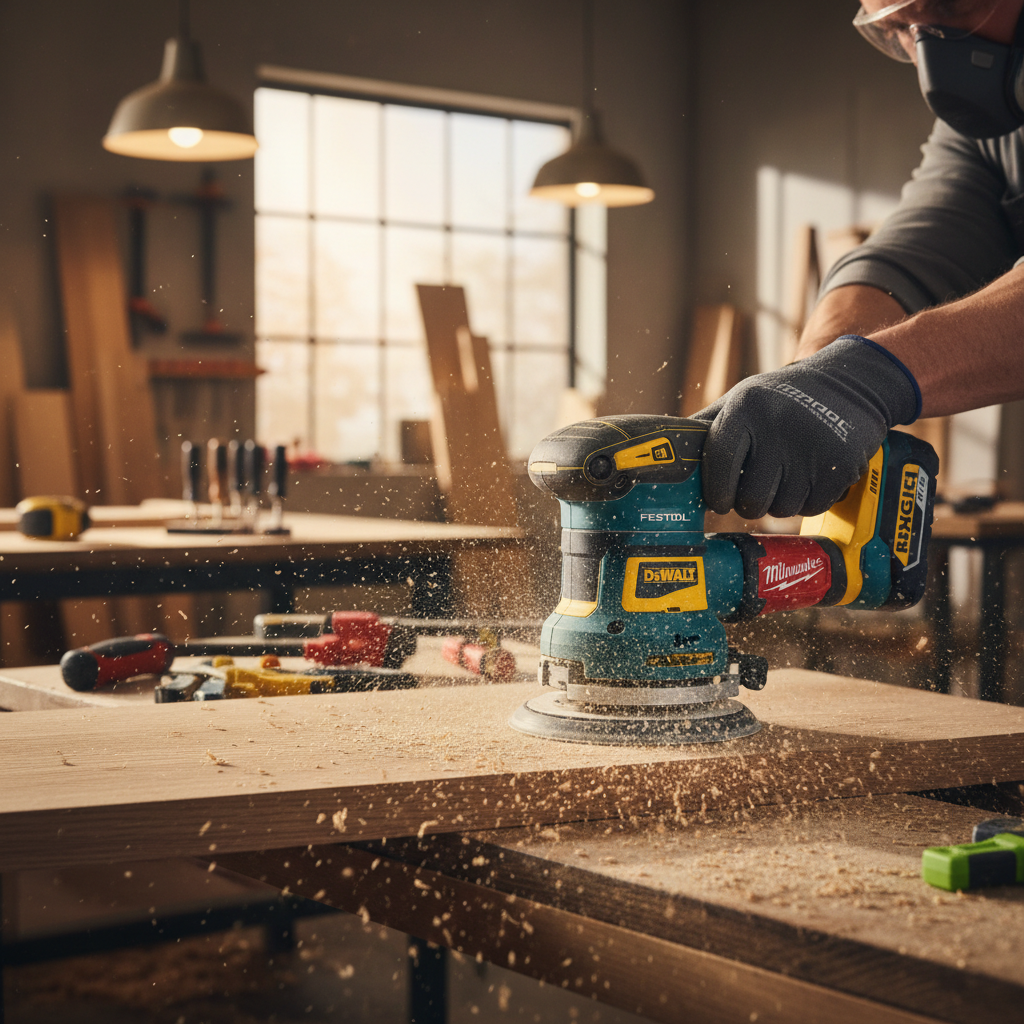
A random orbital sander (ROS) spins its sanding pad in an orbital pattern while simultaneously rotating randomly, producing a swirl-free finish that no other sander type can match. This dual-action motion removes material efficiently while leaving a smooth surface ready for finishing. It is the most versatile and forgiving sander for woodworkers at every level.
Key Takeaways
- A random orbital sander (ROS) spins its sanding pad in an orbital pattern while simultaneously rotating randomly, producing a swirl-free finish that no other sander type can match.
- This dual-action motion removes material efficiently while leaving a smooth surface ready for finishing.
- It is the most versatile and forgiving sander for woodworkers at every level.
- Random orbital sanders are used for smoothing raw wood before finishing, removing old paint and finish, preparing surfaces between finish coats, flattening panel glue-ups, rounding edges, removing mill marks, sanding trim and molding profiles (with contour pads), and final surface preparation on furniture, cabinets, and woodworking projects.
- Pad size (5 or 6 inch), orbit diameter (1/8, 3/16, or 3/32 inch), variable speed control, dust collection (bag, canister, or vacuum port), hook-and-loop pad, low vibration design, one-hand grip vs palm grip, rubberized grip surface, pad brake, and weight (under 4 lbs preferred).
What It's Used For
Random orbital sanders are used for smoothing raw wood before finishing, removing old paint and finish, preparing surfaces between finish coats, flattening panel glue-ups, rounding edges, removing mill marks, sanding trim and molding profiles (with contour pads), and final surface preparation on furniture, cabinets, and woodworking projects.
Types & Variations
5-inch (most common, widest sandpaper selection), 6-inch (faster material removal, larger pad), Corded (constant power), Cordless (portability), Variable-Speed (essential for fine work), and Brushless (longer motor life). Pad types include hook-and-loop and PSA (pressure-sensitive adhesive).
Key Features to Look For
- Pad size (5 or 6 inch)
- orbit diameter (1/8
- 3/16
- or 3/32 inch)
- variable speed control
- dust collection (bag
- canister
- or vacuum port)
- hook-and-loop pad
- low vibration design
- one-hand grip vs palm grip
- rubberized grip surface
- pad brake
- and weight (under 4 lbs preferred).
How to Use
1) Attach the correct grit sandpaper to the hook-and-loop pad, aligning the dust holes. 2) Set the speed — lower for finish sanding and delicate materials, higher for aggressive stock removal. 3) Place the sander flat on the surface before starting it. 4) Move the sander slowly in overlapping passes — about 1 inch per second. 5) Let the weight of the sander do the work; do not press down. 6) Sand through progressive grits: 80, 120, 150, 180, 220. 7) Vacuum between grits to remove loose particles. 8) Lift the sander off the surface only after turning it off.
⚠️ Safety Tips
Always wear a dust mask or respirator — wood dust is a carcinogen. Wear safety glasses. Use dust collection (bag or vacuum attachment) to minimize airborne dust. Never start the sander while it is on the workpiece — it will gouge. Do not press down hard — this slows the random action and creates swirl marks. Sand with the grain whenever possible.
Maintenance
Replace the hook-and-loop pad when sandpaper no longer sticks reliably. Clean the dust port and bag after each use. Check the pad for flat, even contact — replace warped pads. Blow motor vents clean with compressed air. Inspect the cord for damage. Store with no sandpaper attached to prevent pad deformation.
Price Range & Recommendations
Price Range: $30-$60 for basic corded, $60-$120 for mid-range variable speed, $100-$200 for cordless, $150-$350 for premium Festool and Mirka models, $400+ for Festool ETS EC.
Beginners should start with the DeWalt DWE6421 or Makita BO5041 — both are under $70, variable speed, and produce excellent results with good dust collection. Cordless users will enjoy the DeWalt DCW210 or Ryobi ONE+. Pros will invest in the Festool ETS 150/3 EQ or Mirka DEROS for their unmatched dust extraction, vibration damping, and brushless motors that deliver flawless finishes.
Top Brands
Related Tools
Frequently Asked Questions
Related Guides
Belt Sander
Tame rough lumber with a belt sander. Compare Makita, DeWalt & Porter-Cable models. Belt sizes, spee
Read guideBenchtop Planer
Thickness rough lumber to perfection with a benchtop planer. Compare DeWalt DW735, Makita 2012NB & W
Read guideDrum Sander
Flatten and thickness-sand like a pro with a drum sander. Compare SuperMax, Jet & Performax models.
Read guideElectric Hand Planer
Trim, chamfer & surface with an electric hand planer. Compare Makita, DeWalt & Bosch models. Depth s
Read guide