The Complete Guide to Benchtop Planers (2026)
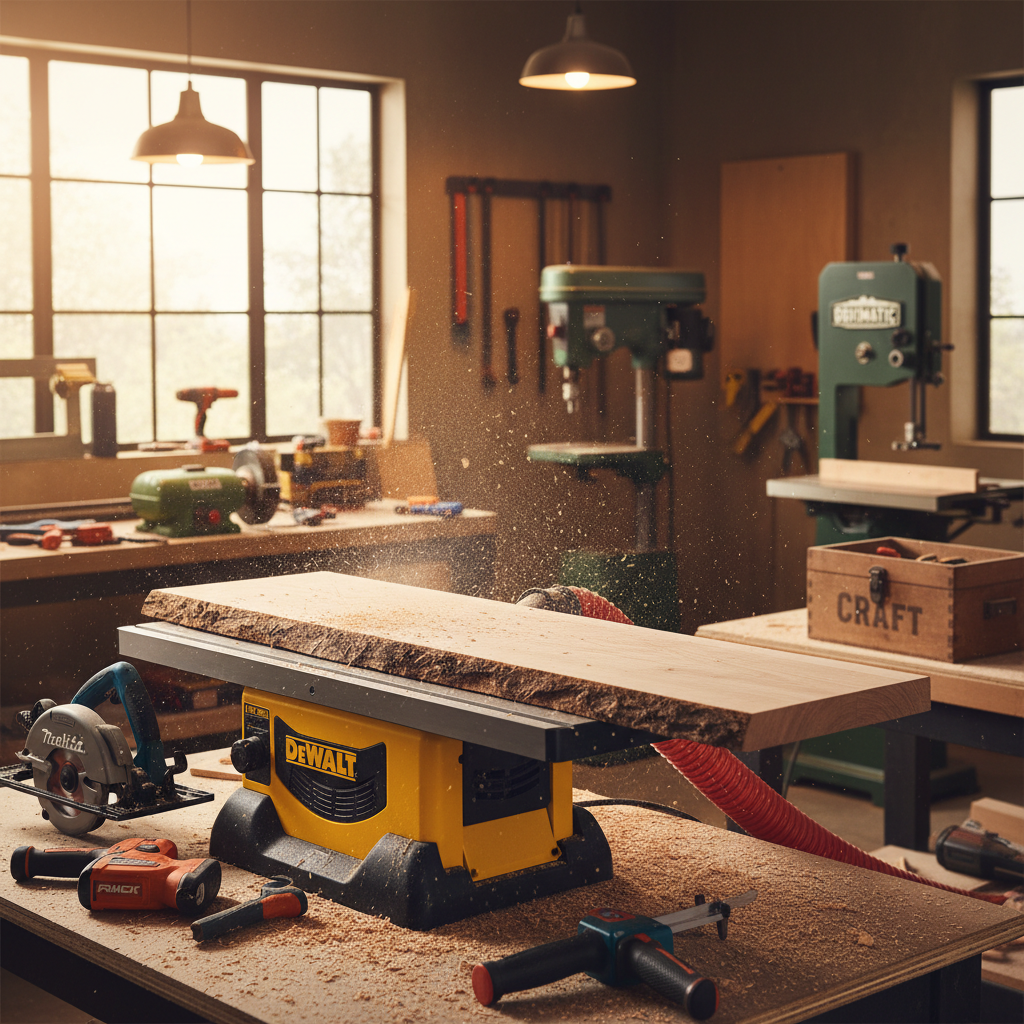
A benchtop planer (thickness planer) feeds rough lumber through a spinning cutterhead to produce boards of uniform thickness with smooth, flat surfaces. It is the essential machine for woodworkers who buy rough-sawn lumber, recover pallet wood, or need to mill stock to custom thicknesses. A benchtop planer transforms cheap rough lumber into expensive-looking project wood at a fraction of the cost.
Key Takeaways
- A benchtop planer (thickness planer) feeds rough lumber through a spinning cutterhead to produce boards of uniform thickness with smooth, flat surfaces.
- It is the essential machine for woodworkers who buy rough-sawn lumber, recover pallet wood, or need to mill stock to custom thicknesses.
- A benchtop planer transforms cheap rough lumber into expensive-looking project wood at a fraction of the cost.
- Benchtop planers are used for milling rough-sawn lumber to consistent thickness, surfacing reclaimed and pallet wood, creating custom-thickness stock for projects, removing cup and twist from warped boards (after jointing one face), dimensioning multiple boards to identical thickness, and smoothing surfaces for glue-ups and finishing.
- Cutting width (12-13 inches), maximum depth of cut per pass (1/16 to 1/8 inch), cutterhead type (straight-knife vs helical), number of knives, two-speed feed rate, snipe-reduction features (cutterhead lock, extension tables), dust port size (4 inch), infeed/outfeed table support, material removal gauge, and motor power (15 amps typical).
What It's Used For
Benchtop planers are used for milling rough-sawn lumber to consistent thickness, surfacing reclaimed and pallet wood, creating custom-thickness stock for projects, removing cup and twist from warped boards (after jointing one face), dimensioning multiple boards to identical thickness, and smoothing surfaces for glue-ups and finishing.
Types & Variations
Straight-Knife Cutterhead (HSS blades, standard on most benchtop models), Helical/Spiral Cutterhead (carbide inserts, quieter, better finish), Portable (12-13 inch capacity, under 65 lbs), and Heavy-Duty Benchtop (13-15 inch, more power). The DeWalt DW735 and Makita 2012NB are benchmarks in this category.
Key Features to Look For
- Cutting width (12-13 inches)
- maximum depth of cut per pass (1/16 to 1/8 inch)
- cutterhead type (straight-knife vs helical)
- number of knives
- two-speed feed rate
- snipe-reduction features (cutterhead lock
- extension tables)
- dust port size (4 inch)
- infeed/outfeed table support
- material removal gauge
- and motor power (15 amps typical).
How to Use
1) Flatten one face of the board on a jointer or with a hand plane first. 2) Place the flattened face down on the planer bed. 3) Set the depth — take no more than 1/32 inch per pass for finish cuts, 1/16 inch for rough dimensioning. 4) Turn on the dust collector and then the planer. 5) Feed the board straight into the infeed. 6) Do not push or pull the board — let the feed rollers do the work. 7) Alternate flipping the board between passes for even stock removal. 8) Use the slow feed rate for the final passes for a smoother finish.
⚠️ Safety Tips
Always connect to a dust collector — planers produce enormous amounts of chips. Never plane boards shorter than the distance between the feed rollers (typically 12 inches minimum). Never plane multiple boards of different thicknesses side by side. Do not reach into the infeed or outfeed while the cutterhead is spinning. Wear hearing protection — planers are loud. Stand to the side during operation in case of kickback.
Maintenance
Change or sharpen blades when the surface shows tearout, ridges, or glazing. Clean the feed rollers with mineral spirits to maintain grip. Check and adjust the bed rollers. Clean the dust port and internal passages regularly — chip buildup causes snipe. Wax the bed surface. Tighten the gib screws if the cutterhead develops play. Inspect the drive belt for wear.
Price Range & Recommendations
Price Range: $250-$400 for basic 12-13 inch models, $400-$600 for premium models (DeWalt DW735), $600-$1,000 for helical-head upgrades, $1,000-$3,000 for stationary floor models.
Beginners will thrive with the WEN 6552T 13-inch ($330 range) for great value or the DeWalt DW734 12-1/2-inch ($400 range). For the best overall benchtop planer, the DeWalt DW735X with extra knives and outfeed tables is the gold standard under $600. Pros who want a glass-smooth finish should upgrade to a Shelix or Byrd helical cutterhead, or invest in the Jet JWP-15BHH or Powermatic 15HH with factory helical heads.
Top Brands
Related Tools
Frequently Asked Questions
Related Guides
Belt Sander
Tame rough lumber with a belt sander. Compare Makita, DeWalt & Porter-Cable models. Belt sizes, spee
Read guideDrum Sander
Flatten and thickness-sand like a pro with a drum sander. Compare SuperMax, Jet & Performax models.
Read guideElectric Hand Planer
Trim, chamfer & surface with an electric hand planer. Compare Makita, DeWalt & Bosch models. Depth s
Read guidePalm Sander
Get smooth results with a quarter-sheet palm sander. Compare Makita, DeWalt & Black+Decker models. B
Read guide