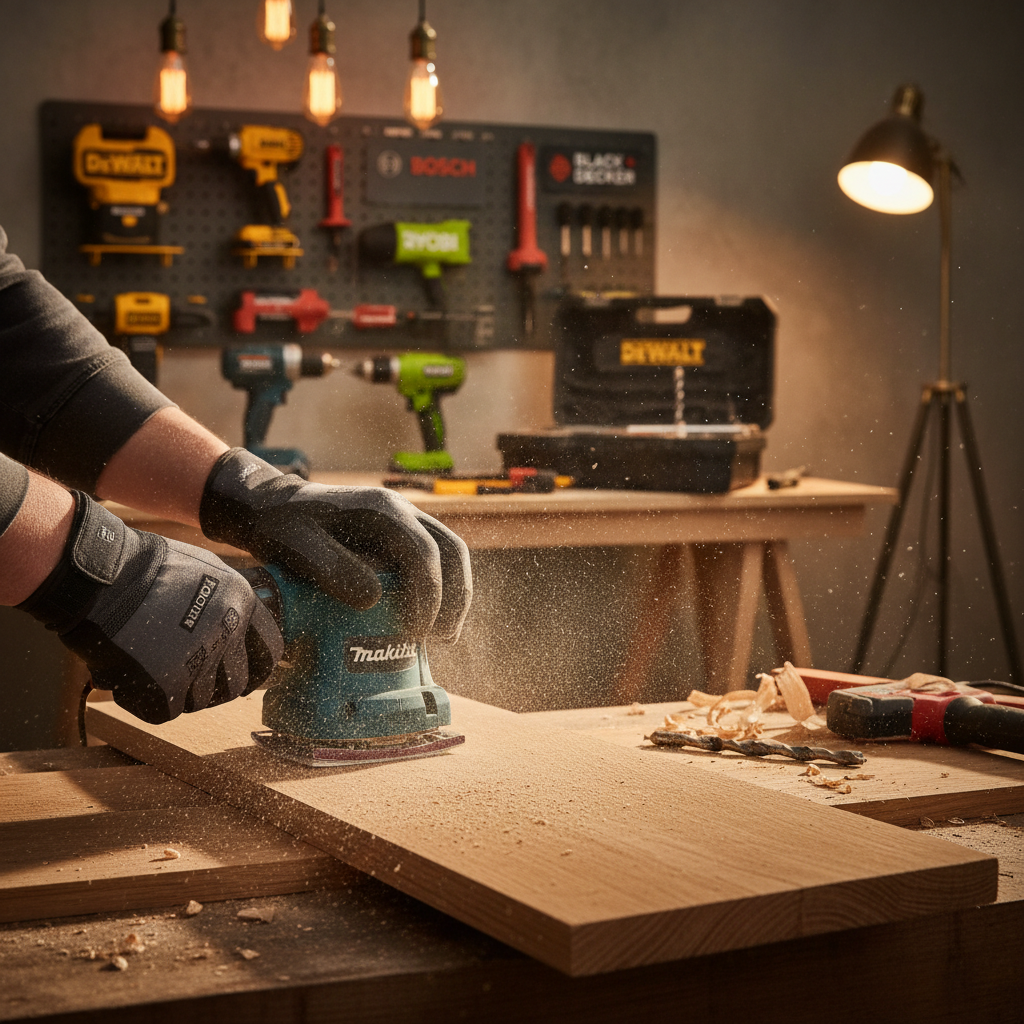
The Complete Guide to Palm Sanders (2026)
A palm sander (also called a quarter-sheet or finish sander) uses a vibrating rectangular pad to deliver fine, controlled sanding in a compact, one-hand-operated package. While slower at material removal than orbital or belt sanders, palm sanders excel at detail work, tight corners, and final surface preparation. Their small size and square edges make them the ideal sander for reaching into corners that round-pad sanders cannot.
Key Takeaways
- A palm sander (also called a quarter-sheet or finish sander) uses a vibrating rectangular pad to deliver fine, controlled sanding in a compact, one-hand-operated package.
- While slower at material removal than orbital or belt sanders, palm sanders excel at detail work, tight corners, and final surface preparation.
- Their small size and square edges make them the ideal sander for reaching into corners that round-pad sanders cannot.
- Palm sanders are used for final finish sanding before staining or painting, sanding trim and molding details, getting into corners and tight spaces, between-coat sanding on furniture, sanding small parts and craft projects, preparing surfaces for refinishing, and light smoothing on delicate workpieces.
- Pad size (quarter-sheet standard), orbits per minute (10,000-14,000 OPM), paper attachment system (clamp vs hook-and-loop), dust collection, one-hand operation, low vibration, weight (under 3 lbs), rubber grip, and ability to use standard sandpaper sheets (cut to fit).
What It's Used For
Palm sanders are used for final finish sanding before staining or painting, sanding trim and molding details, getting into corners and tight spaces, between-coat sanding on furniture, sanding small parts and craft projects, preparing surfaces for refinishing, and light smoothing on delicate workpieces.
Types & Variations
Quarter-Sheet (1/4 of a standard 9x11 sandpaper sheet), Half-Sheet (for larger surfaces), Detail/Mouse Sander (triangular pad for tight corners), Corded Palm (lightweight, constant power), and Cordless (battery-powered for portability). Most palm sanders use a simple orbital vibration pattern.
Key Features to Look For
- Pad size (quarter-sheet standard)
- orbits per minute (10
- 000-14
- 000 OPM)
- paper attachment system (clamp vs hook-and-loop)
- dust collection
- one-hand operation
- low vibration
- weight (under 3 lbs)
- rubber grip
- and ability to use standard sandpaper sheets (cut to fit).
How to Use
1) Cut sandpaper to size or use pre-cut sheets. 2) Attach the paper using the clamp or hook-and-loop system. 3) Place the sander flat on the surface and turn it on. 4) Move in smooth, overlapping strokes with the grain. 5) Apply very light pressure — the tool's weight is sufficient. 6) Use the squared edge to sand into corners. 7) Progress through grits as needed. 8) Connect to dust collection for a cleaner workspace.
⚠️ Safety Tips
Wear a dust mask and safety glasses. Though palm sanders are low-powered, wood dust is still a health hazard. Do not sand aggressively — palm sanders are designed for light finishing work. Avoid pressing hard, which increases vibration to your hand and reduces effectiveness. Take breaks during extended use to reduce vibration exposure.
Maintenance
Clean the dust collection bag or port after each use. Inspect the sanding pad for wear and replace if the surface is uneven. Check the paper clamps for proper tension. Blow out motor vents with compressed air. Replace the pad if hook-and-loop no longer grips. Store with sandpaper removed.
Price Range & Recommendations
Price Range: $20-$40 for basic models, $40-$70 for mid-range with dust collection, $60-$100 for premium corded, $80-$150 for cordless.
Beginners should grab the Black+Decker BDEQS300 ($30) or Makita BO4556 ($55) — both are affordable, effective, and easy to use right out of the box. They use inexpensive sandpaper sheets cut from standard stock. Pros will prefer the Festool RTS 400 REQ for its dust extraction and precision, or a cordless option like the Milwaukee M18 for mobility.
Top Brands
Related Tools
Frequently Asked Questions
Related Guides
Belt Sander
Tame rough lumber with a belt sander. Compare Makita, DeWalt & Porter-Cable models. Belt sizes, spee
Read guideBenchtop Planer
Thickness rough lumber to perfection with a benchtop planer. Compare DeWalt DW735, Makita 2012NB & W
Read guideDrum Sander
Flatten and thickness-sand like a pro with a drum sander. Compare SuperMax, Jet & Performax models.
Read guideElectric Hand Planer
Trim, chamfer & surface with an electric hand planer. Compare Makita, DeWalt & Bosch models. Depth s
Read guide