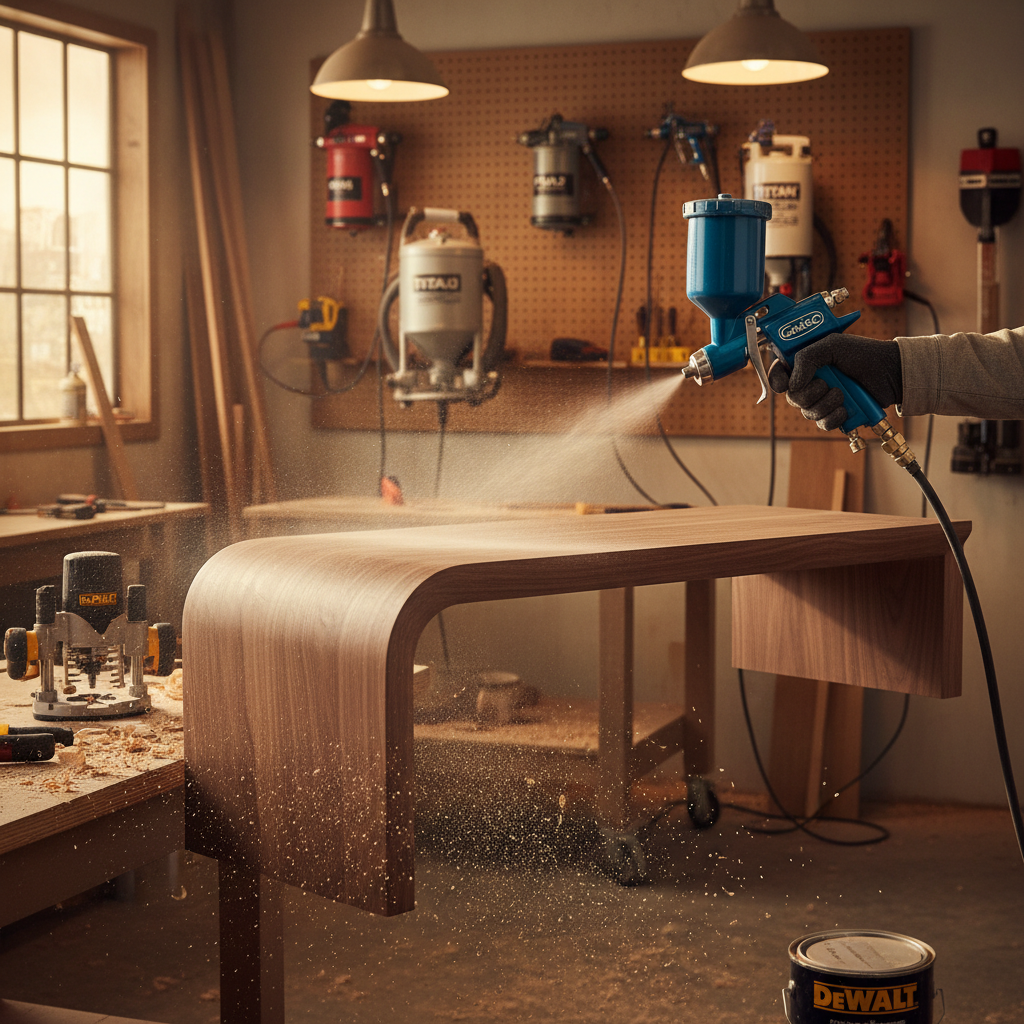
The Complete Guide to Paint Sprayers (2026)
A paint sprayer atomizes liquid coatings — paint, stain, lacquer, polyurethane, and more — into a fine mist that produces smooth, even finishes many times faster than brush or roller application. From small HVLP units for furniture finishing to large airless sprayers for exterior painting, sprayers deliver professional-quality results with proper technique and setup.
Key Takeaways
- A paint sprayer atomizes liquid coatings — paint, stain, lacquer, polyurethane, and more — into a fine mist that produces smooth, even finishes many times faster than brush or roller application.
- From small HVLP units for furniture finishing to large airless sprayers for exterior painting, sprayers deliver professional-quality results with proper technique and setup.
- Paint sprayers are used for painting walls, ceilings, and exterior surfaces, spraying cabinet doors and furniture, applying deck stain and sealers, coating fences and large surfaces, applying lacquer and polyurethane finishes, priming large areas, spraying texture, and any painting task where speed and finish quality are priorities.
- Spray type (HVLP vs airless), tip size (determines material and pattern), flow rate (GPM), pressure adjustment, hose length, cup or hopper capacity, turbine power (HVLP), motor power (airless), gun weight and ergonomics, easy cleaning system, and compatible materials (latex, oil, lacquer).
What It's Used For
Paint sprayers are used for painting walls, ceilings, and exterior surfaces, spraying cabinet doors and furniture, applying deck stain and sealers, coating fences and large surfaces, applying lacquer and polyurethane finishes, priming large areas, spraying texture, and any painting task where speed and finish quality are priorities.
Types & Variations
HVLP (High Volume Low Pressure — fine finish, low overspray, for furniture and cabinets), Airless (high pressure, fast coverage, for walls and exteriors), Air-Assisted Airless (combines HVLP finish with airless speed), Handheld/Cup Gun (small projects, portable), and Turbine-Based HVLP Systems (Fuji, Apollo — self-contained, no compressor needed).
Key Features to Look For
- Spray type (HVLP vs airless)
- tip size (determines material and pattern)
- flow rate (GPM)
- pressure adjustment
- hose length
- cup or hopper capacity
- turbine power (HVLP)
- motor power (airless)
- gun weight and ergonomics
- easy cleaning system
- and compatible materials (latex
- oil
- lacquer).
How to Use
1) Prepare the surface — clean, sand, and prime as needed. 2) Mask and cover all areas you do not want painted. 3) Thin the paint if required (check manufacturer recommendations). 4) Set the spray pattern (horizontal, vertical, or round). 5) Test the spray on cardboard to verify pattern and flow. 6) Hold the gun 10-12 inches from the surface. 7) Move at a consistent speed, overlapping each pass by 50%. 8) Keep the gun perpendicular to the surface at all times. 9) Apply multiple thin coats rather than one thick coat. 10) Clean the sprayer immediately after use.
⚠️ Safety Tips
Wear a respirator (not just a dust mask) when spraying. Work in a well-ventilated area or outdoors. Airless sprayers operate at extremely high pressure — never point at skin, as the spray can inject paint under the skin causing serious injury. Cover skin and wear safety glasses. Mask all surrounding areas thoroughly — overspray travels far. Follow fire safety guidelines for flammable finishes.
Maintenance
Clean the sprayer thoroughly immediately after every use — dried paint in the system is the number one cause of sprayer failure. Run appropriate cleaner through the system (water for latex, mineral spirits for oil). Disassemble and clean the gun, tip, and filter. Inspect O-rings and packings. Store the pump in Pump Armor or antifreeze solution. Replace tips when the spray pattern becomes uneven.
Price Range & Recommendations
Price Range: $50-$100 for handheld cup sprayers, $100-$300 for entry airless (Graco Magnum X5), $300-$600 for mid-range airless, $200-$500 for turbine HVLP systems (Fuji Mini-Mite), $500-$1,500 for professional HVLP (Fuji Platinum), $500-$2,000+ for professional airless.
Beginners should start with the Graco Magnum X5 airless ($300) for walls and exterior projects, or the Wagner Spraytech FLEXiO 5000 ($200) for a versatile handheld. For furniture finishing, the Fuji Mini-Mite 3 HVLP ($400) produces beautiful results. Pros will invest in the Graco GXFF airless for everyday painting, or the Fuji Platinum T75G HVLP for world-class furniture and cabinet finishing.
Top Brands
Related Tools
Frequently Asked Questions
Related Guides
Biscuit Joiner
Align panels and reinforce joints with a biscuit joiner. Compare DeWalt, Makita & Porter-Cable plate
Read guideBrad Nailer
Drive 18-gauge brads with precision using a brad nailer. Compare DeWalt, Milwaukee & Ryobi models. P
Read guideDovetail Jig
Cut perfect dovetails every time with a dovetail jig. Compare Porter-Cable, Leigh & MLCS models. Thr
Read guideFinish Nailer
Install trim like a pro with a finish nailer. Compare DeWalt, Milwaukee & Metabo HPT 15 & 16 gauge m
Read guide