Wood Shrinkage and Expansion: Why It Moves and How to Design for It
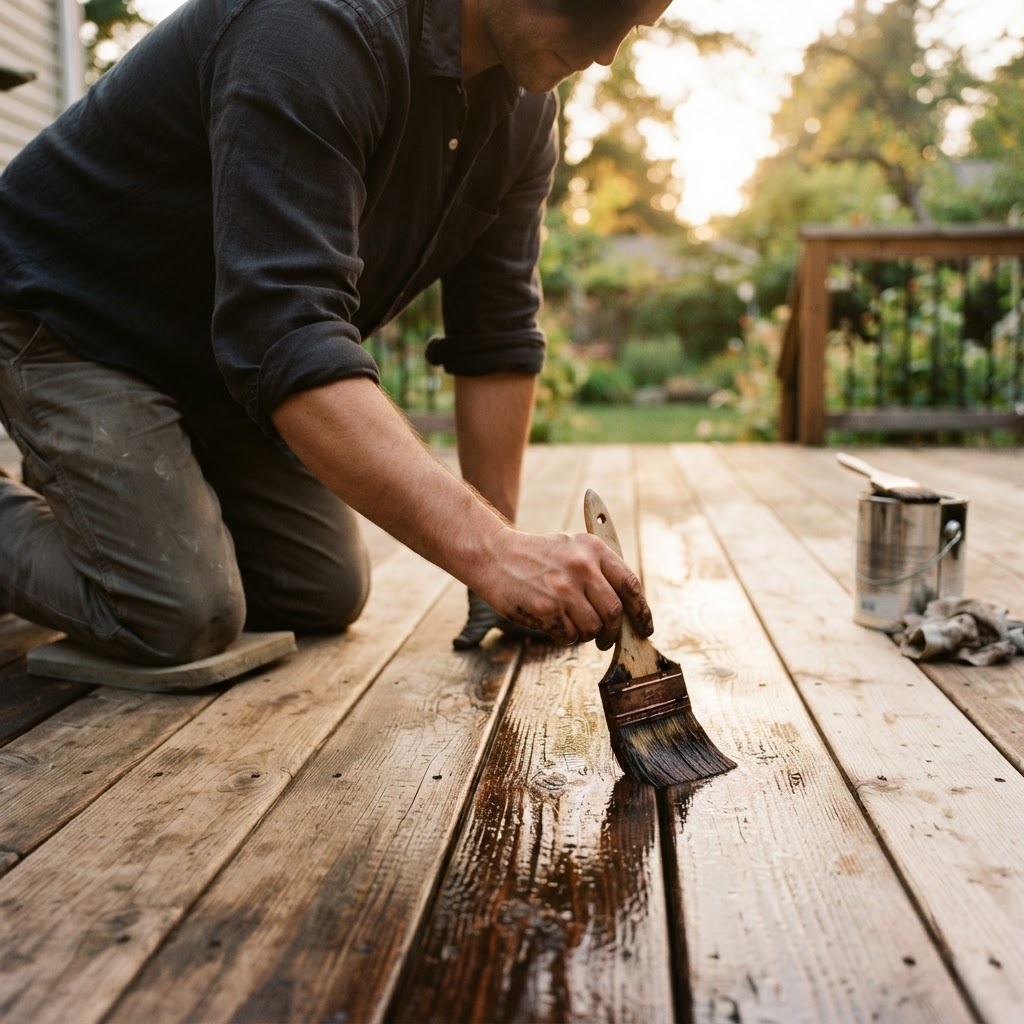
Why Wood Moves
Wood is hygroscopic — it absorbs and releases moisture from the surrounding air until it reaches equilibrium moisture content (EMC). As humidity rises, wood absorbs water and swells. As humidity drops, wood releases water and shrinks. This cycle repeats every season, every year, for the life of the wood.
Key fact: wood only moves across the grain, never along it. A 12" wide board may grow or shrink by 1/4" or more across its width seasonally, but its length stays essentially constant. This asymmetry is what causes problems — cross-grain construction (wood pieces joined perpendicular to each other) fights this movement and something has to give.
Types of Movement
Tangential shrinkage: Movement parallel to the growth rings. This is the greatest direction of movement — typically 6-12% from green to oven-dry (about twice the radial rate). Flat-sawn boards (growth rings roughly parallel to the face) experience the most movement across their width.
Radial shrinkage: Movement perpendicular to the growth rings. About half the tangential rate (3-6% from green to oven-dry). Quarter-sawn boards (growth rings roughly perpendicular to the face) experience less width change and are more dimensionally stable.
Longitudinal shrinkage: Movement along the length of the grain. Negligible (0.1-0.2%) and can be ignored for all practical purposes. A 10-foot board gets maybe 1/32" shorter from green to oven-dry.
Shrinkage Rates by Species
Low movement (most stable): Teak (tangential 4.0%, radial 2.5%), mahogany (4.1%/3.0%), white oak (5.6%/3.5%), cedar (5.0%/2.4%), redwood (4.4%/2.6%)
Medium movement: Cherry (7.1%/3.7%), walnut (7.8%/5.5%), red oak (8.6%/4.4%), maple (9.9%/4.8%)
High movement (least stable): Beech (11.9%/5.5%), hickory (11.5%/7.0%), Douglas fir (7.6%/4.8%)
These are percentages from green to oven-dry. In real life, kiln-dried furniture wood moves between roughly 6-14% MC seasonally, which is about 1/3 to 1/2 of the total green-to-oven-dry range.
Practical Movement Calculator
For furniture-making purposes, expect kiln-dried wood to move about 1/8" per 12" of width in flat-sawn boards across a typical humidity season (30-65% RH). Quarter-sawn boards move about half that. So a 24"-wide table top in flat-sawn red oak may grow or shrink by 1/4" across the seasons.
Designing for Movement
Table tops: Never glue a solid wood top to the apron/base. Use figure-8 fasteners, elongated screw slots, or Z-clips that allow the top to slide side-to-side while staying attached. The top will move; the base won't. If you glue them together, the top will crack.
Frame-and-panel construction: The panel floats in grooves in the frame. The frame (narrow pieces) barely moves. The panel (wide piece) moves freely in the grooves. This is why raised panel doors, drawer bottoms, and cabinet backs use frame-and-panel — it allows the wide panel to move without cracking or distorting the frame.
Breadboard ends: The cross-grain piece at the end of a table top is only glued at the center. The outer portions are attached with elongated mortises and tenons (or elongated screw holes) that allow the top to expand and contract while the breadboard keeps it flat.
Trim and molding: Allow 1/8" gap at butt joints for expansion. Cope interior corners rather than mitering (miters open up with movement). Nail rather than glue to allow movement.
Floors: Leave 3/8-1/2" expansion gap around the perimeter (hidden by baseboard). Acclimate flooring for 3-7 days before installation. Install when indoor humidity is at mid-range.
Common Mistakes
Cross-grain glue-ups: Gluing wood with grain running perpendicular is a guarantee of failure. The joint will either crack or pull apart within one season.
Trapping panels: Gluing panels into frames instead of floating them. The panel needs room to move.
Ignoring seasonal timing: Building furniture in dry winter air (low MC) means the wood will expand in summer. If joints are tight in winter, they'll buckle in summer. Build at mid-range humidity whenever possible.
Mixing movement rates: Combining species with very different shrinkage rates in the same panel or structure. The differential movement causes warping and joint failure.
Frequently Asked Questions
Lumberama Editorial Team
Wood Science & Furniture Design Specialists
Contributor to Lumberama’s reference library. Read our editorial standards and source methodology.
Wood properties and behavior
Where readers of this article usually go next.
Related Articles

Wainscoting Guide: Types, Cost & Installation Ideas
Add classic charm and protection to your walls.

Trim & Baseboard Guide: Types, Cost & Installation
Finish your rooms with the perfect trim.
Crown Molding Guide: Types, Cost & Installation
Add elegance to any room with crown molding.