How to Read a Hardwood Lumber Tally (And Avoid Overpaying)
Why the tally matters
When you buy dimensional softwood you buy pieces: twenty 2x4s at sixteen feet. Hardwood does not work that way. It arrives in random widths and random lengths, and it is priced per board foot. The tally is the document that translates a stack of boards into the number you pay for.
If you cannot read the tally, you cannot check the invoice.
The parts of a tally line
A typical line reads something like: `4/4 FAS Walnut — 12 pcs — 86 SM — 86 BF @ $12.50 = $1,075.00`
Quarter thickness (4/4). Hardwood thickness is expressed in quarter inches of rough thickness. 4/4 is one inch rough, 8/4 is two inches rough. This is the thickness before surfacing. A 4/4 board surfaced on two sides lands near 13/16", which is why a "one inch" walnut board measures thinner than expected.
Grade (FAS). The NHLA grade describes the percentage of clear cutting area, not the beauty of the face. FAS, Select, #1 Common and #2 Common each yield differently.
Pieces. Count, for reference only. You are not paying by the piece.
Surface measure (SM). Width in inches times length in feet, divided by twelve. It is the square footage of the face.
Board feet (BF). Surface measure multiplied by the quarter thickness. At 4/4, board feet and surface measure are the same number — which is why 4/4 tallies look deceptively simple. At 8/4, board feet are double the surface measure.
The math, once
Board feet = (thickness in inches x width in inches x length in inches) / 144.
For rough lumber sold by the quarter, the shop shortcut is: board feet = surface measure x (quarter / 4). An 8/4 board with 40 SM is 80 BF.
Four places tallies go wrong
Thickness charged above thickness delivered. You are billed 8/4 and the boards measure 1-3/4" rough. Rough 8/4 should measure a full two inches or very close to it. Measure a sample at several points before unloading.
Nominal width rounded up. Widths are conventionally rounded to the nearest inch, but consistent rounding in the seller's favor on a large lot adds up. Spot-check a dozen boards with a tape.
Surfacing footage billed as rough footage. If boards are surfaced to S2S or S4S, the removed material is not yours. Footage should be tallied rough, before surfacing, and the surfacing charged as a separate line — not tallied after milling at the rough rate.
Footage counted on defect. Split ends, wane, and end checks are trimmed off by you but appear in the footage you paid for. Ask whether the tally is net of trim.
What to do before you sign
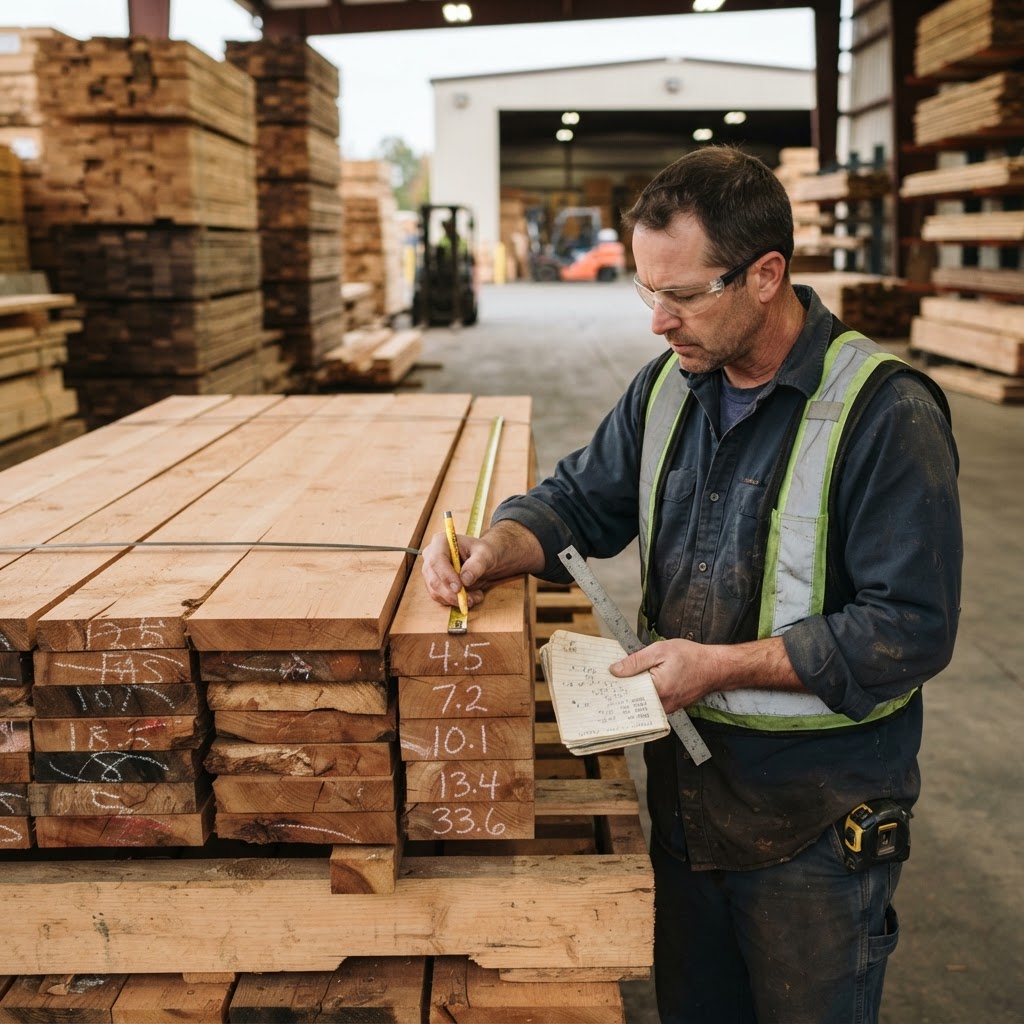
Pull five boards at random. Measure thickness, width and length. Run the board feet yourself. If your number lands within roughly two percent of the tally, the sheet is honest. If it is off by ten percent, the conversation is worth having before the truck leaves.
Our board foot calculator runs the same math, and the lumber grades reference explains what each NHLA grade actually guarantees.
Frequently Asked Questions
Lumberama Editorial
Hardwood Reference Team
Contributor to Lumberama’s reference library. Read our editorial standards and source methodology.
Sizing and measurement resources
Where readers of this article usually go next.
Related Articles

Is Plywood Waterproof? Exterior vs. Exposure 1 Explained
Water-resistant glue does not make an entire plywood sheet waterproof. Learn which panel markings matter and where coatings, drainage and assembly details still do the work.

How Much Does a 2x4 Weigh? Weight Chart by Length
A 2x4 does not have one fixed weight. Use actual dimensions and species density to estimate a load, then account for moisture before arranging pickup or delivery.

How Much Lumber Does It Take to Build a House?
There is no fixed board-foot number for a house. Footprint, stories, roof design, framing method and engineered components all change the package. Here is how builders estimate it.