Composite Decking vs Wood Decking: Cost, Durability & Maintenance Compared
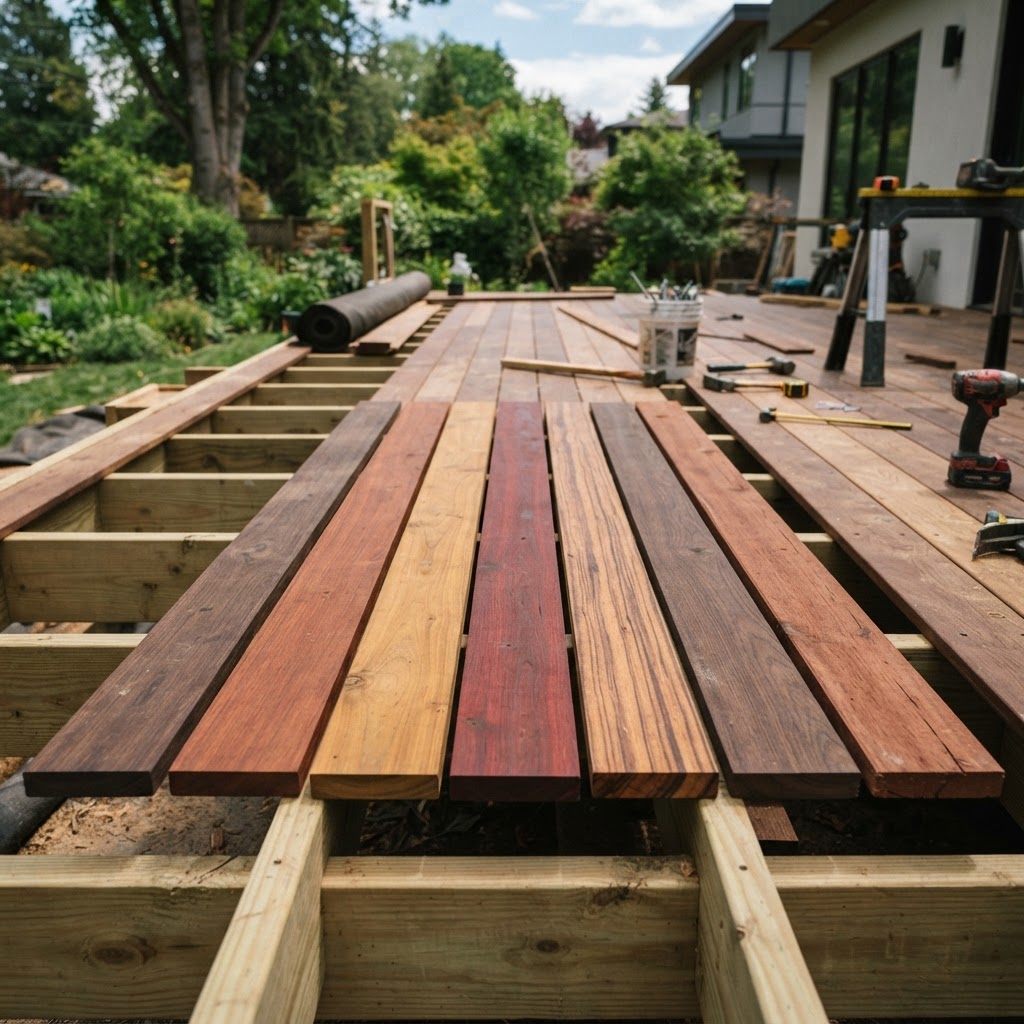
What Is Composite Decking
Composite decking is a manufactured board made from a blend of wood fibers (or wood flour) and plastic (polyethylene or polypropylene). The wood fibers provide structural rigidity; the plastic provides moisture and insect resistance. Most composite decking is "capped" — the wood/plastic core is wrapped in a protective polymer shell that resists staining, fading, and scratching.
Major brands include Trex (the market leader), TimberTech/AZEK, Fiberon, MoistureShield, and Deckorators. Prices range from $3-$12 per linear foot depending on the brand and product line.
Wood Decking Options
Pressure-treated pine/SYP: The most common and affordable wood decking in America. Southern yellow pine or hem-fir treated with preservatives (ACQ, CA-C, or MCA) to resist rot, insects, and fungal decay. Cost: $1.50-$3/LF for 5/4x6 boards. Lifespan: 15-25 years with maintenance (staining/sealing every 1-3 years).
Cedar: Naturally rot-resistant with a warm reddish-brown color. More attractive than pressure-treated but more expensive. Cost: $3-$5/LF. Lifespan: 15-25 years. Cedar weathers to silver-gray if left unfinished; regular staining maintains the warm color.
Redwood: Premium natural decking with beautiful color and natural durability. Limited availability (primarily West Coast). Cost: $5-$8/LF. Lifespan: 25-30+ years.
Ipe (Brazilian hardwood): The premium wood decking choice. Janka hardness: 3,680 lbf. Extremely dense, hard, and naturally resistant to rot, insects, and fire. Cost: $5-$10/LF. Lifespan: 40-75+ years. Ipe requires specialized tools (carbide blades, pre-drilling) and is very heavy (69 lbs/ft³).
Cost Comparison
Upfront cost: Pressure-treated wood wins: $15-$25/SF installed vs. $25-$45/SF for mid-range composite (Trex Transcend, TimberTech Legacy). Premium composites (AZEK, TimberTech Advanced PVC) cost $35-$60/SF installed. A 300 SF deck costs $4,500-$7,500 in pressure-treated wood vs. $7,500-$13,500 in composite.
Lifetime cost: Composite wins over 20+ years. Wood requires annual or biannual staining/sealing ($200-$400 per application for a 300 SF deck). Over 20 years, a pressure-treated deck costs $4,000-$8,000 in maintenance. Composite maintenance cost: $0 (occasional cleaning with soap and water). When you add 20 years of maintenance to the upfront cost, wood and composite approach the same total cost — and the composite deck still looks new while the wood deck may need board replacements.
Durability and Maintenance
Composite: No staining, sealing, or painting required. No rot, no splinters, no insect damage. Capped composites resist staining from food, wine, and grease. Scratches can be buffed out of most capped products. Mold and mildew can grow on the surface in shady, damp areas but can be cleaned with deck wash. Composite does not need to be replaced due to rot — the most common reason wood decks are rebuilt.
Wood: Requires staining or sealing every 1-3 years (pressure-treated and cedar) to prevent graying, cracking, and rot. Without maintenance, wood decking deteriorates rapidly — boards crack, split, warp, and develop splinters. Pressure-treated wood is prone to checking (surface cracks) as it dries. Wood can also be damaged by insects (carpenter ants, termites in some regions).
Appearance
Modern composite decking closely mimics the look of natural wood with embossed grain patterns, streaked color variation, and multi-tonal boards. However, composite still looks and feels like a manufactured product up close — the grain is repetitive (the same pattern repeats every few boards), the surface is uniformly smooth (lacking the tactile irregularity of real wood), and the color is consistent in a way that natural wood never is.
Natural wood has an authentic appearance that composite cannot fully replicate: the depth of real grain, the subtle color variations from board to board, the way wood absorbs and reflects light differently than plastic. For homeowners who value the look and feel of real wood, no composite fully matches it.
Heat and Feel
Composite decking gets significantly hotter than wood in direct sunlight. On a 90°F day, composite surface temperatures can reach 150-175°F — hot enough to be uncomfortable or even painful on bare feet. Darker colors absorb more heat. Wood decking stays 20-30°F cooler under the same conditions because wood doesn't absorb and retain heat as efficiently as the plastic in composite.
This is the #1 complaint about composite decking and a genuine consideration in hot, sunny climates. Lighter colors and capped products with heat-reflective technology (like Trex Transcend Lineage) mitigate but don't eliminate the heat issue.
Frequently Asked Questions
Lumberama Editorial Team
Decking Materials & Outdoor Construction Specialists
Contributor to Lumberama’s reference library. Read our editorial standards and source methodology.
Continue researching decking
Where readers of this article usually go next.
Related Articles

Tree Removal Guide: Cost, When to Remove & DIY vs Pro
Make safe and informed tree removal decisions.

Countertop Guide: Granite vs Quartz vs Marble and More
Choose the right kitchen or bathroom countertop with this comprehensive comparison.

Pool Guide: Above Ground vs In-Ground Cost and Types
Learn about costs, types, and which pool is right for your home.