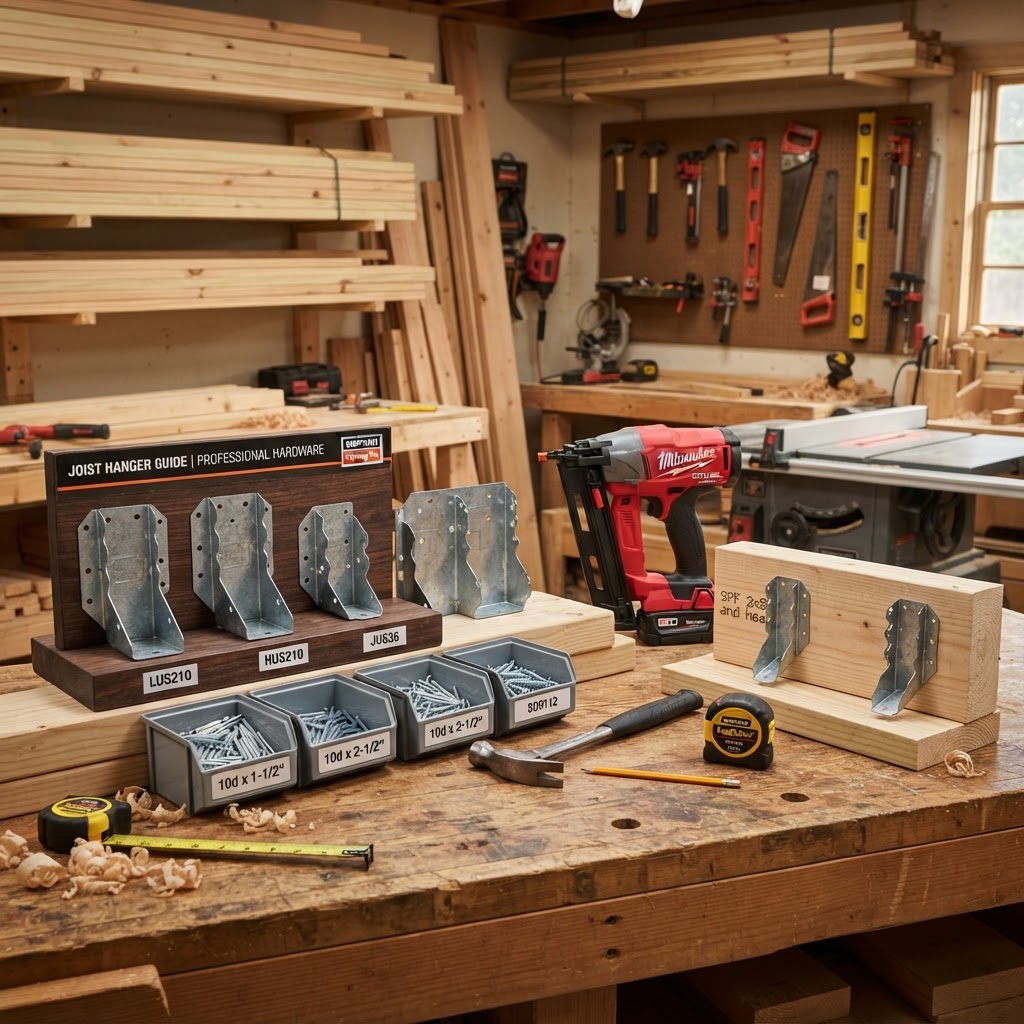
Joist Hanger Selection Guide: Types, Sizes, and Load Ratings (2026)
Joist hangers are essential structural connectors that transfer floor and deck loads from joists to beams and ledger boards. Using the correct hanger ensures your framing meets building codes and can safely carry live and dead loads. This guide covers hanger types, sizing, nail patterns, and installation requirements for residential deck and floor construction.
Key Takeaways
- Joist hangers are essential structural connectors that transfer floor and deck loads from joists to beams and ledger boards.
- Using the correct hanger ensures your framing meets building codes and can safely carry live and dead loads.
- This guide covers hanger types, sizing, nail patterns, and installation requirements for residential deck and floor construction.
- Joist lumber dimensions (2x6, 2x8, 2x10, 2x12), single vs double joist hangers, face-mount vs top-flange styles, load capacity requirements (check your local code), material coating for outdoor use (galvanized or stainless), skew and slope angles if needed, and compatible nail or screw specifications.
- Simpson Strong-Tie LUS series is the industry standard for face-mount hangers with easy nail patterns and high load ratings.
What to Consider
Joist lumber dimensions (2x6, 2x8, 2x10, 2x12), single vs double joist hangers, face-mount vs top-flange styles, load capacity requirements (check your local code), material coating for outdoor use (galvanized or stainless), skew and slope angles if needed, and compatible nail or screw specifications.
Product Comparison
Simpson Strong-Tie LUS series is the industry standard for face-mount hangers with easy nail patterns and high load ratings. TheDERA series by MiTek offers adjustable widths for non-standard lumber. USP Structural ConnectorsDERA series provides cost-effective alternatives. For engineered lumber (LVL, I-joists), Simpson ITS and HIT series hangers are purpose-built with wider flanges.
Size Selection Guide
Match the hanger model to your exact joist size: LUS26 for 2x6, LUS28 for 2x8, LUS210 for 2x10, LUS212 for 2x12. Double-joist hangers use the LUS26-2 designation. For 45-degree angles, use LSU or LSSU skewable models. Always verify the hanger width matches your actual lumber width — modern 2x lumber is 1.5 inches wide, not 2 inches.
Installation Tips
Fill every nail hole in the hanger — empty holes drastically reduce load capacity. Use only joist hanger nails (short, thick 10d x 1-1/2 inch), never standard framing nails. The joist should sit fully in the saddle with no gap at the bottom. Install hangers level using a speed square. For ledger board connections, ensure the ledger is properly bolted before hanging joists.
Common Mistakes to Avoid
Using regular 16d nails instead of proper joist hanger nails, which can split the lumber and reduce capacity by 50%. Leaving nail holes empty. Installing hangers upside down or with the joist not fully seated. Using interior-rated galvanized hangers outdoors with pressure-treated lumber. Not accounting for skew or slope angles.
Budget Guide
Standard face-mount joist hangers cost $2-5 each depending on size. Heavy-duty and adjustable models run $6-12 each. Stainless steel versions for coastal environments are $8-15 each. A typical 300 sq ft deck with 16-inch joist spacing needs approximately 20-25 hangers. Joist hanger nails cost about $8-12 per pound.
Frequently Asked Questions
Related Guides
Concrete Anchors for Wood Posts
Install wood posts on concrete with the right anchors. Compare wedge, sleeve, epoxy, and expansion a
Read guidePergola Hardware Kit Guide
Build a beautiful pergola with the right hardware kits. Compare post-to-beam brackets, rafter hanger
Read guidePost Bracket and Base Guide
Choose the right post brackets and bases for deck, fence, and pergola posts. Compare standoff, surfa
Read guideTimber Connector Plates Guide
Guide to timber connector plates including tie plates, gusset plates, mending plates, and nail plate
Read guide