Accent pieces
decorative panels
furniture accents
turned objects
knife handles
veneer
How to Finish Leopardwood: Complete Staining & Sealing Guide (2026)
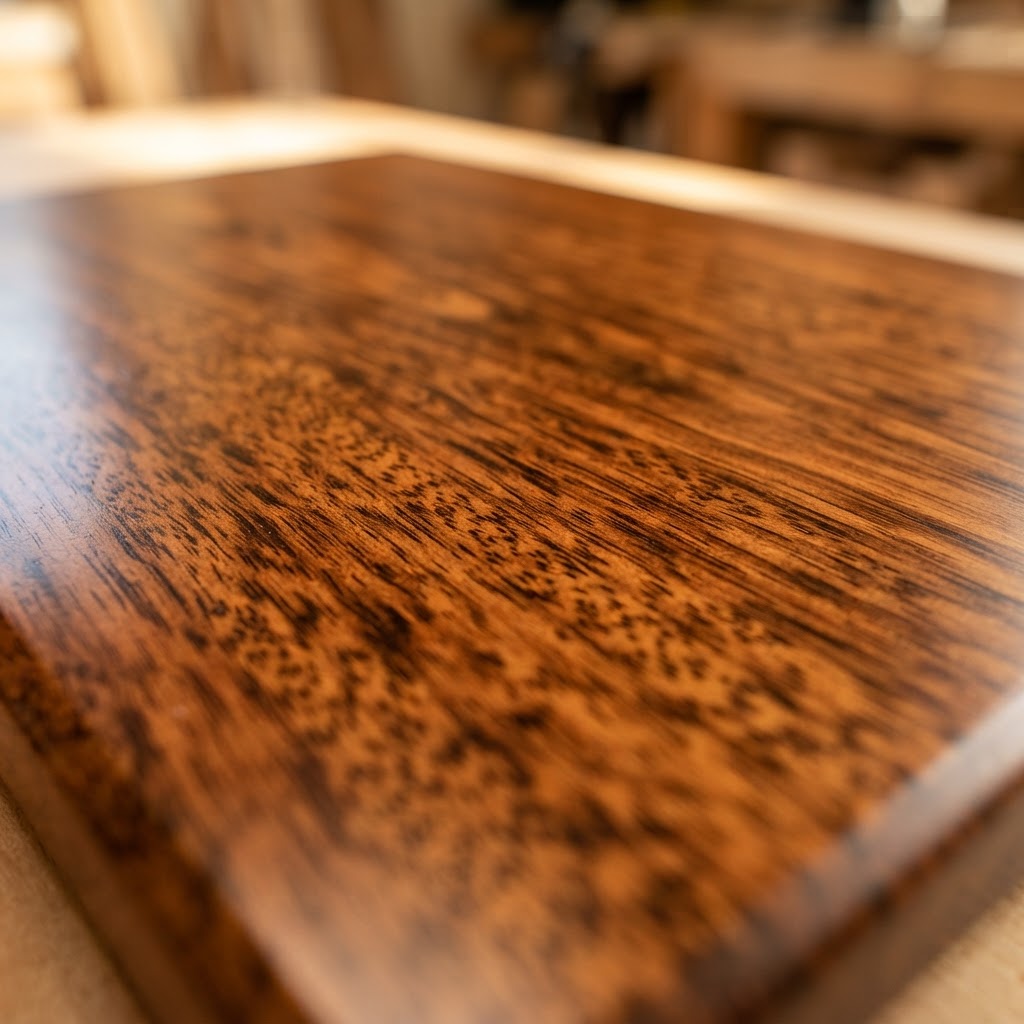
Leopardwood features a distinctive spotted or flecked pattern that resembles a leopard's coat, created by large rays visible on quartersawn surfaces. Similar to lacewood but with darker, more pronounced spots, it makes a stunning accent wood.
Key Takeaways
- Leopardwood features a distinctive spotted or flecked pattern that resembles a leopard's coat, created by large rays visible on quartersawn surfaces.
- Similar to lacewood but with darker, more pronounced spots, it makes a stunning accent wood.
- Clear lacquer or poly to showcase spotted pattern; shellac for warm traditional tone; oil to deepen contrast between spots and background.
- Quartersawn shows dark spotted pattern from medullary rays.
- Diffuse-porous with medium pores.
Wood Characteristics
Quartersawn shows dark spotted pattern from medullary rays. Diffuse-porous with medium pores. 1340 Janka. Reddish-brown with dark brown to black leopard-like spots. Low tannin.
Recommended Finishes
Clear lacquer or poly to showcase spotted pattern; shellac for warm traditional tone; oil to deepen contrast between spots and background. Never stain.
Preparation Steps
Sand through 120, 150, 180, 220 grit. Light pressure to avoid flaking ray cells. Fill pores with grain filler for smooth finish. No conditioner needed.
Application Steps
1. Apply grain filler if desired, tinted to match background. 2. Sand flush 320. 3. Apply clear finish in thin coats. 4. Dry 24 hours. 5. Sand 400 between coats. 6. Apply 3 coats. 7. Buff final coat.
Maintenance Schedule
Oil: refresh every 6-12 months. Poly: recoat every 5-8 years. The spotted pattern remains visible and beautiful through all clear finishes.
Common Mistakes
Using stain that masks the spotted pattern; aggressive sanding that damages ray fleck cells; skipping grain filler when smooth finish needed; not showcasing quartersawn face.
Interior vs Exterior
Interior: Stunning for accent pieces, decorative panels, furniture highlights. Clear finish essential. Exterior: Not recommended for outdoor use.
Frequently Asked Questions
Leopardwood has darker, more pronounced spots while lacewood has a finer, more delicate lace-like pattern. Both are ray-fleck figures.
Yes, the spotted pattern only appears on quartersawn surfaces.
The background color may deepen slightly but the spotted pattern remains prominent.
Related Guides
Live-edge furniture, flooring, cutting boards, outdoor furniture, turned objects, decorative pieces
Acacia
Learn how to finish acacia wood for furniture, flooring, and cutting boards. Expert tips on enhancin
Read guideFurniture, flooring, outdoor applications, boat building, joinery, window frames
Afrormosia
Expert guide to finishing afrormosia wood. Learn how to enhance this premium teak alternative for fu
Read guideCabinetry, furniture, interior trim, doors, turned objects, craft projects
Alder
Expert guide to finishing alder wood for cabinets and furniture. Learn how to stain alder to mimic c
Read guideDecking, dock pilings, heavy construction, marine applications, boardwalks, retaining walls
Angelim Pedra
Complete guide to finishing angelim pedra for decking and heavy construction. Learn oiling, sealing,
Read guide