Laminate vs Vinyl Plank Flooring: Complete Comparison Guide (2026)
Laminate and luxury vinyl plank (LVP) flooring are the two most popular affordable alternatives to hardwood, and both have improved dramatically in appearance and performance. The critical difference comes down to water resistance. This side-by-side comparison helps you choose the right product for every room in your home.
Key Takeaways
- Laminate and luxury vinyl plank (LVP) flooring are the two most popular affordable alternatives to hardwood, and both have improved dramatically in appearance and performance.
- The critical difference comes down to water resistance.
- This side-by-side comparison helps you choose the right product for every room in your home.
- Choose LVP/SPC for any room with moisture exposure — bathrooms, kitchens, basements, laundry, and entries.
- Laminate provides a slightly more realistic wood feel underfoot and often has higher scratch resistance for pet owners.
Types Overview
Standard laminate flooring features a photographic wood-grain image over an HDF core — not water-resistant. Waterproof laminate uses a waterproof core (WPC or stone composite) to handle splashes and spills. Luxury vinyl plank (LVP) is 100% waterproof with a rigid or flexible core and realistic wood or stone visuals. SPC (stone polymer composite) vinyl has a rigid mineral core for excellent dent resistance and flat installation. WPC (wood polymer composite) vinyl has a foam-like core for a softer, warmer feel underfoot. Sheet vinyl provides seamless waterproof coverage for bathrooms and laundry rooms.
Selection Criteria
Choose LVP/SPC for any room with moisture exposure — bathrooms, kitchens, basements, laundry, and entries. Laminate provides a slightly more realistic wood feel underfoot and often has higher scratch resistance for pet owners. SPC vinyl is best for uneven subfloors due to its rigidity. WPC vinyl feels softer and warmer. For budget installations, standard laminate offers excellent value in dry areas. Consider the wear layer thickness for durability — 12 mil minimum, 20+ mil for commercial-grade.
Installation Guide
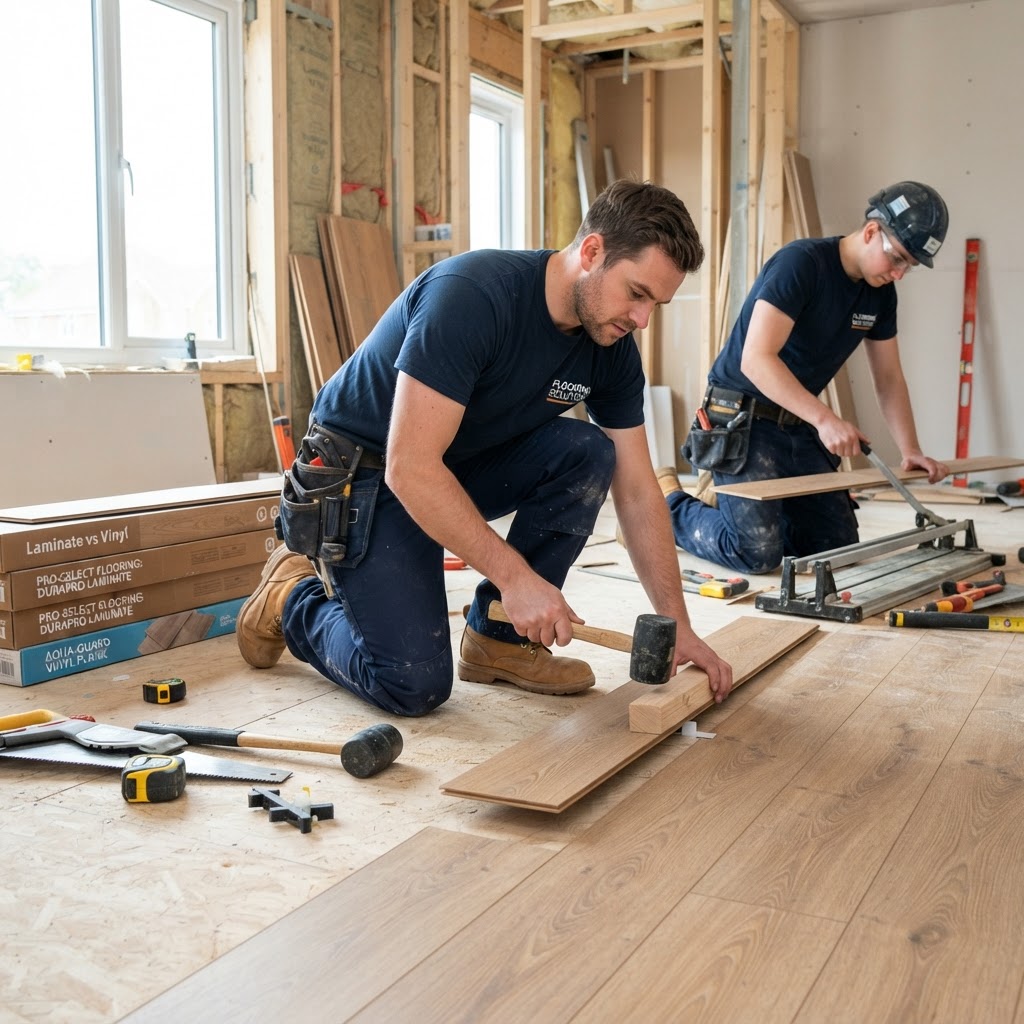
Both products feature click-lock installation that floats over the subfloor. Ensure the subfloor is flat to within 3/16 inch over 10 feet. Install appropriate underlayment — some products have pre-attached padding. Maintain expansion gaps per manufacturer specs (typically 1/4 to 3/8 inch) at all walls and fixed objects. Cut with a miter saw, utility knife (for vinyl), or laminate-specific cutter. Stagger end joints by minimum 6 inches between rows. Transition strips are needed at doorways and material changes.
Code Requirements
Floating floors do not have specific building code requirements beyond subfloor specifications. Subfloor must meet deflection limits of L/360 for the span. Concrete subfloors must be tested for moisture — most products allow up to 85% RH or 5 lbs per 1,000 sq ft calcium chloride test. Underlayment with moisture barrier is required over concrete. Some products have specific temperature limits for radiant heat systems (typically 85°F maximum surface temperature).
Cost Breakdown
Standard laminate: $1.00-$3.00 per square foot. Premium laminate: $3.00-$5.00. Waterproof laminate: $3.50-$6.00. LVP/SPC (budget): $2.00-$3.50. LVP/SPC (mid-range): $3.50-$6.00. LVP/SPC (premium): $5.00-$8.00. WPC vinyl: $4.00-$7.00. Underlayment: $0.25-$0.75 per square foot. Professional installation: $2.00-$4.00 per square foot. Average room (200 sq ft): $600-$2,400 installed.
DIY vs Professional
Both laminate and LVP are the most DIY-friendly flooring options. Click-lock installation requires no glue, nails, or special tools beyond a saw, tapping block, and pull bar. Most homeowners can complete a room in a day. The key skills are accurate measuring, proper expansion gap maintenance, and clean transitions. Professional installation is worthwhile for large open areas requiring perfectly straight rows.
Common Mistakes to Avoid
Not leaving adequate expansion gaps causes buckling in temperature swings — critical for laminate. Ignoring subfloor flatness causes clicking and bounce between planks. Skipping moisture testing on concrete leads to trapped moisture and mold. Using the wrong underlayment (or doubled up with pre-attached pad) creates an unstable floor. Dragging heavy furniture across LVP without pads causes permanent dents. Not acclimating laminate to room temperature before installation.