Hardwood Flooring Buying Guide: Solid vs Engineered, Species, and Costs (2026)
Hardwood flooring adds warmth, value, and timeless beauty to any home. With options ranging from traditional solid oak to exotic engineered species, the choices can be overwhelming. This guide breaks down the key decisions — solid vs engineered, species selection, finish types, and installation methods — to help you choose the perfect hardwood floor.
Key Takeaways
- Hardwood flooring adds warmth, value, and timeless beauty to any home.
- With options ranging from traditional solid oak to exotic engineered species, the choices can be overwhelming.
- This guide breaks down the key decisions — solid vs engineered, species selection, finish types, and installation methods — to help you choose the perfect hardwood floor.
- Hardness rating (Janka scale) determines durability — oak rates 1290, hickory 1820, and Brazilian cherry 2350.
- Choose engineered hardwood for basements, over radiant heat, and in climates with significant humidity swings.
Types Overview
Solid hardwood is milled from a single piece of wood, typically 3/4-inch thick, and can be sanded and refinished multiple times over its lifetime. Engineered hardwood features a real wood veneer bonded to a plywood or HDF core, offering superior dimensional stability and below-grade installation capability. Popular domestic species include red oak, white oak, maple, and hickory. Exotic species like Brazilian cherry, acacia, and teak offer unique grain patterns and extreme hardness. Wide plank flooring (5 inches and wider) creates a modern, open look. Hand-scraped and wire-brushed textures add character and hide wear.
Selection Criteria
Hardness rating (Janka scale) determines durability — oak rates 1290, hickory 1820, and Brazilian cherry 2350. Choose engineered hardwood for basements, over radiant heat, and in climates with significant humidity swings. Solid hardwood is ideal for above-grade installations where future refinishing is desired. Finish type matters: site-finished allows custom colors, and pre-finished provides factory-applied durability with aluminum oxide coatings. Wider planks show more wood character but are more susceptible to cupping.
Installation Guide
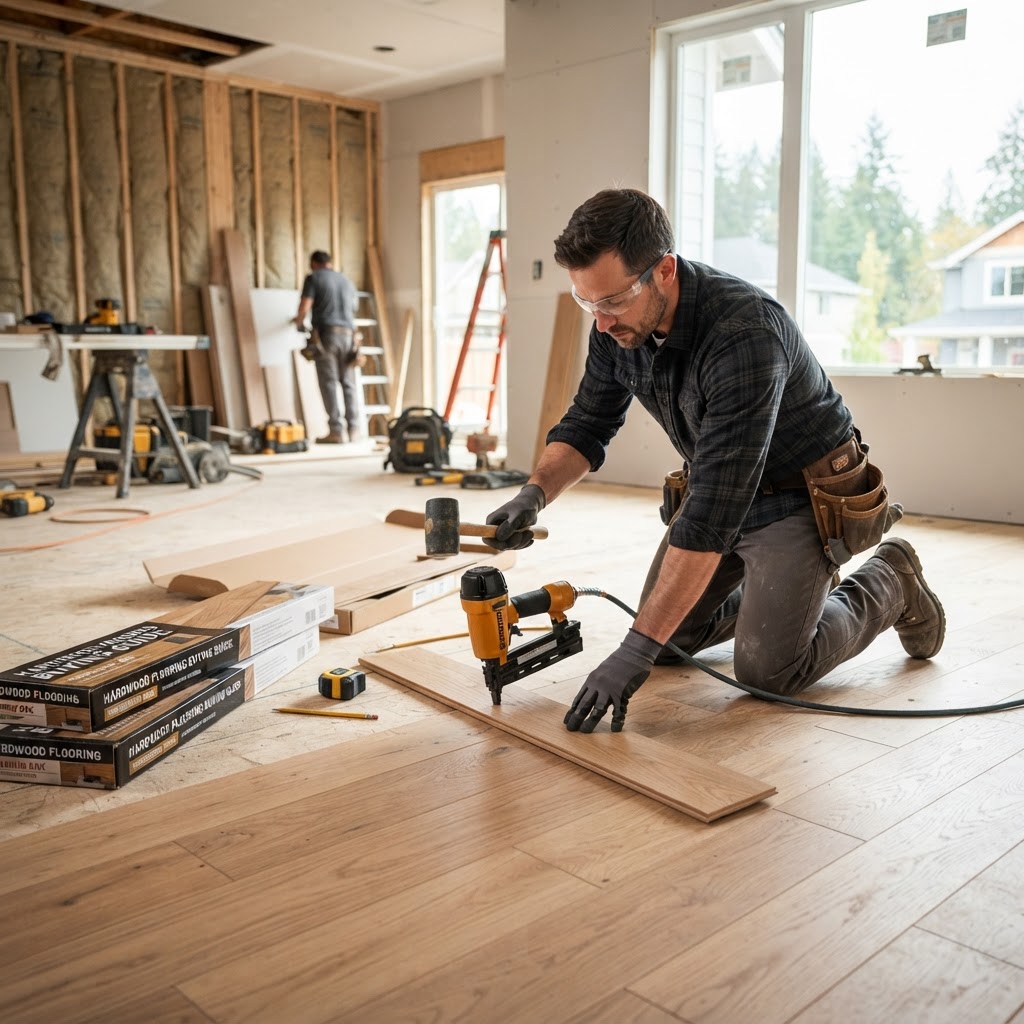
Acclimate hardwood in the installation space for minimum 3-5 days. Solid hardwood installs over a plywood or OSB subfloor using blind nailing with a flooring nailer or stapler. Engineered hardwood can be nailed, glued, or floated depending on the product and subfloor. Maintain 1/2-inch expansion gap at all walls. Install a moisture barrier over concrete subfloors. Run boards perpendicular to floor joists for solid hardwood. Stagger end joints by minimum 6 inches for a natural appearance.
Code Requirements
Hardwood flooring must be installed over a code-compliant subfloor. Moisture content of the subfloor must be within 2-4% of the flooring moisture content before installation. Concrete subfloors must test below 3 lbs per 1,000 sq ft per 24 hours (calcium chloride test) or below 75% relative humidity (in-situ probe test). Subfloor must be flat to within 3/16 inch over 10 feet. Radiant heat systems must not exceed 85°F surface temperature for most hardwood products.
Cost Breakdown
Solid oak (3/4-inch, unfinished): $3.50-$6.00 per square foot. Solid oak (pre-finished): $5.00-$9.00. Solid exotic species: $6.00-$15.00. Engineered hardwood (standard): $4.00-$8.00. Engineered hardwood (premium wide plank): $7.00-$14.00. Professional nail-down installation: $3.00-$5.00 per square foot. Site sanding and finishing: $3.00-$5.00 per square foot. Complete hardwood floor project (1,000 sq ft): $8,000-$18,000 installed.
DIY vs Professional
Floating engineered hardwood installation is a good DIY project — click-lock systems are straightforward with a miter saw and tapping block. Nail-down solid hardwood is achievable with a rented flooring nailer but requires experience for tight, consistent results. Site sanding and finishing should be left to professionals — uneven sanding shows dramatically in the final finish. Staircase installation is the most challenging element.
Common Mistakes to Avoid
Not acclimating the wood to the home environment causes expansion, buckling, or excessive gapping after installation. Ignoring subfloor moisture leads to cupping, crowning, and finish failure. Nailing too close to board ends causes splits. Not maintaining expansion gaps results in buckling. Using the wrong adhesive for glue-down installation on concrete can fail. Choosing a soft species for high-traffic areas leads to rapid wear.