Wood Dock & Pier Building Guide: Materials, Design & Construction
Dock Types and Configurations
Docks fall into two main categories: fixed (permanent) and floating. Fixed docks are built on pilings driven into the lake or river bed, with the deck surface at a constant height above the water. They're stronger, more stable, and handle boat wakes better, but don't adjust to water level changes — a problem in reservoirs, tidal areas, or rivers with significant seasonal fluctuation. Floating docks rest on the water surface using pontoons, foam-filled floats, or air-filled drums, rising and falling with water levels. They're easier to install, don't require piling driving, and work in any water depth, but they move with waves and wakes, which can be uncomfortable and makes them less suitable for heavy boat moorage.
Dock Layout
A standard residential dock consists of a gangway (the walkway from shore to the dock), the main platform (typically 4-6 feet wide), and optional finger piers or slips for boat moorage. Minimum recommended width is 4 feet for a walkway dock, 6 feet for a dock with boat cleats and seating, and 8-10 feet for entertaining and swimming platforms. Length depends on water depth at the end — you need at least 3-4 feet of water at the dock end for most recreational boats. Common configurations include straight docks (simplest), L-shaped (adds side moorage), T-shaped (provides two boat slips), and U-shaped (protected slip).
Wood and Material Selection
The wood must withstand constant water exposure, UV radiation, and marine borers (in saltwater). Pressure-treated southern yellow pine is the most common dock lumber in freshwater applications. Use marine-grade treatment rated for saltwater submersion (UC5B retention level) for any components in saltwater or brackish water. Standard ground-contact treatment (UC4A/UC4B) is adequate for freshwater pilings and framing. Tropical hardwoods are the premium choice for dock construction. Ipe (Brazilian walnut), cumaru, garapa, and tigerwood are extremely dense (sinking in water), naturally resistant to rot and marine borers, and last 25-50+ years in marine environments without chemical treatment. They're expensive ($4-8 per linear foot for decking) but unmatched in durability. Cedar works for dock decking above the waterline but is not suitable for pilings or submerged structural members — it lacks the density and strength needed for marine structural applications.
Pilings
Pilings are the vertical posts driven into the bottom that support fixed docks. Pressure-treated pilings (Southern yellow pine, CCA-treated for marine use — CCA is still permitted for marine and commercial applications) are the standard. Typical sizes are 8-10 inch diameter round pilings, 10-16 feet long. They're driven into the bottom using a pile driver (rented equipment or hired contractor). In soft bottom conditions, pilings may need to be driven 6-8 feet into the sediment for stability. In rocky bottoms, pilings are set in drilled holes filled with concrete. Steel pipe pilings with concrete fill are used in heavy-duty applications and are essentially permanent.
Dock Framing and Decking
Stringers (the horizontal frame members running the dock's length) are typically pressure-treated 2x8 or 2x10, doubled for strength on wider docks. Cross frames (running across the width) are 2x8 on 4-foot centers. All connections use hot-dipped galvanized or stainless steel hardware — standard zinc-plated hardware corrodes rapidly in marine environments. Use 316 stainless steel for saltwater applications. Decking options: pressure-treated 2x6 or 5/4x6 is the most affordable, spaced 1/4-inch apart for drainage and expansion. Composite decking (Trex, TimberTech) provides a low-maintenance, splinter-free surface that's comfortable for bare feet and doesn't need annual finishing. Ipe decking is the ultimate dock surface — hard as steel, naturally non-slip when wet, resistant to everything the marine environment throws at it, and lasts 40+ years.
Permits and Regulations
Dock construction is heavily regulated. You'll typically need permits from multiple agencies: the Army Corps of Engineers (Section 10 permit for navigable waters), your state's Department of Natural Resources or equivalent, the local county or municipal building department, and potentially the EPA for environmental impact. Permits can take 3-12 months to obtain, so start the process well before you want to build. Many jurisdictions limit dock size, length, materials, and placement to protect aquatic habitat, navigation channels, and neighboring property owners' sight lines and access. Some lakes and rivers prohibit new dock construction entirely. The permit process is often the most time-consuming part of a dock project.
Construction and Cost
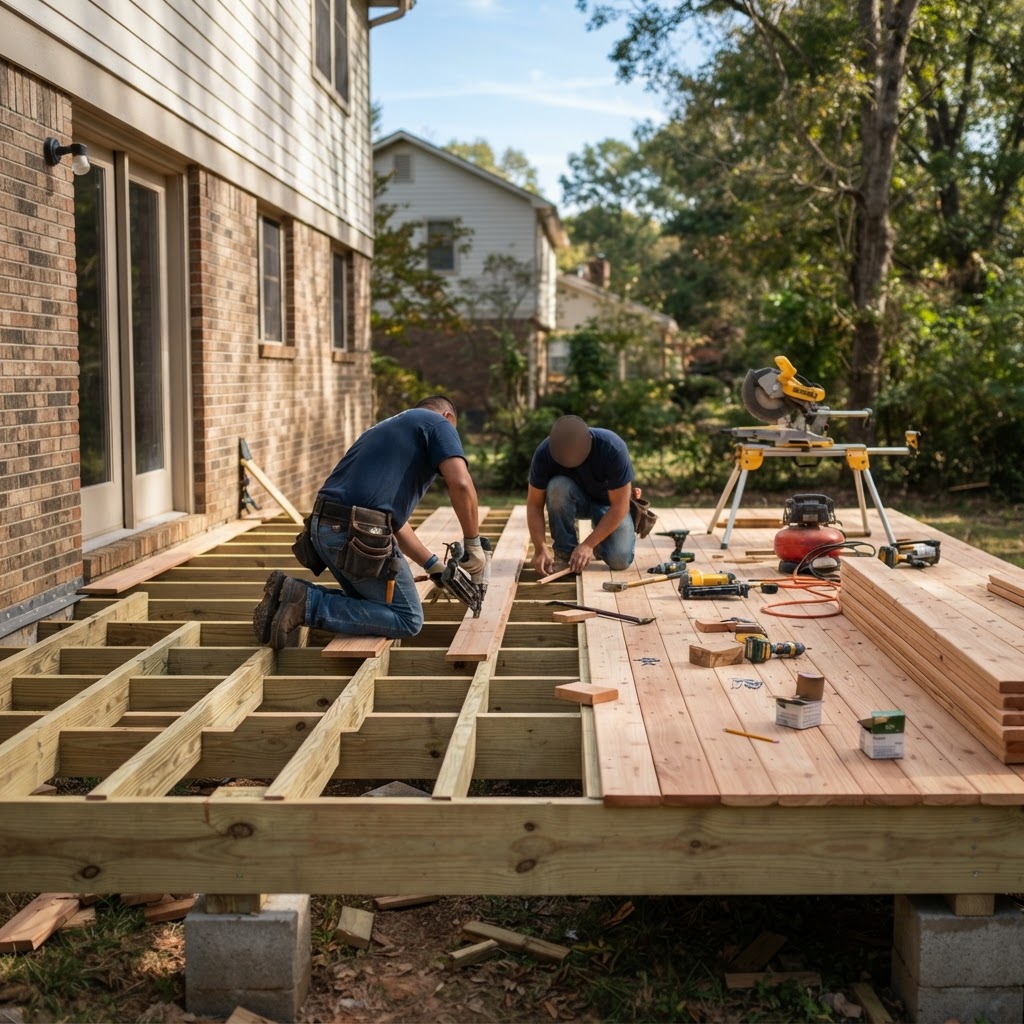
For fixed docks, the construction sequence is: drive pilings, install caps and stringers, attach cross frames, lay decking, add accessories (cleats, bumpers, ladders, lighting). For floating docks, assemble the frame on shore, attach flotation, launch, and anchor in position with pilings or anchoring systems. A basic 4x24-foot fixed dock costs approximately $3,000-5,000 in materials with pressure-treated lumber, or $5,000-10,000 with ipe. Professional dock construction runs $50-150 per square foot depending on materials and site conditions. Floating dock sections cost $30-80 per square foot for commercial aluminum-frame systems.
Frequently Asked Questions
Lumberama Editorial Team
Outdoor Building Experts
Contributor to Lumberama’s reference library. Read our editorial standards and source methodology.
Continue researching decking
Where readers of this article usually go next.
Related Articles

Pressure Washing Guide: Cost, Tips & What to Clean
Restore your home's exterior with pressure washing.

Arbor & Trellis Guide: Types, Cost & DIY Ideas
Add vertical beauty to your garden.

Screen Porch Guide: Types, Cost & Design Ideas
Enjoy the outdoors without bugs.