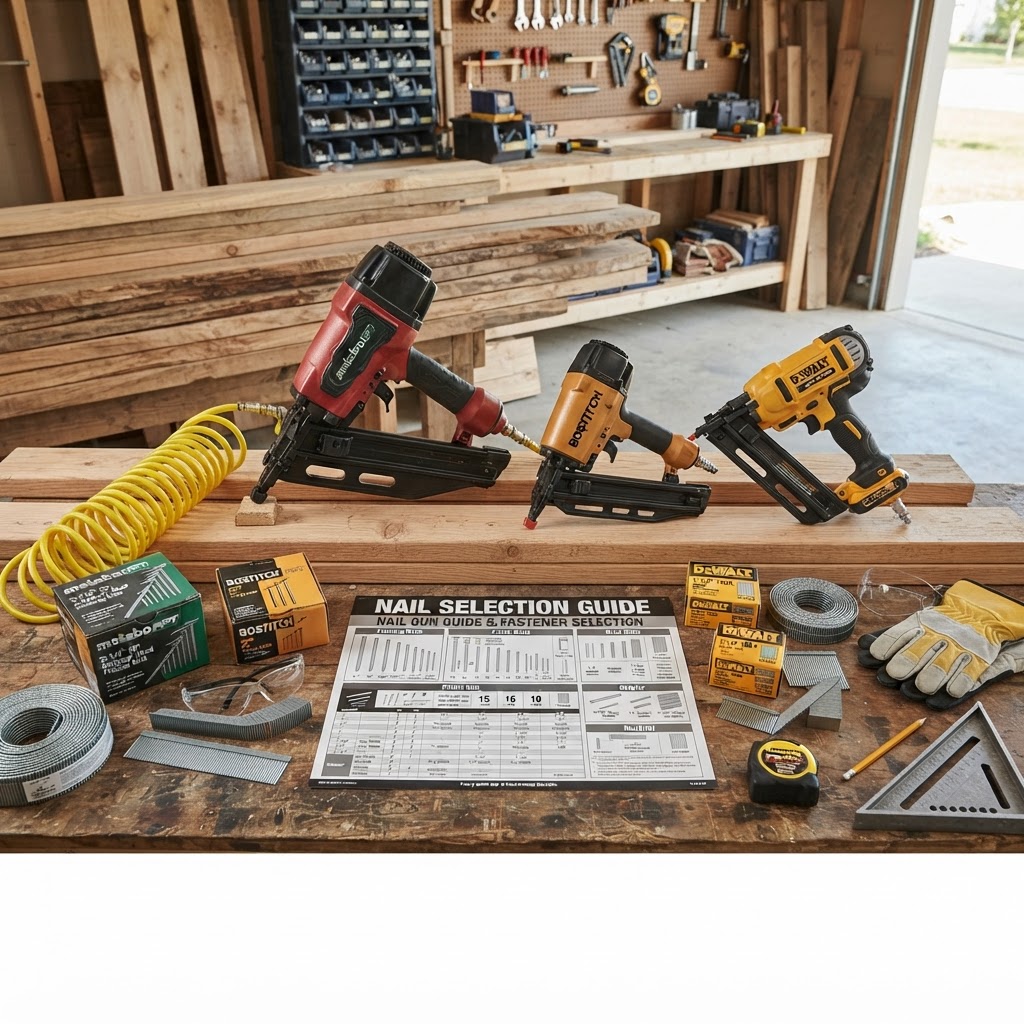
Nail Gun and Nail Selection Guide: Match the Right Nailer to Your Project (2026)
Nail guns dramatically speed up construction and woodworking by driving nails in a fraction of a second with consistent depth and holding power. From heavy-duty framing nailers driving 3-1/2 inch nails into structural lumber to delicate 23-gauge pin nailers for trim work, each nailer type is designed for specific applications and nail sizes. This guide matches you with the right nailer and nail combination for every project.
Key Takeaways
- Nail guns dramatically speed up construction and woodworking by driving nails in a fraction of a second with consistent depth and holding power.
- From heavy-duty framing nailers driving 3-1/2 inch nails into structural lumber to delicate 23-gauge pin nailers for trim work, each nailer type is designed for specific applications and nail sizes.
- This guide matches you with the right nailer and nail combination for every project.
- Nailer type (framing, finish, brad, pin, roofing, or siding), power source (pneumatic, cordless battery, or fuel-cell), nail gauge and length range, collation type (paper, wire, or plastic strip), magazine angle (21-degree, 28-degree, or 34-degree for framing), nail head type (clipped vs full-round), and the specific application (framing, trim, cabinetry, upholstery, or specialty).
- DeWalt DCN692 cordless framing nailer provides gas-free battery power for framing with 20V MAX.
What to Consider
Nailer type (framing, finish, brad, pin, roofing, or siding), power source (pneumatic, cordless battery, or fuel-cell), nail gauge and length range, collation type (paper, wire, or plastic strip), magazine angle (21-degree, 28-degree, or 34-degree for framing), nail head type (clipped vs full-round), and the specific application (framing, trim, cabinetry, upholstery, or specialty).
Product Comparison
DeWalt DCN692 cordless framing nailer provides gas-free battery power for framing with 20V MAX. Hitachi/Metabo NT65MA4 finish nailer is an industry favorite for trim with consistent depth control. Milwaukee M18 FUEL 18-gauge brad nailer offers cordless convenience for cabinet and light trim work. Bostitch BTFP12233 Smart Point finish nailer features a small nose for precise placement near edges and corners.
Size Selection Guide
Framing nailers: 21 or 30/34-degree, driving 2 to 3-1/2 inch nails (16d and 8d common). 15-gauge finish nailers: 1-1/4 to 2-1/2 inch nails for heavy trim, door frames, and baseboards. 16-gauge finish nailers: 1 to 2-1/2 inch nails for general trim and cabinet face frames. 18-gauge brad nailers: 5/8 to 2 inch nails for light trim, molding, and panel goods. 23-gauge pin nailers: 1/2 to 1 inch pins for delicate trim where no visible hole is desired.
Installation Tips
Always test fire into scrap wood to set the depth adjustment correctly. Maintain proper air pressure (70-120 PSI for most pneumatic nailers). Hold the nailer firmly and perpendicular to the surface for straight driving. For trim work, set nails slightly below the surface and fill with putty. Use sequential trigger mode (not bump fire) for precise finish work. Keep the gun clean and lubricated per the manufacturer's schedule.
Common Mistakes to Avoid
Using a framing nailer for finish trim (nails are too large and leave ugly holes). Driving nails at angles unintentionally due to improper contact with the surface. Not adjusting depth setting causing nails to sit proud or drive too deep. Using the wrong nail strip angle for your nailer model. Ignoring safety — always treat a nail gun like a loaded weapon and never point at anyone.
Budget Guide
Pneumatic brad nailers start at $50-80. Pneumatic finish nailers cost $100-200. Pneumatic framing nailers run $150-300. Cordless battery nailers cost $200-400 for brad/finish and $300-500 for framing. A basic compressor for pneumatic nailers costs $100-200. Nail strips cost $30-60 per box of 2,500-5,000 depending on gauge and finish. Cordless eliminates the compressor and hose cost.
Frequently Asked Questions
Related Guides
Deck Board Clips Comparison
Compare deck board clips from Tiger Claw, Ipe Clip, and Mantis. Find the best hidden clip for groove
Read guideDeck Screws Selection Guide
Find the best deck screws for your project. Compare stainless steel, coated, and composite screws by
Read guideHidden Fastener Systems Comparison
Compare hidden deck fastener systems including Camo, Tiger Claw, and Ipe Clip. Side-by-side review o
Read guideStructural Screws vs Lag Bolts
Compare structural screws and lag bolts for deck ledgers, beam connections, and framing. Learn load
Read guide