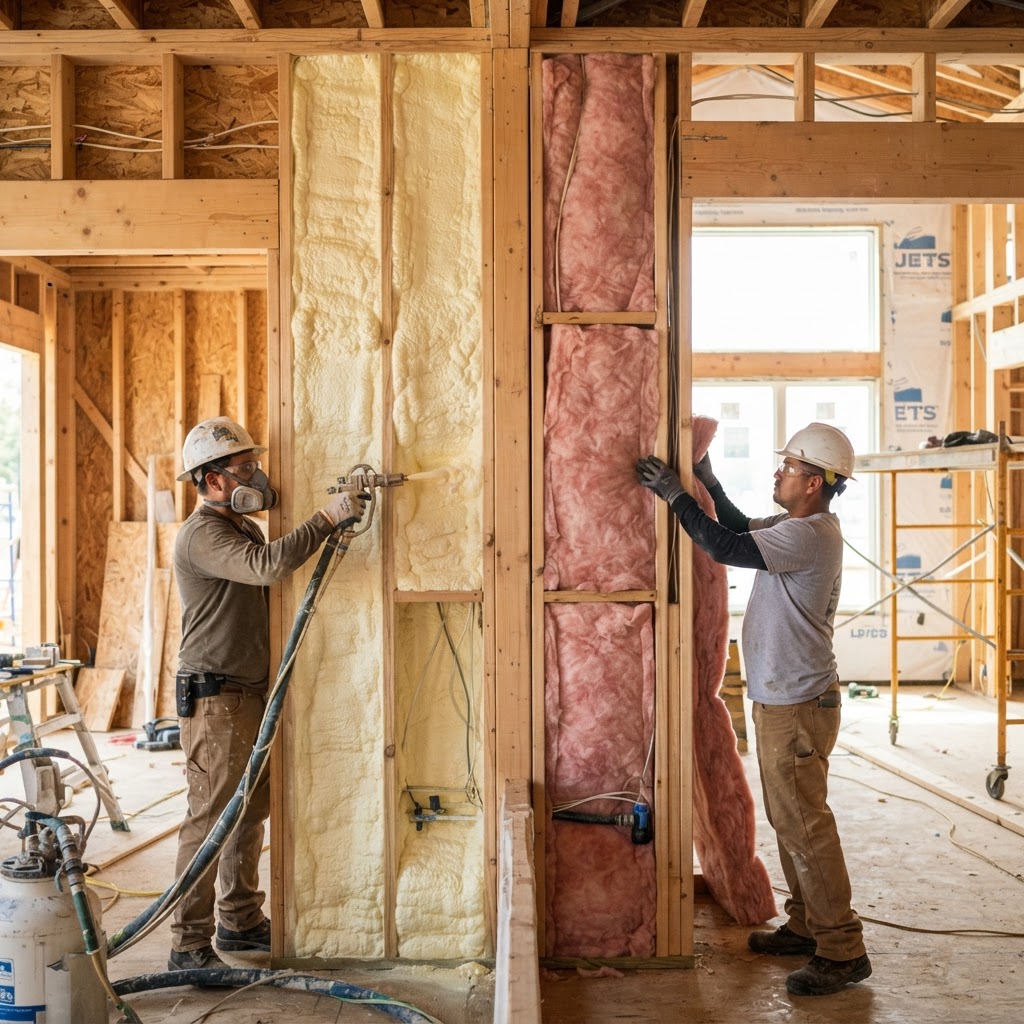
Spray Foam vs Fiberglass Insulation: Complete Comparison (2026)
Choosing between spray foam and fiberglass insulation is one of the most impactful decisions in a building project. Each has distinct advantages in cost, performance, and application. This head-to-head comparison covers R-value, air sealing, moisture control, cost, and the best use cases for each type.
Key Takeaways
- Choosing between spray foam and fiberglass insulation is one of the most impactful decisions in a building project.
- Each has distinct advantages in cost, performance, and application.
- This head-to-head comparison covers R-value, air sealing, moisture control, cost, and the best use cases for each type.
- Choose spray foam when air sealing is critical — rim joists, cathedral ceilings, and crawlspaces.
- Fiberglass batts are ideal when budget is the primary concern and cavities are standard dimensions.
Types Overview
Open-cell spray foam (R-3.6-3.8 per inch) is a soft, spongy material that expands to fill cavities and provides excellent air sealing at a moderate cost. Closed-cell spray foam (R-6.0-7.0 per inch) is rigid, adds structural strength, and acts as a vapor barrier. Standard fiberglass batts (R-3.0-3.8 per inch) are the most widely used insulation, available in pre-cut sizes for standard framing. High-density fiberglass batts (R-4.2 per inch) provide better performance in standard cavity depths. Blown-in fiberglass (R-2.5-3.7 per inch) fills irregular spaces better than batts.
Selection Criteria
Choose spray foam when air sealing is critical — rim joists, cathedral ceilings, and crawlspaces. Fiberglass batts are ideal when budget is the primary concern and cavities are standard dimensions. Closed-cell spray foam is the best choice for below-grade and flood-prone areas due to moisture resistance. Fiberglass wins on cost for straightforward attic insulation. Consider hybrid approaches — spray foam at the air barrier with fiberglass fill for the remaining depth.
Installation Guide
Spray foam requires professional application with specialized spray equipment, proper temperature conditions (substrate and ambient), and adequate ventilation during application. Fiberglass batts should be cut to fill cavities completely without compression, split around wires and pipes, and installed with the vapor retarder facing the conditioned space. Both types require proper attention to fire blocking and thermal barrier requirements.
Code Requirements
Spray foam requires a 15-minute thermal barrier (typically 1/2-inch drywall) when applied in occupied spaces per IRC R316. Ignition barrier is required in attics and crawlspaces. Fiberglass faced with kraft paper serves as a Class III vapor retarder. Closed-cell spray foam at 1.5 inches or greater qualifies as a vapor retarder. Both must meet the minimum R-value requirements of IECC for the climate zone.
Cost Breakdown
Fiberglass batts: $0.50-$1.00 per square foot (DIY). Open-cell spray foam: $0.50-$0.75 per board foot installed ($1.75-$2.85 per sq ft for 2x4 wall). Closed-cell spray foam: $1.25-$2.00 per board foot installed ($3.75-$6.00 per sq ft for 2x4 wall). Fiberglass blown-in attic: $1.00-$1.50 per square foot installed. For a 1,500 sq ft attic: fiberglass costs $1,500-$2,250 vs spray foam at $3,500-$7,500.
DIY vs Professional
Fiberglass batts and blown-in are excellent DIY projects. Spray foam kits exist for small jobs (rim joists, gaps) but full-cavity spray foam requires professional equipment and training. Improper spray foam application can result in poor adhesion, off-ratio mixing that creates odors, and voided warranties. Always hire certified spray foam contractors.
Common Mistakes to Avoid
Comparing R-value alone ignores spray foam's air sealing advantage, which can be worth R-5 to R-10 in effective performance. Applying closed-cell spray foam too thick in a single pass causes heat buildup and poor cure. Not providing thermal barrier over spray foam in living spaces violates fire code. Compressing fiberglass batts significantly reduces R-value. Mixing faced and unfaced insulation improperly creates moisture traps.