Insulation R-Value Chart: Types, Ratings, and Requirements by Zone (2026)
Insulation is one of the highest-return investments in any building project, directly reducing energy costs and improving comfort. R-value measures thermal resistance — the higher the number, the better the insulation performs. This guide breaks down every insulation type, their R-values per inch, and what your climate zone requires.
Key Takeaways
- Insulation is one of the highest-return investments in any building project, directly reducing energy costs and improving comfort.
- R-value measures thermal resistance — the higher the number, the better the insulation performs.
- This guide breaks down every insulation type, their R-values per inch, and what your climate zone requires.
- Match insulation type to the application — batts for open stud cavities, blown-in for enclosed cavities and attics, rigid foam for continuous exterior insulation and below grade, spray foam for air sealing and irregular spaces.
- Climate zone determines minimum R-values: Zone 1-2 needs R-30 attic/R-13 wall, Zone 3-4 needs R-38-49 attic/R-20 wall, Zone 5-7 needs R-49-60 attic/R-20+5ci wall.
Types Overview
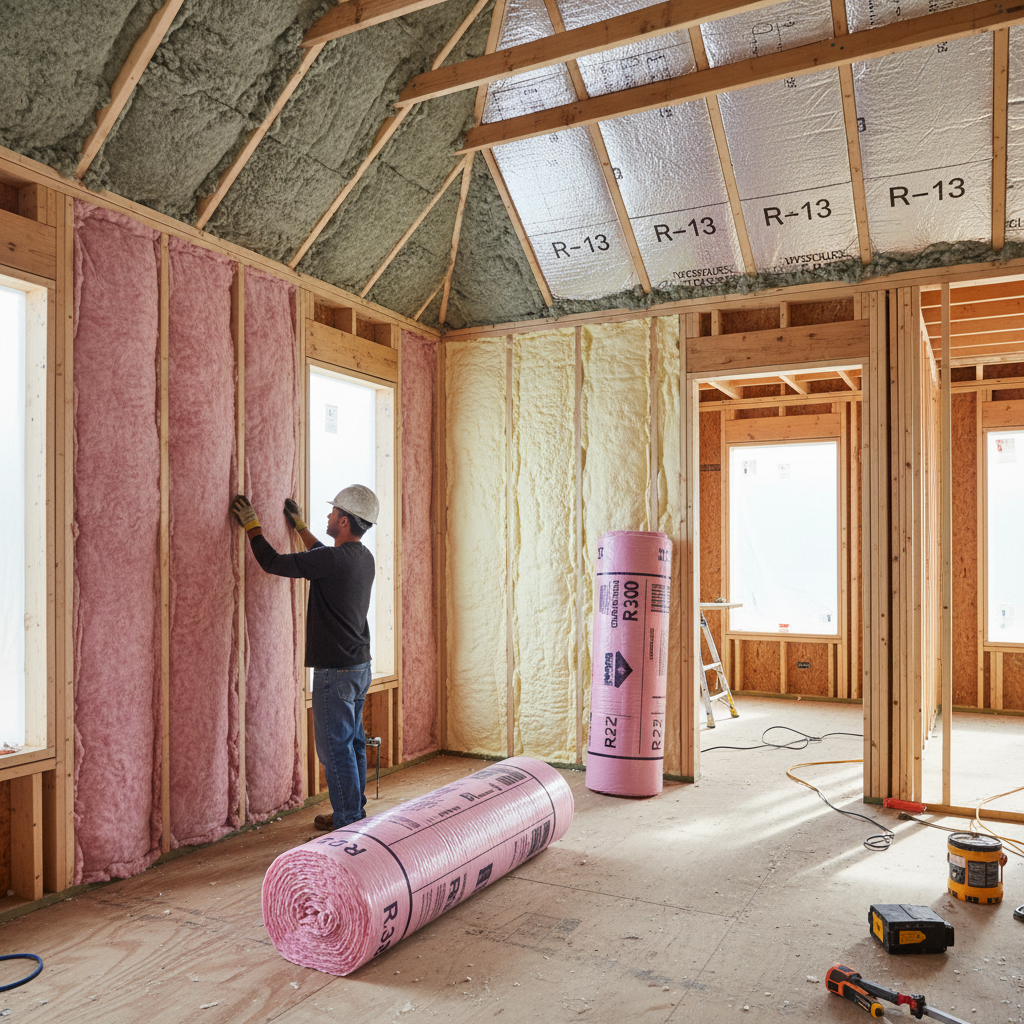
Fiberglass batts (R-3.0-3.8 per inch) are the most common and affordable, available in standard widths for stud and joist cavities. Blown-in cellulose (R-3.2-3.8 per inch) fills irregular cavities and provides excellent air sealing. Mineral wool batts (R-3.3-4.2 per inch) offer superior fire resistance and soundproofing. Rigid foam boards — EPS (R-3.8-4.4), XPS (R-5.0), and polyiso (R-5.7-6.5) per inch — add continuous insulation to walls and foundations. Open-cell spray foam (R-3.6-3.8 per inch) and closed-cell spray foam (R-6.0-7.0 per inch) provide both insulation and air sealing.
Selection Criteria
Match insulation type to the application — batts for open stud cavities, blown-in for enclosed cavities and attics, rigid foam for continuous exterior insulation and below grade, spray foam for air sealing and irregular spaces. Climate zone determines minimum R-values: Zone 1-2 needs R-30 attic/R-13 wall, Zone 3-4 needs R-38-49 attic/R-20 wall, Zone 5-7 needs R-49-60 attic/R-20+5ci wall.
Installation Guide
Batt insulation must fill the cavity completely without compression or gaps — cut precisely around wires and pipes. Blown-in insulation requires proper density to prevent settling. Install vapor retarder on the warm-in-winter side of the assembly. Rigid foam seams should be taped and sealed. Maintain required clearances from recessed lights and exhaust flues. Do not block soffit vents with insulation — use baffles.
Code Requirements
IECC and IRC set minimum insulation R-values by climate zone. Attic insulation ranges from R-30 (Zone 1) to R-60 (Zone 7). Wall insulation ranges from R-13 (Zone 1) to R-20+5ci (Zone 5-7). Floor insulation ranges from R-13 to R-38. Rim joist requires R-13 to R-30. Vapor retarder requirements vary by climate zone — required in Zones 5 and above on the interior side.
Cost Breakdown
Fiberglass batts: $0.50-$1.00 per square foot. Blown-in cellulose: $0.80-$1.50 per square foot installed. Mineral wool batts: $1.00-$1.75 per square foot. XPS rigid foam (2 inch): $1.50-$2.50 per square foot. Open-cell spray foam: $0.50-$0.75 per board foot. Closed-cell spray foam: $1.25-$2.00 per board foot. Full home insulation package: $3,000-$10,000.
DIY vs Professional
Fiberglass and mineral wool batts are very DIY-friendly — wear protective equipment including respirator, goggles, and long sleeves. Blown-in insulation can be DIY with rental equipment from home centers. Spray foam requires professional application due to specialized equipment and chemical handling. Rigid foam board installation is DIY-friendly for accessible areas.
Common Mistakes to Avoid
Compressing batt insulation reduces its R-value — a R-19 batt compressed into a 2x4 cavity only provides about R-13. Gaps and voids create thermal bypasses that dramatically reduce effective R-value. Missing vapor retarder in cold climates leads to condensation and mold. Blocking soffit vents causes ice dams and moisture problems. Using kraft-faced batts on both sides of a wall traps moisture.