Material selection & project planning
Fire-Resistant Decking: WUI Listings & Test Reports
“Class A,” “ignition-resistant” and “WUI approved” do not mean the same thing. For a deck in a wildfire-exposed area, establish the local requirements, identify an acceptable product and assembly, then keep the supporting documents with the order. A wood species name or sales badge is not a permit approval.
Lumberama editorial guide · Published November 5, 2026
Before you choose
- A flame-spread classification does not by itself establish WUI compliance.
- Listings can limit dimensions, fastening and adjacent construction.
- Material selection, assembly details and ongoing debris removal all matter.
| Claim or document | What it addresses | What it does not establish alone |
|---|---|---|
| ASTM E84 / Class A claim | Surface-burning characteristics under the stated test | Approval of every deck assembly or noncombustibility |
| WUI product listing | An identified product under listed conditions | Acceptance outside its scope or by every jurisdiction |
| Fire-retardant treatment | A named treated product and its documented properties | Exterior suitability or structural values without supporting documentation |
Start with the local building department
WUI means wildland-urban interface, where buildings and wildland vegetation meet or intermingle. Whether a particular project is subject to wildfire construction requirements depends on its location, adopted rules and scope of work. Ask which code edition and local amendments govern the project before requesting material quotes.
California’s Office of the State Fire Marshal publishes a WUI listed-products handbook and a searchable building-material listing service. These are useful evidence sources, not a substitute for the authority having jurisdiction. Other locations may use different requirements or accepted compliance routes.
Understand the limits of a Class A label
ASTM E84 evaluates surface-burning characteristics in a specified test. A flame-spread classification is not the same as a fire-resistance duration, a noncombustible-material designation or proof that a complete deck will survive a wildfire.
Never copy a rating from one board size, manufacturer or treatment onto every product sold under the same species name. Obtain a current report or listing identifying the actual offer. The description, tested configuration and limitations matter as much as the classification on the cover.
Check the exact product in the listing
Compare the proposed manufacturer, product name, dimensions and any treatment or coating against the official document. Read the installation notes, fastening conditions and any requirements for adjacent wall construction. Keep a copy that your designer or building official can review.
A product may be acceptable through a code-prescribed path rather than a particular directory entry. Have the responsible professional document that path; do not invent an approval because a name is absent from a quick search. Conversely, a marketing page saying “WUI compliant” is not enough to establish the scope of approval.
Compare wood, composite, PVC and framing as an assembly
There is no blanket approval for all hardwoods, composites or PVC products. Start with documented candidates and compare appearance, maintenance, fasteners, support requirements and installed scope only after checking suitability.
Framing, wall interfaces, stairs, rails and the area underneath the deck can change the exposure. Metal framing is not a reason to ignore connections, load design or heat effects. Do not improvise underside enclosures or ventilation details; coordinate them with the design and local requirements.
Keep the deck and its surroundings maintainable
A qualifying board does not eliminate ignition hazards from accumulated leaves, stored firewood, combustible furniture or vegetation. Plan access so debris can be removed from gaps, corners and beneath the deck. Follow local defensible-space guidance and the site’s approved design.
Treat heat sources, grills and fire pits as separate equipment and clearance decisions. No decking classification makes an open flame safe everywhere on the deck. Follow equipment instructions, local restrictions and the responsible professional’s advice.
Control substitutions before purchasing
Require written review before a supplier substitutes another collection, thickness, treatment or fastener system. Preserve the approved product identity, installation document and applicable report with invoices and delivery records.
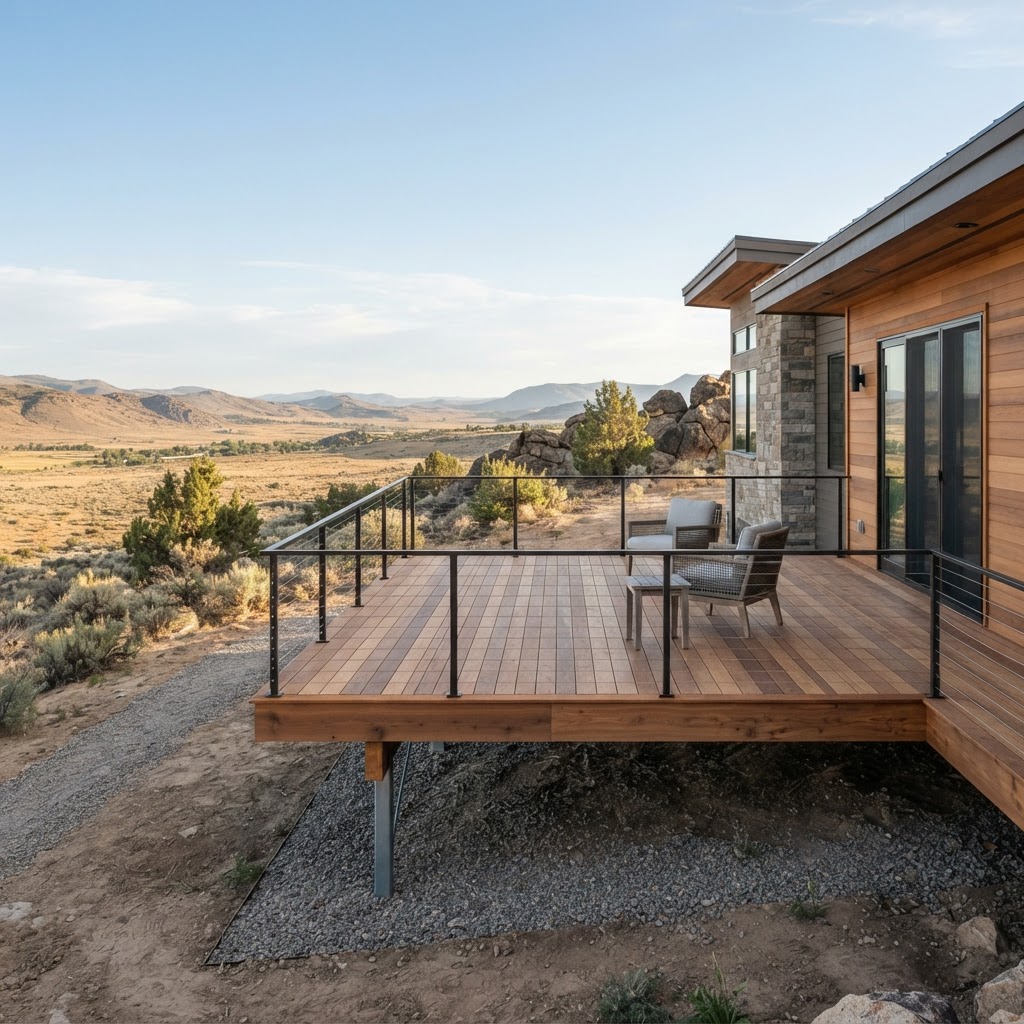
This article is a document-checking guide, not engineering advice, legal interpretation or certification. No product shown in the illustrative image has been independently verified or endorsed for your project. Obtain final acceptance for the actual site and assembly.
Project specification checklist
- Project jurisdiction, applicable rules and scope confirmed
- Exact manufacturer, product, dimensions and treatment/coating
- Current listing or documented code-compliance path
- Complete report conditions, adjacent-wall details and installation instructions
- Approved support, connection, fastening and maintenance details
- Written substitution approval and documents retained with the order
Frequently Asked Questions
Sources and scope
Sources consulted November 5, 2026. Manufacturer guidance applies to its named products; local requirements and documents can change. This guide is not a site-specific design, product certification or live stock/price statement.
Continue planning
Prepare a comparable material request
Use the checklist to describe the exact product and assembly. Sourcing requests are subject to human review of specification fit, service area, current availability and permission to respond; supplier matching and quotes are not guaranteed.
Request a sourcing review