Fiber Cement Siding Guide: Hardie Board and Alternatives (2026)
Fiber cement siding has become the premium siding choice for homeowners wanting superior durability and a genuine wood appearance without the maintenance. James Hardie dominates the market, but several quality alternatives exist. This guide covers product options, installation requirements, and the true cost of fiber cement ownership.
Key Takeaways
- Fiber cement siding has become the premium siding choice for homeowners wanting superior durability and a genuine wood appearance without the maintenance.
- James Hardie dominates the market, but several quality alternatives exist.
- This guide covers product options, installation requirements, and the true cost of fiber cement ownership.
- Choose the HardieZone product formulated for your climate — HZ5 for freeze-thaw regions and HZ10 for hot-humid climates.
- ColorPlus factory finish costs more upfront but eliminates field painting labor and provides a superior, warranted finish.
Types Overview
HardiePlank lap siding is the best-selling fiber cement product, available in smooth and wood-grain textures. HardieShingle mimics cedar shingle in staggered and straight-edge styles. HardiePanel vertical siding creates a modern board-and-batten look with HardieTrim battens. Artisan lap siding features a thicker profile for deeper shadow lines. ColorPlus factory finish provides a 15-year color warranty with baked-on paint. Primed fiber cement allows field painting in any color. Allura and Nichiha offer competitive fiber cement alternatives.
Selection Criteria
Choose the HardieZone product formulated for your climate — HZ5 for freeze-thaw regions and HZ10 for hot-humid climates. ColorPlus factory finish costs more upfront but eliminates field painting labor and provides a superior, warranted finish. Smooth texture has a modern look while wood grain provides traditional character. Consider the complete trim system for a cohesive appearance. Panel thickness is standard at 5/16 inch for lap and panel products.
Installation Guide
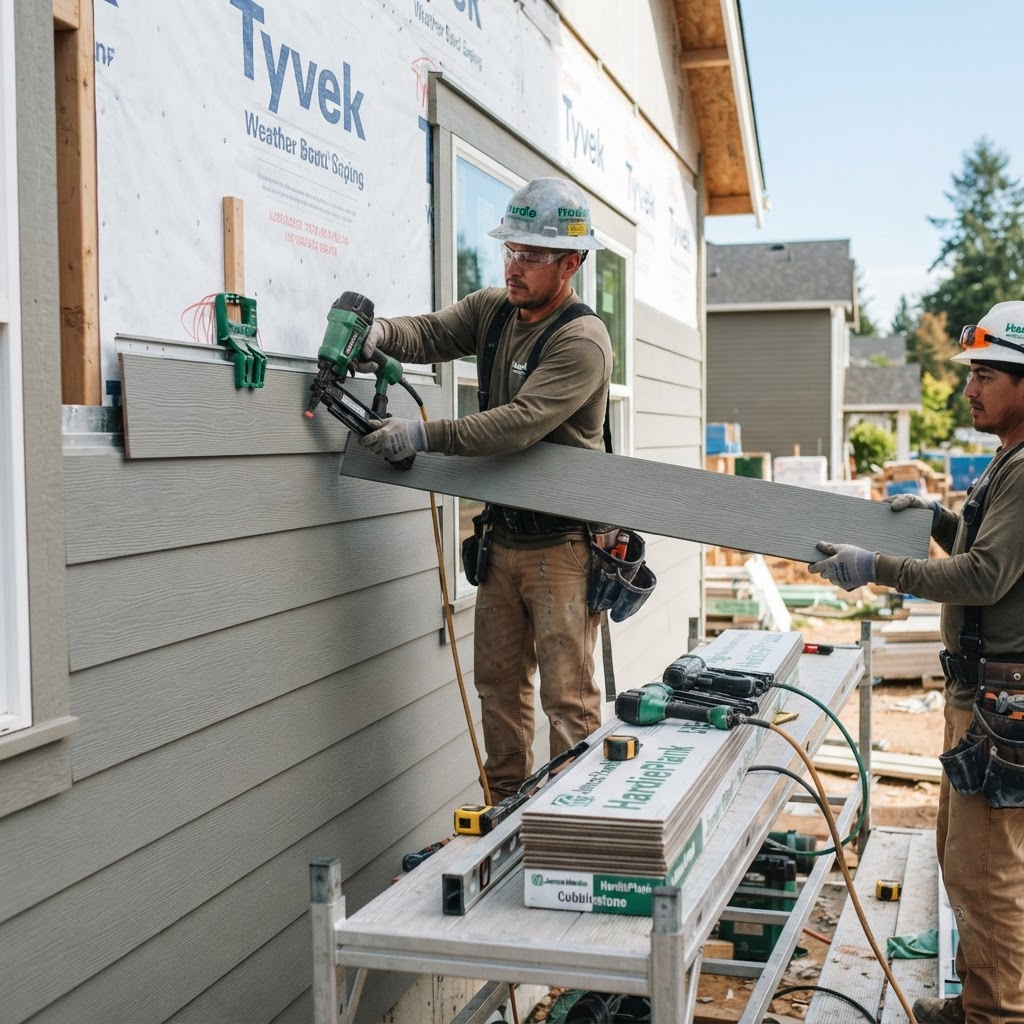
Fiber cement requires special tools — a fiber cement shear or circular saw with a polycrystalline diamond (PCD) blade (generates silica dust requiring respirator use). Install over WRB with minimum 1-1/4 inch overlap at horizontal joints. Blind-nail with corrosion-resistant siding nails 1 inch from the top edge into studs. Maintain 1/4-inch gap at butt joints filled with caulk. Prime all cut edges immediately. Follow Hardie's specific flashing and joint detail requirements.
Code Requirements
Fiber cement siding complies with ASTM C1186 Type A (non-structural). Must be installed over code-compliant WRB. Fastening requires corrosion-resistant nails into framing members — minimum 1-1/4 inch penetration into studs. Minimum 6-inch clearance above grade and 2-inch clearance above roofing surfaces. The material is non-combustible, meeting fire code requirements without restrictions.
Cost Breakdown
HardiePlank primed lap siding: $1.50-$2.50 per square foot material. HardiePlank ColorPlus: $3.00-$5.00 per square foot. HardieShingle: $4.00-$7.00 per square foot. HardieTrim: $1.50-$3.00 per linear foot. Professional installation: $5.00-$10.00 per square foot including materials. Complete fiber cement siding job on average home: $15,000-$35,000 installed. Field painting costs add $2,000-$5,000 if not using ColorPlus.
DIY vs Professional
Fiber cement installation is more demanding than vinyl due to the weight (about 2.5 lbs per square foot), dust generation, and precise fastening requirements. It requires two people to handle 12-foot planks. Professional installation is strongly recommended — Hardie's warranty requires installation per their specifications. Many warranty claims are denied due to improper installation by non-certified contractors.
Common Mistakes to Avoid
Not priming cut edges allows moisture absorption and premature failure. Using incorrect nails — only corrosion-resistant siding nails are approved. Over-driving or under-driving nails both create problems. Cutting without a PCD blade or fiber cement shear creates ragged edges and excessive silica dust. Not maintaining proper clearances from grade and roofing surfaces. Caulking butt joints with non-paintable caulk.