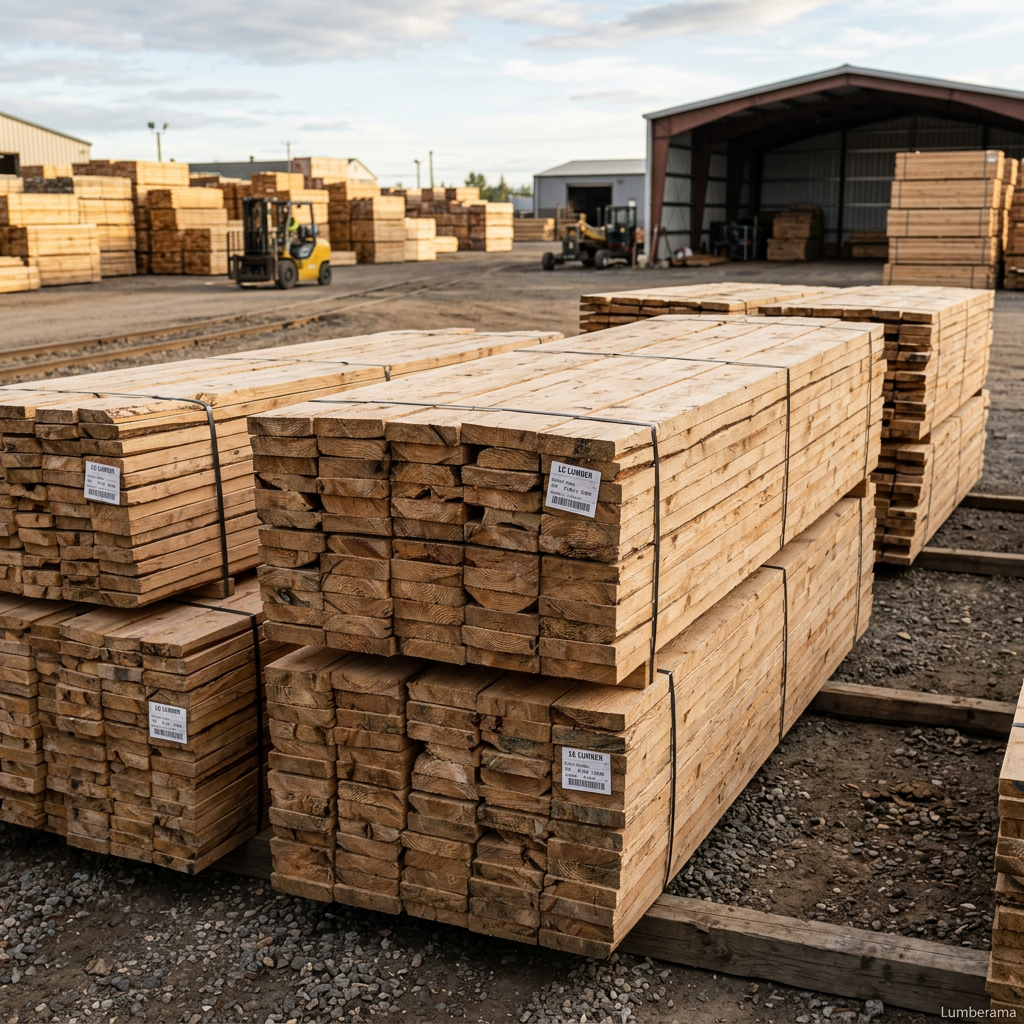
Sawn Lumber Basics
Understanding lumber types, sawing methods, moisture content, and quality factors to make informed purchasing decisions.
Types of Lumber
Lumber is categorized by the type of tree it comes from. Understanding these differences helps you choose the right material for your project.
Softwood
From coniferous (evergreen) trees
Examples:
Characteristics:
- Generally lighter and less dense
- Faster growing trees
- More affordable
- Easier to work with
- Common for framing and construction
Common Uses:
Framing, Decking, Siding, Fencing, General construction
Hardwood
From deciduous (leaf-shedding) trees
Examples:
Characteristics:
- Generally denser and harder
- Slower growing trees
- More expensive
- More durable
- Better for high-wear applications
Common Uses:
Flooring, Furniture, Cabinetry, Millwork, Interior trim
Tropical Hardwood
From tropical regions
Examples:
Characteristics:
- Extremely dense and durable
- Natural rot and insect resistance
- Premium pricing
- Requires pre-drilling
- Minimal maintenance
Common Uses:
Outdoor decking, Marine applications, High-end furniture, Exterior siding
Sawing Methods
How a log is cut affects the lumber's appearance, stability, and price. Each method has distinct advantages and trade-offs.
Plain Sawn (Flat Sawn)
Most common and economical method
Advantages
- • Most economical - least waste
- • Wider boards possible
- • Distinctive cathedral grain pattern
- • Faster to produce
Disadvantages
- • More prone to cupping and warping
- • Less dimensionally stable
- • More expansion/contraction across width
Best For:
General construction, framing, sheathing, cost-sensitive projects
Quarter Sawn
Log is cut perpendicular to growth rings
Advantages
- • Superior dimensional stability
- • Less warping and cupping
- • Wears more evenly
- • Distinctive ray fleck pattern (especially oak)
- • Better for moisture-prone areas
Disadvantages
- • More expensive - more waste
- • Narrower boards
- • Takes longer to produce
Best For:
Fine furniture, flooring, musical instruments, high-end millwork
Rift Sawn
Cut at a slight angle to growth rings
Advantages
- • Straight, consistent grain
- • Very stable
- • Minimal ray fleck
- • Clean, modern appearance
Disadvantages
- • Most expensive method
- • Highest waste
- • Limited availability
Best For:
High-end cabinetry, contemporary furniture, premium flooring
Moisture Content
Moisture content (MC) dramatically affects lumber's stability, workability, and suitability for different applications.
Important: Lumber will always try to reach equilibrium with its environment. Indoor lumber should be 6-8% MC, outdoor lumber 12-15% MC. Using lumber with incorrect MC will result in warping, cracking, and gaps.
Green Lumber
Freshly cut, not dried
Advantages:
- Less expensive
- Easier to work with power tools
- More flexible
Considerations:
- Will shrink and warp as it dries
- Not suitable for finished work
- Heavier to transport
Best Uses:
Rough framing, temporary structures, projects where shrinkage is acceptable
Air-Dried (AD)
Naturally dried outdoors
Advantages:
- More affordable than kiln-dried
- Retains some natural properties
- Environmentally friendly
Considerations:
- Takes months to years
- Less consistent moisture content
- May still shrink
Best Uses:
Outdoor projects, rustic furniture, barns, sheds
Kiln-Dried (KD)
Dried in controlled kiln
Advantages:
- Dimensionally stable
- Consistent moisture content
- Ready to use immediately
- Less warping
Considerations:
- More expensive
- Can be brittle
- May reabsorb moisture
Best Uses:
Interior construction, flooring, furniture, cabinetry, millwork
Kiln-Dried Heat Treated (KD-HT)
Kiln-dried with heat treatment
Advantages:
- Kills insects and larvae
- Meets international shipping standards
- Very stable
Considerations:
- Most expensive
- May darken wood slightly
Best Uses:
Export lumber, pest-sensitive applications, premium projects
Surfacing Options
Surfacing refers to how many sides of the lumber have been planed smooth. This affects dimensions, appearance, and price.
Rough Sawn
Straight from the sawmill, no planing
Texture:
Rough, textured surface with saw marks
Dimensions:
Full nominal dimensions
Common Uses:
Rustic projects, barns, fencing, will be planed on-site
S1S
Surfaced 1 Side
Texture:
One smooth face, three rough sides
Dimensions:
Slightly under nominal on surfaced side
Common Uses:
Projects where only one side is visible
S2S
Surfaced 2 Sides
Texture:
Two opposite faces smooth, edges rough
Dimensions:
Reduced thickness, full width
Common Uses:
Shelving, where edges will be hidden
S3S
Surfaced 3 Sides
Texture:
Two faces and one edge smooth
Dimensions:
Reduced thickness and one edge
Common Uses:
Specialized applications
S4S
Surfaced 4 Sides
Texture:
All four sides smooth and square
Dimensions:
Actual dimensions (smaller than nominal)
Common Uses:
Most common for construction, ready to use
Remember: S4S lumber has smaller actual dimensions than nominal dimensions. A 2x4 S4S is actually 1.5" × 3.5". Rough sawn lumber is closer to full nominal size.
Common Defects & Quality Issues
Understanding lumber defects helps you assess quality, select appropriate grades, and avoid problems in your projects.
Knots
Where branches grew from the trunk
Impact:
Can weaken structural integrity, affect appearance
Grading Factor:
Size, number, and tightness affect grade
Checks & Splits
Cracks along the grain
Impact:
Reduce strength, allow moisture entry
Grading Factor:
Length and depth affect grade
Wane
Bark or missing wood on edge/corner
Impact:
Reduces usable width, affects appearance
Grading Factor:
Amount of wane affects grade
Cupping
Board curves across its width
Impact:
Makes installation difficult, gaps in decking
Grading Factor:
Severity affects usability
Bowing
Board curves along its length
Impact:
Difficult to install flat, structural issues
Grading Factor:
Severity affects grade
Twisting
Board twists along its length
Impact:
Very difficult to install, often unusable
Grading Factor:
Severe twist = lower grade
Key Takeaways
For Structural Projects
- Softwood is typically most economical
- Plain sawn is standard for framing
- KD or KD-HT for dimensional stability
- S4S for ready-to-use convenience
- Grade based on strength requirements
For Appearance Projects
- Hardwood for durability and beauty
- Quarter or rift sawn for stability
- KD to proper MC for environment
- S4S for finished surfaces
- Higher grade for fewer defects
For Outdoor Projects
- Tropical hardwood for maximum durability
- Cedar/Redwood for natural resistance
- Pressure treated for economy
- 12-15% MC for outdoor equilibrium
- Consider maintenance requirements
Budget Considerations
- Plain sawn is most economical
- Green lumber costs less but requires drying
- Rough sawn saves money if you can mill
- Lower grades acceptable for hidden work
- Balance cost with project requirements
Pro Tip: Always inspect lumber before purchasing. Some defects are acceptable depending on your project. Structural lumber prioritizes strength, while appearance lumber prioritizes looks. Know your project requirements.