Wood Countertops
2026 Wood Countertops Buying Guide for Kitchens & Islands (2026)
Reviewed by Lumberama's Buying Guides Team
|Last updated May 25, 2026Wood countertops bring natural warmth and character that stone and laminate cannot replicate. Whether you want a full kitchen counter, a statement island top, or a bathroom vanity surface, the right species and finish make the difference between a showpiece and a maintenance headache. This guide covers construction styles, wood selection, and sealing strategies for lasting beauty.
Key Takeaways
- Wood countertops bring natural warmth and character that stone and laminate cannot replicate.
- Whether you want a full kitchen counter, a statement island top, or a bathroom vanity surface, the right species and finish make the difference between a showpiece and a maintenance headache.
- This guide covers construction styles, wood selection, and sealing strategies for lasting beauty.
- Construction method: Edge-grain, face-grain, or end-grain (butcher block)
- Species hardness and porosity: Closed-grain species resist moisture better
What to Look For
- Construction method: Edge-grain, face-grain, or end-grain (butcher block)
- Species hardness and porosity: Closed-grain species resist moisture better
- Finish type: Food-safe oil, conversion varnish, or waterproof hard-wax oil
- Thickness: 1-1/2" standard; 2"–3" for statement islands
- Certification: Look for FSC-certified or sustainably sourced wood
Species Comparison
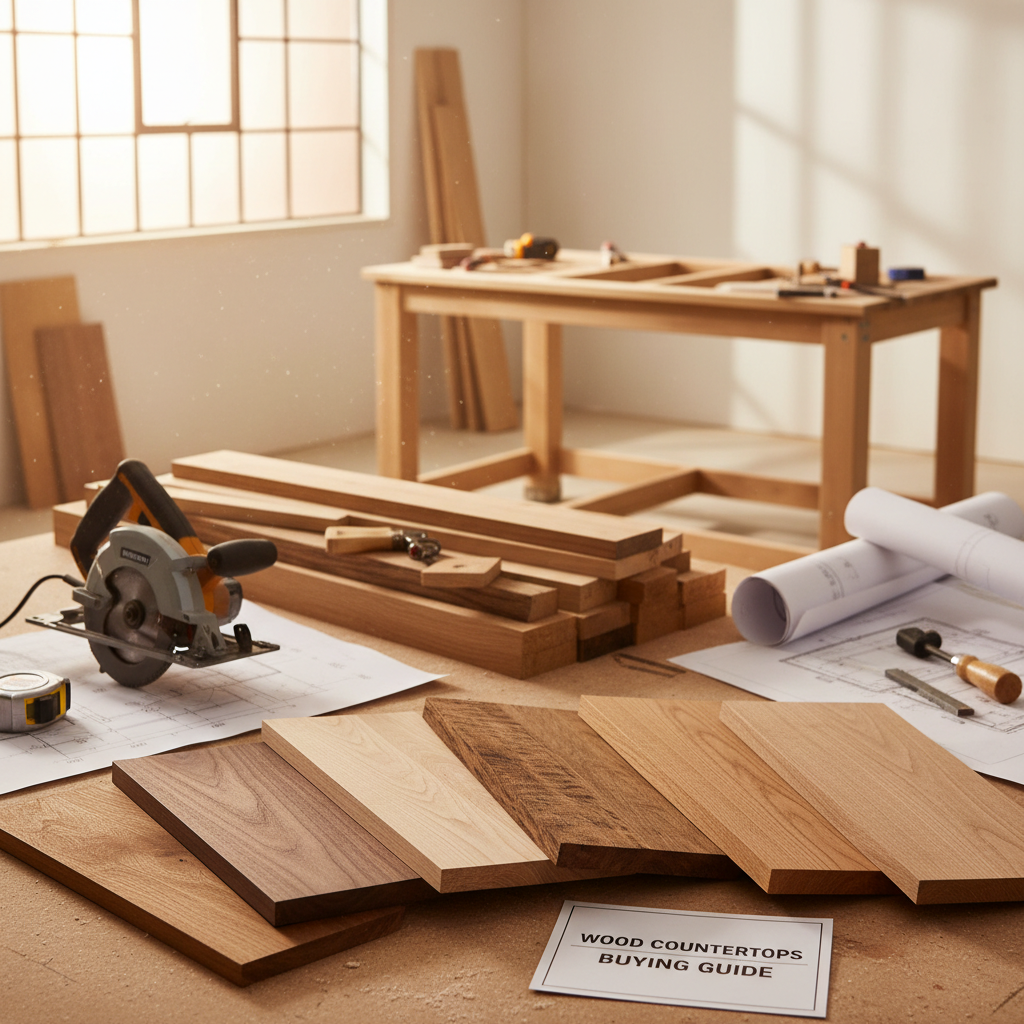
Hard maple is the top choice — tight grain, light color, and excellent food safety. White oak offers a warm, modern aesthetic with good water resistance thanks to its tyloses. Walnut delivers dark, rich tones and is softer but prized for islands and accent counters. Cherry darkens beautifully over time. For high-moisture areas, teak provides natural oil content and exceptional water resistance. Avoid red oak for countertops due to its open pores.
Size Guide
Standard countertop depth: 25" (with overhang on base cabinets). Island tops: 36"–48" deep. Thickness: 1-1/2" is standard; 1-3/4" and 2" available for premium look. Lengths up to 12 ft are common; longer runs may require a glue-up seam. Custom sizes are available from most fabricators.
Grade Guide
FAS (First and Seconds) grade delivers the clearest, most uniform boards for countertops. Select grade is acceptable with minimal character. Character or rustic grades include knots and color variation — popular for farmhouse aesthetics. For butcher block, look for kiln-dried stock at 6–8% moisture content with food-grade edge glue.
Budget Breakdown
Budget: Birch or beech edge-grain countertops at $30–$50 per sq ft installed. Mid-range: Hard maple or white oak at $60–$100 per sq ft. Premium: Walnut, cherry, or teak at $100–$175 per sq ft. End-grain butcher block commands a 30–50% premium over edge-grain in the same species.
Common Mistakes to Avoid
- Using polyurethane near food-prep areas — it chips and is not food-safe when damaged
- Placing wood counters directly next to a sink undermount without proper sealing
- Choosing a species with open pores (red oak, ash) that trap moisture and bacteria
- Neglecting regular oiling — mineral oil or hard-wax oil should be reapplied every 1–3 months
- Not allowing for wood movement by rigidly fastening the countertop
Pre-Purchase Checklist
- Select a closed-grain hardwood species suited to your use case
- Decide on edge-grain, face-grain, or end-grain construction
- Choose a food-safe finish for prep areas
- Confirm countertop depth matches cabinet layout with overhang
- Plan for wood expansion — use slotted mounting clips
- Budget for ongoing maintenance supplies (mineral oil, wax)