Stair Parts & Treads
Your 2026 Guide to Buying Stair Parts & Wood Treads (2026)
Stairs are one of the most visible and heavily used features in any home, making material selection critical for both appearance and safety. From treads and risers to newel posts and handrails, every component must meet building code and withstand decades of foot traffic. This guide helps you navigate species choices, dimensions, and finishing options for a staircase that performs and impresses.
Key Takeaways
- Stairs are one of the most visible and heavily used features in any home, making material selection critical for both appearance and safety.
- From treads and risers to newel posts and handrails, every component must meet building code and withstand decades of foot traffic.
- This guide helps you navigate species choices, dimensions, and finishing options for a staircase that performs and impresses.
- Tread thickness: 1" minimum for residential, 1-1/2" for open-stringer designs
- Species hardness: Janka rating above 1000 for high-traffic stairs
What to Look For
- Tread thickness: 1" minimum for residential, 1-1/2" for open-stringer designs
- Species hardness: Janka rating above 1000 for high-traffic stairs
- Bullnose profile: Square, half-round, or full-round nosing
- Newel and baluster style: Match your architectural theme (colonial, craftsman, modern)
- Code compliance: Tread depth, riser height, and handrail graspability per IRC
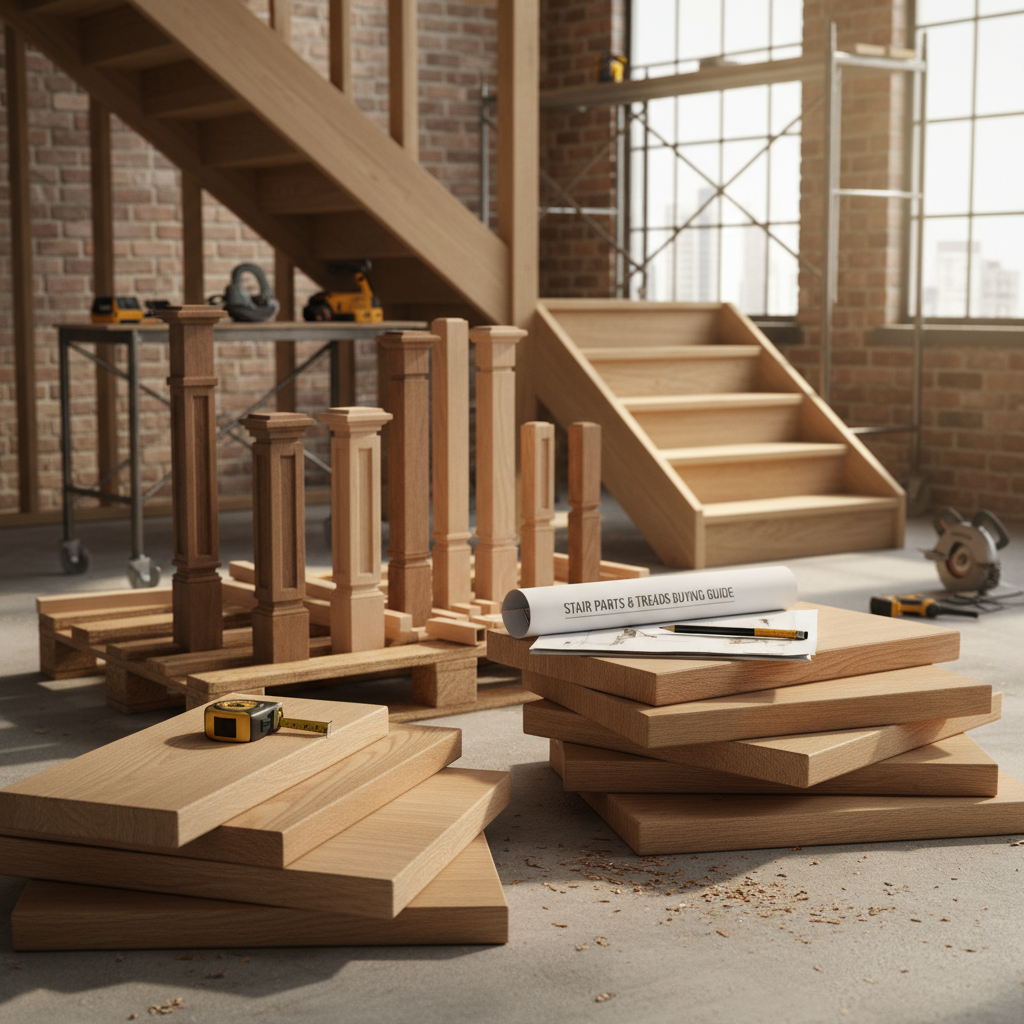
Species Comparison
Red oak is the industry standard — affordable, readily available, and takes stain well. White oak offers a tighter grain and better water resistance. Hard maple provides a clean, contemporary look with excellent durability. Hickory delivers rustic character with the highest Janka hardness among domestic species. For exotic options, Brazilian cherry (jatoba) and santos mahogany offer extreme hardness and rich color.
Size Guide
Standard treads: 36", 42", 48", and 60" lengths; 10-1/2" to 11-1/2" depth; 1" to 1-1/2" thick. Risers: 36"–60" long, 7-1/2" tall, 1/2" to 3/4" thick. Newel posts: 3-1/2" square, 48"–62" tall. Balusters: 1-1/4" square or 1-5/16" round, 31"–42" long. Handrails: 6' to 16' lengths in standard profiles.
Grade Guide
Select grade treads have minimal knots and consistent color — ideal for stain-grade staircases. #1 Common (character grade) includes small knots and color variation for a rustic look at lower cost. Paint-grade parts use finger-jointed or poplar stock that takes primer and paint well. Stair treads should be kiln-dried to 6–8% moisture content to prevent cupping and cracking.
Budget Breakdown
Budget: Paint-grade poplar or finger-jointed treads at $20–$40 per tread. Mid-range: Red oak select-grade treads at $50–$90 each. Premium: White oak, hard maple, or exotic hardwood treads at $100–$200+ each. Full balustrade systems (newels, balusters, handrail) typically add $500–$2,000 per flight depending on species and style.
Common Mistakes to Avoid
- Choosing a softwood species for treads — pine dents easily under foot traffic
- Not verifying local code requirements for riser height and tread depth before ordering
- Skipping proper sanding between finish coats, causing peeling on high-wear surfaces
- Ordering treads without confirming exact stringer width — standard sizes don't fit every staircase
- Mixing species between treads and trim, which stain differently
Pre-Purchase Checklist
- Measure stringer width and stair opening precisely
- Confirm tread nosing projection meets code (typically 3/4" to 1-1/4")
- Choose species with Janka hardness suited to traffic level
- Decide stain-grade vs. paint-grade before ordering
- Order 10% extra balusters for cuts and breakage
- Verify handrail profile is graspable per building code
Frequently Asked Questions
Pine is a softwood and dents easily. It works for paint-grade stairs with low traffic but is not recommended for stain-grade or high-traffic applications.
A return tread (also called mitered return) wraps the nosing around the open side of the stair for a finished look on open-stringer staircases.
Order the same species and mill a matching nosing profile. Have your floor finisher sand and finish treads and floors together for a seamless color match.
Prefinished treads save time but can be harder to color-match to railings and trim. Site-finished treads give more control over the final look.