Reclaimed
Reclaimed Lumber Buying Guide: History, Character, and Quality (2026)
Reclaimed lumber carries the story of its previous life — from century-old barn beams to industrial warehouse flooring, each piece has a patina and character that new wood simply cannot match. Beyond aesthetics, reclaimed wood is an environmentally responsible choice that keeps valuable material out of landfills. This guide shows you how to buy reclaimed lumber wisely.
Key Takeaways
- Reclaimed lumber carries the story of its previous life — from century-old barn beams to industrial warehouse flooring, each piece has a patina and character that new wood simply cannot match.
- Beyond aesthetics, reclaimed wood is an environmentally responsible choice that keeps valuable material out of landfills.
- This guide shows you how to buy reclaimed lumber wisely.
- Source and provenance — reputable dealers document where the wood was salvaged and what species it is.
- Hidden hardware — nails, screws, staples, and even barbed wire can lurk inside reclaimed boards.
What to Look For
- Source and provenance — reputable dealers document where the wood was salvaged and what species it is.
- Hidden hardware — nails, screws, staples, and even barbed wire can lurk inside reclaimed boards. Metal detection is essential.
- Lead paint and chemical exposure — wood from painted structures or industrial settings may contain hazardous materials.
- Moisture content — reclaimed lumber varies widely; verify MC is appropriate for your application.
- Structural integrity — check for excessive rot, insect damage, and cross-grain cracking.
- Dimensional accuracy — reclaimed lumber often comes in non-standard sizes and irregular thicknesses.
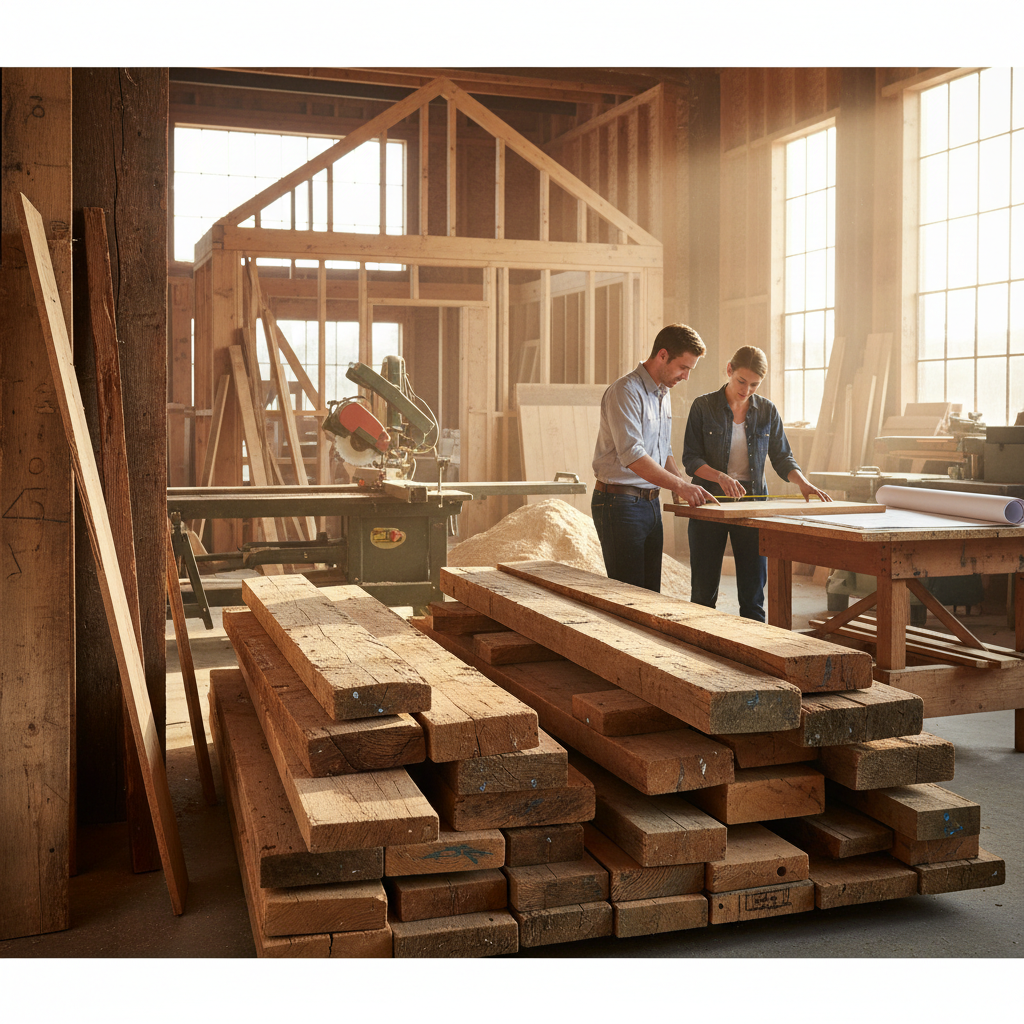
Species Comparison
Reclaimed heart pine: Dense old-growth longleaf pine with tight grain. Stunning for flooring and paneling. Premium pricing.
Reclaimed white oak: Extremely durable hardwood from old barns and warehouses. Excellent for flooring, furniture, and timbers.
Reclaimed chestnut: Rare species (extinct standing timber due to blight). Warm brown tones with worm holes. Highly sought after.
Reclaimed Douglas fir: Salvaged from old factories and warehouses. Beautiful vertical grain in old-growth specimens.
Reclaimed barn wood (mixed species): Weathered surface with silver-gray patina. Popular for accent walls and rustic decor.
Size Guide
Barn siding boards (3/4" to 1"): Accent walls, paneling, and craft projects. Varying widths from 4" to 12".
Reclaimed flooring (3/4"): Re-milled to standard flooring dimensions with tongue-and-groove. Common widths 3" to 8".
Reclaimed timbers (6x6 to 12x12): Mantels, decorative beams, post-and-beam construction.
Reclaimed planks (2" thick): Table tops, benches, and shelving.
Note: Dimensions may not match modern standards. Reclaimed 2x4s might actually be 2" x 4" (vs. modern 1.5" x 3.5").
Grade Guide
Select/Premium: Cleanest faces, fewest nail holes, minimal checking. Best for flooring and fine furniture.
Standard/Character: Moderate nail holes, surface checking, and patina. Good for accent walls and rustic furniture.
Rustic/Weathered: Maximum character — deep patina, significant nail holes, checking, and natural aging. Best for accent walls and decorative use.
Structural: Evaluated for structural integrity regardless of appearance. Required for load-bearing applications.
Budget Breakdown
Barn siding (as-is): $4–$8 per sq ft.
Reclaimed flooring (re-milled): $8–$15 per sq ft.
Reclaimed heart pine flooring: $12–$20 per sq ft.
Reclaimed chestnut: $15–$30 per board foot.
Reclaimed timbers: $8–$20 per linear foot depending on size and species.
De-nailing and milling services add $1–$4 per board foot to raw material cost.
Common Mistakes to Avoid
- Not scanning for metal — a hidden nail can destroy expensive saw blades and create safety hazards.
- Assuming reclaimed wood is ready to use as-is — most reclaimed lumber needs cleaning, de-nailing, and re-milling.
- Skipping lead paint testing on painted reclaimed wood — lead paint was common before 1978.
- Expecting uniform dimensions — reclaimed lumber varies in thickness, width, and length. Plan for waste.
- Underestimating the cost — quality reclaimed lumber is often more expensive than new premium lumber due to labor-intensive processing.
Pre-Purchase Checklist
- Source from a reputable dealer with documented provenance
- Scan every board with a metal detector before milling
- Test painted wood for lead if the source building pre-dates 1978
- Verify moisture content matches your application requirements
- Inspect for active insect infestation (fresh sawdust is a red flag)
- Confirm your tools can handle old, dense, nail-scarred wood
- Order 20-25% extra to account for defects, metal damage, and irregular sizing
Frequently Asked Questions
Yes. It diverts wood from landfills, preserves irreplaceable old-growth character, and eliminates the environmental impact of harvesting new trees.
Generally yes, but test any painted wood for lead and avoid wood from industrial facilities where chemical contamination is possible.
The labor cost of careful demolition, de-nailing, metal detection, cleaning, and re-milling is significant. The material itself is also irreplaceable old-growth wood.
Yes, when properly graded by a qualified inspector. Many reclaimed timbers are denser and stronger than modern lumber because they're old-growth.