Pressure-Treated
Pressure-Treated Lumber: Ratings, Uses, and What to Buy (2026)
Pressure-treated lumber is the workhorse of outdoor construction, providing affordable rot and insect protection for everything from deck framing to fence posts. But not all treated lumber is the same — different retention levels serve different exposures. This guide explains the treatment ratings and helps you choose the right product for every application.
Key Takeaways
- Pressure-treated lumber is the workhorse of outdoor construction, providing affordable rot and insect protection for everything from deck framing to fence posts.
- But not all treated lumber is the same — different retention levels serve different exposures.
- This guide explains the treatment ratings and helps you choose the right product for every application.
- Use Category (UC) rating — this tells you exactly what exposure the treatment protects against.
- Treatment chemical — modern treatments (MCA, ACQ, CA-C) are all copper-based and safe for residential use.
What to Look For
- Use Category (UC) rating — this tells you exactly what exposure the treatment protects against.
- Treatment chemical — modern treatments (MCA, ACQ, CA-C) are all copper-based and safe for residential use.
- Kiln-dried after treatment (KDAT) — preferred for decking and visible applications; less warping and ready for finish.
- End-tag and stamp — every piece must have a legible treatment stamp for code compliance.
- Species base — SYP accepts treatment deeper than SPF; choose SYP for ground-contact applications.
- Incising — western species are incised (small slits) to improve chemical penetration; affects appearance.
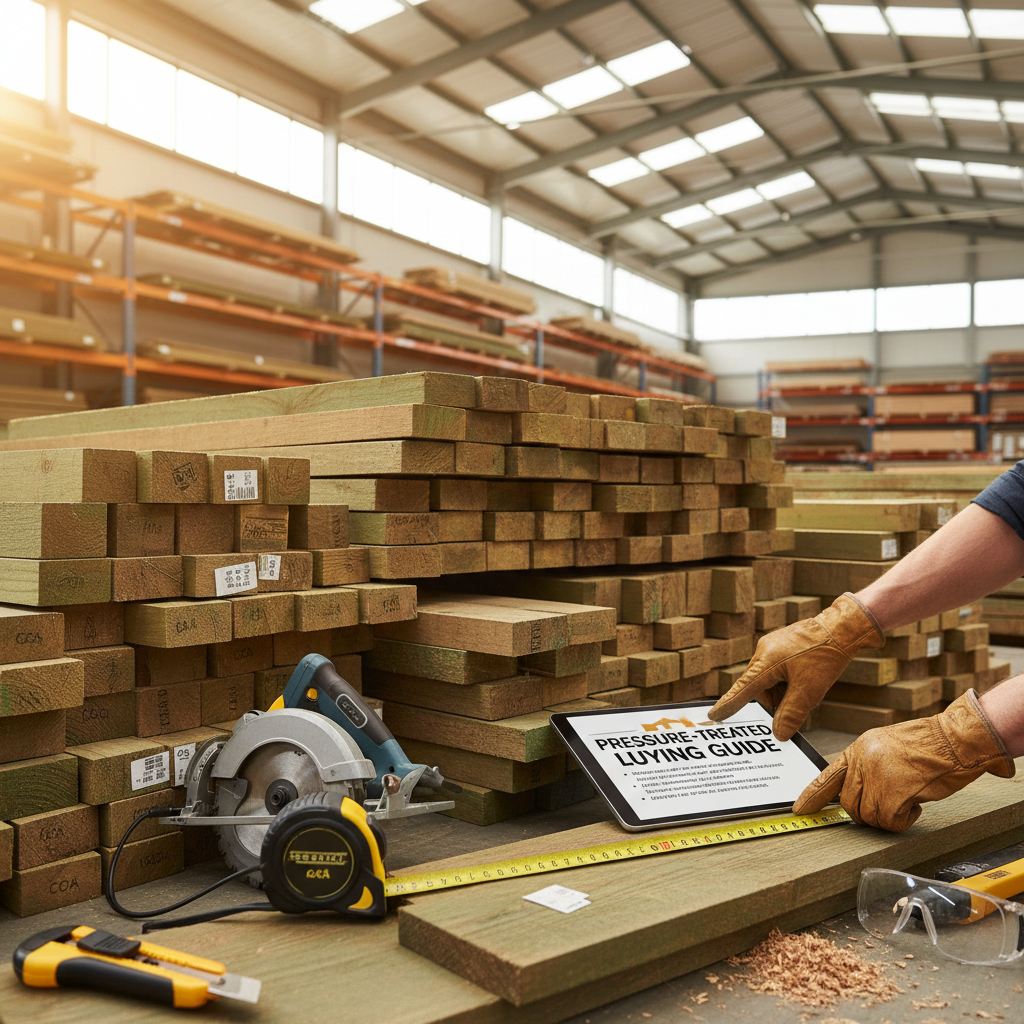
Species Comparison
Southern yellow pine (SYP): Best treatment penetration due to open cell structure. Gold standard for treated lumber in the eastern US.
Hem-fir: Requires incising for treatment. Lighter weight than SYP. Common in western regions.
Spruce-pine-fir (SPF): Also requires incising. Economical but lower treatment retention in heartwood.
Douglas fir: Dense and strong but treats unevenly. Incising helps but doesn't match SYP penetration.
Ponderosa pine: Treats reasonably well. Regional availability in the western US.
Size Guide
2x4 and 2x6: Deck rails, fence rails, light framing near grade.
2x8 through 2x12: Deck joists, beams, stair stringers, headers.
4x4: Fence posts, deck rail posts (above-ground use).
4x6 and 6x6: Deck support posts, pergola posts, retaining wall members.
5/4x6: Treated deck boards — the standard for residential deck surfaces.
Plywood (3/4" treated): Rim boards, subfloor near grade, exterior sheathing.
Grade Guide
UC3A (Above Ground, Coated): Decking, railings, and trim that won't contact ground or trap water. Requires a water-repellent finish.
UC3B (Above Ground, Uncoated): Exposed to weather without finish. Joists, structural members above ground.
UC4A (Ground Contact, General): Posts and lumber in direct soil contact in non-critical applications.
UC4B (Ground Contact, Heavy Duty): Critical structural ground contact — support posts, permanent wood foundations.
UC4C (Ground Contact, Extreme): Fresh-water immersion, salt-water splash zones.
Budget Breakdown
Treated 2x4x8: $4–$7 each.
Treated 2x6x12: $8–$14 each.
Treated 5/4x6x12 deck boards: $8–$12 each.
Treated 4x4x8 posts: $10–$16 each.
Treated 6x6x12 posts: $30–$50 each.
KDAT premium: Add 15-25% over green treated lumber.
UC4B ground-contact premium: Add 10-20% over UC3A/UC3B rated lumber.
Common Mistakes to Avoid
- Using UC3A lumber for ground contact — it will rot because the chemical retention is too low.
- Staining green (wet) treated lumber immediately — wait 2-4 weeks for KDAT or let green lumber dry.
- Cutting treated lumber and not applying end-cut preservative — exposed untreated wood is vulnerable.
- Using galvanized fasteners with ACQ treatment — ACQ corrodes standard galvanized steel. Use hot-dipped galvanized or stainless.
- Burning treated lumber scraps — treated wood releases toxic compounds when burned.
Pre-Purchase Checklist
- Match the UC rating to your specific application
- Verify the treatment stamp is legible on every piece
- Choose KDAT if finishing within 2 weeks of installation
- Confirm fastener compatibility (hot-dip galvanized or stainless steel)
- Purchase end-cut preservative for field cuts
- Inspect for excessive checking, splitting, and warping
- Plan proper disposal — treated lumber cannot go in regular trash or be burned
Frequently Asked Questions
Modern copper-based treatments (MCA, ACQ, CA-C) are considered safe by the EPA for garden use. The old CCA (arsenic) treatment was phased out for residential use in 2003.
Above-ground treated lumber lasts 20-30 years. Ground-contact rated lumber (UC4A/UC4B) lasts 15-25 years in soil.
Yes, once it's dry. KDAT lumber can be finished immediately. Green treated lumber needs 2-4 weeks of drying time.
Use hot-dipped galvanized (minimum G-185 coating), stainless steel, or approved polymer-coated fasteners. Standard zinc-plated fasteners will corrode.