Framing
How to Buy Framing Lumber: Species, Grades, and Sizes Explained (2026)
Framing lumber is the structural backbone of every building project, from house walls to garage additions. Getting the right species, grade, and dimensions ensures your structure meets building codes and stands strong for decades. This guide demystifies framing lumber specifications so you buy exactly what your project demands.
Key Takeaways
- Framing lumber is the structural backbone of every building project, from house walls to garage additions.
- Getting the right species, grade, and dimensions ensures your structure meets building codes and stands strong for decades.
- This guide demystifies framing lumber specifications so you buy exactly what your project demands.
- Structural grade stamp — every framing member must carry an approved grade stamp for code compliance.
- Species group and strength rating — different species groups (SPF, SYP, Doug fir) have different load capacities.
What to Look For
- Structural grade stamp — every framing member must carry an approved grade stamp for code compliance.
- Species group and strength rating — different species groups (SPF, SYP, Doug fir) have different load capacities.
- Moisture content — look for KD (kiln-dried) or S-DRY (surfaced dry, under 19% MC) stamps.
- Straightness — sight down every board for bow, crook, and twist before loading.
- Span requirements — your plans dictate minimum lumber size based on load and span tables.
- Treated vs. untreated — any wood contacting concrete or within 6" of grade needs pressure treatment.
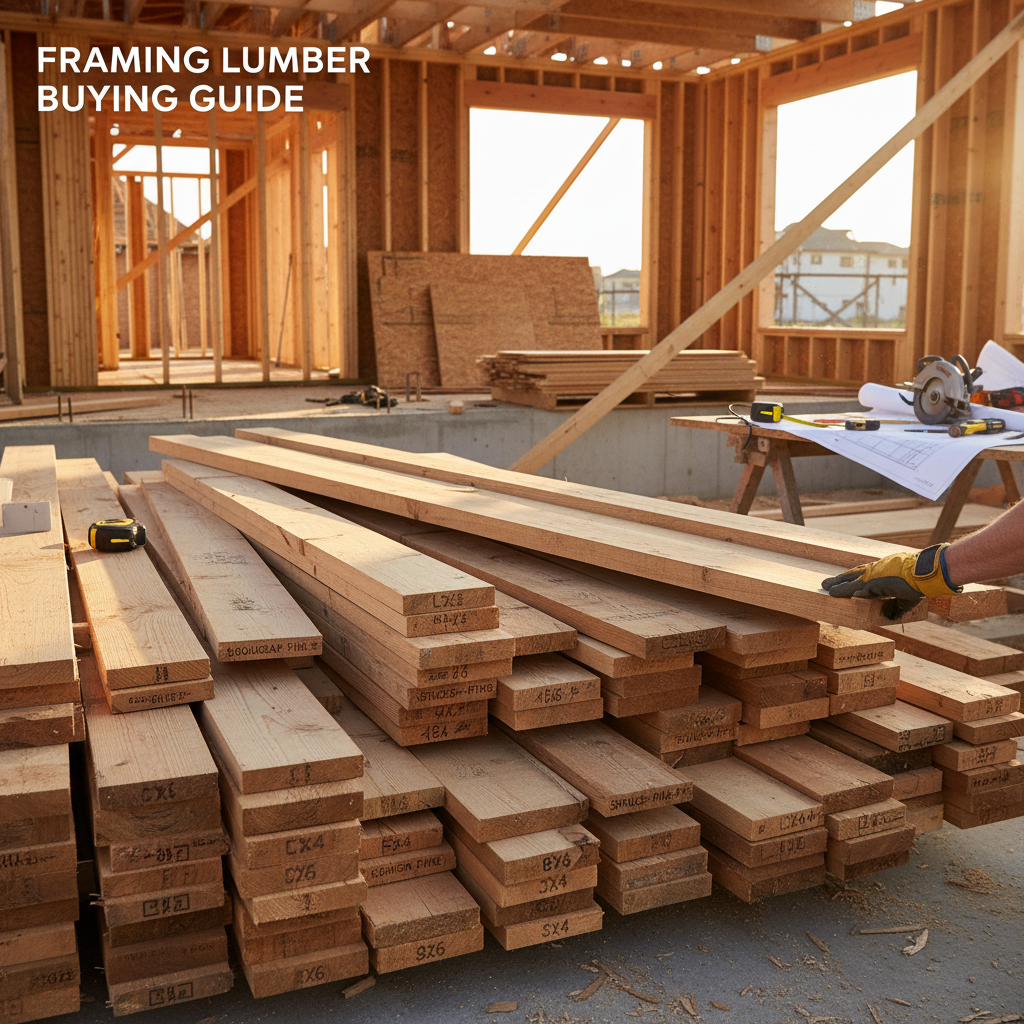
Species Comparison
Southern yellow pine (SYP): Strongest common framing species. Dense, holds fasteners well. Preferred for engineered applications.
Douglas fir-larch (DF-L): Excellent strength-to-weight ratio. Standard framing species in western regions.
Spruce-pine-fir (SPF): Lightweight and economical. Dominates the Canadian and northern US market.
Hem-fir: Good all-around framing species. Moderate strength and weight.
Ponderosa pine: Lighter and weaker than SYP. Suitable for non-load-bearing partitions.
Size Guide
2x4 (1.5" x 3.5"): Interior partition walls, non-load-bearing walls, collar ties.
2x6 (1.5" x 5.5"): Exterior walls (allows more insulation), floor joists on short spans, rafters.
2x8 (1.5" x 7.25"): Floor joists, rafters, headers on moderate spans.
2x10 (1.5" x 9.25"): Floor joists and rafters on longer spans, built-up headers.
2x12 (1.5" x 11.25"): Long-span floor joists, ridge boards, stair stringers.
Standard lengths: 8', 10', 12', 14', 16', 20'. Lengths over 16' carry premium pricing.
Grade Guide
Select Structural: Highest strength grade. Used for critical structural members where maximum load capacity is required.
#1: High quality with few defects. Excellent for visible framing and high-load applications.
#2: Standard structural grade for most residential framing. Most common grade sold at lumber yards.
#3/Stud: Lower strength, suitable for non-load-bearing walls and temporary structures.
Utility: Not for structural use. Blocking, bracing, and non-structural applications only.
Budget Breakdown
SPF 2x4 studs (8'): $3–$6 each.
SYP 2x6 (8'): $5–$9 each.
Douglas fir 2x10 (12'): $15–$25 each.
2x12 (16'): $25–$45 each depending on species.
Prices fluctuate significantly with commodity lumber markets.
Buying in unit quantities (bundles) typically saves 10-20% over individual pieces.
Common Mistakes to Avoid
- Not checking grade stamps — unmarked lumber may not meet code and can fail inspection.
- Using construction-grade lumber for engineered spans — always match grade to your structural plans.
- Buying the cheapest species for load-bearing walls — check span tables for your specific species group.
- Storing framing lumber on bare ground — moisture wicking causes warping and staining.
- Not accounting for crowned boards — always install floor joists and rafters crown-side up.
Pre-Purchase Checklist
- Review structural plans for required species, grade, and dimensions
- Verify grade stamps are present on every piece
- Check moisture content stamp (KD or S-DRY preferred)
- Sight every board for straightness — reject excessive bow, crook, or twist
- Confirm treated lumber is specified where required by code
- Calculate quantities from your cut list and add 5-10% waste factor
- Arrange covered, elevated storage at the job site
Frequently Asked Questions
#2 grade is rated for structural use in any orientation. Stud grade is only rated for vertical (wall stud) use and cannot be used for joists or rafters.
Kiln-dried (KD-HT or S-DRY) is preferred because it's lighter, straighter, and less prone to shrinkage. Green lumber works but expect more movement as it dries.
Yes, but check span tables — SPF has lower allowable spans for the same size. You may need to upsize or reduce spacing.
Framing lumber is a commodity traded on futures markets. Prices respond to housing starts, mill capacity, tariffs, and transportation costs.