Butcher Block
Butcher Block Buying Guide: Countertops, Islands, and Workbenches (2026)
Butcher block brings natural warmth and functionality to kitchens, workshops, and craft rooms. Whether you want a food-prep surface you can cut on, a stunning countertop, or a heavy-duty workbench, the species, construction method, and finish make all the difference. This guide covers the options so you choose the right butcher block for your needs.
Key Takeaways
- Butcher block brings natural warmth and functionality to kitchens, workshops, and craft rooms.
- Whether you want a food-prep surface you can cut on, a stunning countertop, or a heavy-duty workbench, the species, construction method, and finish make all the difference.
- This guide covers the options so you choose the right butcher block for your needs.
- Construction type — edge grain, end grain, and face grain each have different performance characteristics.
- Species hardness — harder species resist knife marks better but are tougher on knife edges.
What to Look For
- Construction type — edge grain, end grain, and face grain each have different performance characteristics.
- Species hardness — harder species resist knife marks better but are tougher on knife edges.
- Food safety — not all finishes are food-safe; if you'll cut directly on the surface, finish matters.
- Thickness — thicker blocks provide more mass, better stability, and longer service life.
- Wood porosity — closed-grain species are more sanitary for food contact than open-pore species.
- Dimensional stability — butcher blocks in kitchens face moisture from above and below.
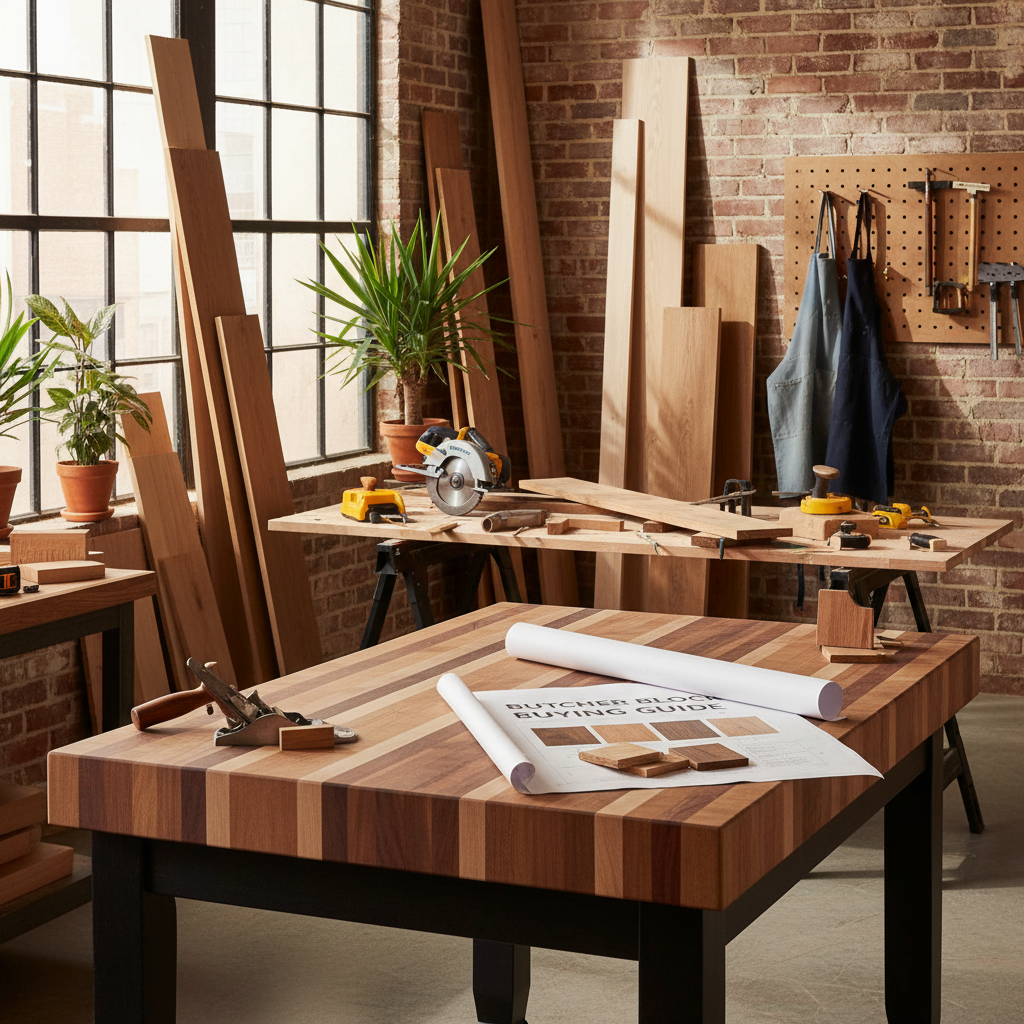
Species Comparison
Hard maple: The industry standard for butcher block. Closed grain, very hard (Janka 1450), light color. Best for food prep surfaces.
Walnut: Beautiful dark alternative to maple. Slightly softer (Janka 1010) but still excellent for countertops.
Cherry: Warm mid-tone that darkens with age. Good hardness for countertops. Less common for cutting surfaces.
White oak: Closed grain despite being ring-porous. Very durable. Modern farmhouse aesthetic.
Beech: Traditional European butcher block species. Hard, affordable, and proven for food-contact use.
Size Guide
1-1/2" thick: Standard countertop thickness. Adequate for edge-grain and face-grain construction.
2-1/4" to 3" thick: Premium countertop thickness. Better stability and more visual mass.
4" to 6" thick: Traditional end-grain butcher block for serious food prep. Heavy and extremely durable.
Standard widths: 25" and 36" (to fit standard counter depths). Custom widths available.
Standard lengths: 4', 6', 8', 10', and 12'. Longer pieces require more support.
Grade Guide
Edge grain: Strips glued face-to-face showing edge grain on the surface. Best balance of cost, durability, and appearance.
End grain: Cross-cut blocks arranged with end grain up. Most durable cutting surface — knife marks self-heal. Most expensive.
Face grain (wide plank): Wide boards showing face grain. Most dramatic grain display but least resistant to knife marks.
Select/Premium: Consistent color, minimal sapwood variation. Best for visible countertops.
Character/Rustic: Color variation, mineral streaks, small knots. Lower cost with more personality.
Budget Breakdown
Maple edge-grain countertop (25" x 8'): $300–$600.
Walnut edge-grain countertop (25" x 8'): $500–$1,000.
End-grain maple block (4" thick, 25" x 8'): $600–$1,200.
Custom countertops: $40–$100 per square foot installed.
DIY butcher block from lumber: $15–$30 per square foot in materials.
Professional installation: $200–$500 for templating, cutting, and mounting.
Common Mistakes to Avoid
- Using polyurethane on a food-prep cutting surface — it chips into food when cut. Use mineral oil or food-safe hardwax oil.
- Not supporting long countertop spans — butcher block needs support every 36" to prevent sagging.
- Placing butcher block next to a sink without proper sealing — water is the enemy of wood countertops.
- Choosing open-pore species (red oak, ash) for cutting surfaces — open pores trap bacteria. Use closed-grain species.
- Not planning for wood movement — butcher block expands and contracts across its width. Don't rigidly attach it.
Pre-Purchase Checklist
- Select construction type (edge, end, or face grain) based on your primary use
- Choose a closed-grain species if the surface will contact food
- Measure accurately including overhangs, sink cutouts, and appliance clearances
- Plan attachment method that allows for wood movement
- Select appropriate finish (mineral oil for cutting, polyurethane for display-only)
- Verify thickness is adequate for your span and support spacing
- Pre-finish all surfaces including undersides to control moisture absorption
Frequently Asked Questions
Mineral oil, butcher block oil (mineral oil + beeswax), and food-safe hardwax oils are all safe for surfaces where food is prepared and cut.
Oil monthly with mineral oil for the first year, then every 2-3 months. Clean with mild soap. Sand out deep scratches and re-oil. Avoid standing water.
Yes, with careful sealing. Apply multiple coats of finish to all edges and the sink cutout area. Consider waterproof sealant around the sink rim. Wipe up standing water promptly.
End grain is more durable for cutting and self-heals knife marks. Edge grain is more affordable, lighter, and easier to install. Choose based on whether you'll cut directly on the surface.