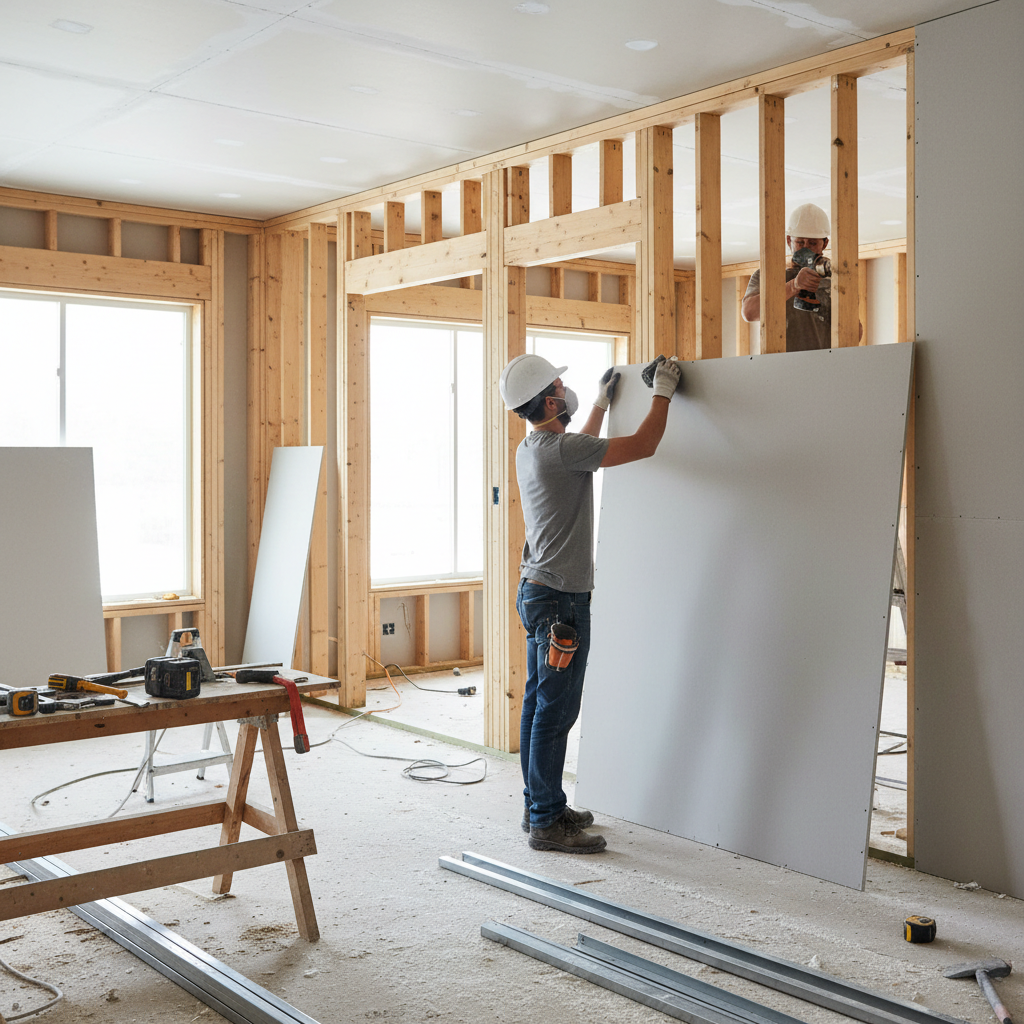
Drywall Buying and Installation Guide: Types, Sizes, and Finishing (2026)
Drywall is the standard wall and ceiling finish in virtually every modern home. Selecting the right type and thickness for each application ensures durability and code compliance. This guide covers all drywall types, hanging techniques, and finishing levels to help you achieve professional results.
Key Takeaways
- Drywall is the standard wall and ceiling finish in virtually every modern home.
- Selecting the right type and thickness for each application ensures durability and code compliance.
- This guide covers all drywall types, hanging techniques, and finishing levels to help you achieve professional results.
- Use 1/2-inch regular drywall for standard walls with 16-inch on-center framing.
- Choose 5/8-inch for ceilings to reduce sag, and it is required for 24-inch on-center framing.
Types Overview
Regular drywall (white face) is the standard choice for most interior walls and ceilings. Moisture-resistant drywall (green board) is designed for bathrooms, kitchens, and laundry rooms but not direct water exposure. Mold-resistant drywall (purple board) uses fiberglass facing for superior mold and moisture protection. Fire-rated Type X drywall (5/8 inch) provides 1-hour fire resistance for garage walls, furnace rooms, and between units. Type C drywall provides enhanced fire resistance. Abuse-resistant drywall has a reinforced core for high-traffic commercial and garage applications.
Selection Criteria
Use 1/2-inch regular drywall for standard walls with 16-inch on-center framing. Choose 5/8-inch for ceilings to reduce sag, and it is required for 24-inch on-center framing. Moisture-resistant or mold-resistant board is required in bathrooms and high-humidity areas. 5/8-inch Type X is required on garage walls and ceilings adjacent to living space. 4x8 sheets are standard; 4x12 sheets reduce joints on longer walls.
Installation Guide
Hang ceiling sheets first, then walls — top sheets before bottom. Stagger joints between rows and between wall and ceiling. Drive screws every 12 inches along edges and 16 inches in the field, keeping screws 3/8 inch from edges. Leave a 1/4-inch gap at the floor. Apply three coats of joint compound — tape coat, fill coat, and finish coat — sanding between coats. Use paper tape for inside corners and metal corner bead for outside corners.
Code Requirements
IRC requires 5/8-inch Type X drywall on the garage side of walls and ceilings between the garage and living space. Minimum 1/2-inch drywall on walls with 16-inch OC framing. Minimum 5/8-inch on ceilings with 24-inch OC framing. Moisture-resistant backing is required behind tile in wet areas. One-hour fire-rated assemblies require Type X per UL design listing.
Cost Breakdown
Regular 1/2-inch 4x8 sheet: $10-$15. Regular 5/8-inch 4x8 sheet: $13-$18. Moisture-resistant 1/2-inch: $14-$18. Type X 5/8-inch: $14-$19. Mold-resistant: $16-$22. Joint compound (5 gal): $12-$18. Paper tape: $3-$5 per roll. Professional hanging and finishing: $1.50-$3.00 per square foot. Average room (12x12): $200-$500 materials, $600-$1,200 installed.
DIY vs Professional
Hanging drywall is physically demanding but achievable for DIYers. Finishing (taping and mudding) is the skill-intensive part — expect the first few rooms to be a learning experience. Use a drywall lift for ceiling panels. Professional finishing is recommended for high-visibility areas like living rooms and kitchens. DIY finishing works well for garages, basements, and utility rooms.
Common Mistakes to Avoid
Butt joints (non-tapered ends) create visible ridges if not feathered out over a wide area. Overdriving screws breaks the paper face and loses holding power. Applying mud too thick causes cracking and extended dry times. Not back-blocking ceiling joints leads to visible cracking along seams. Using mesh tape without setting compound on flat joints results in cracking.