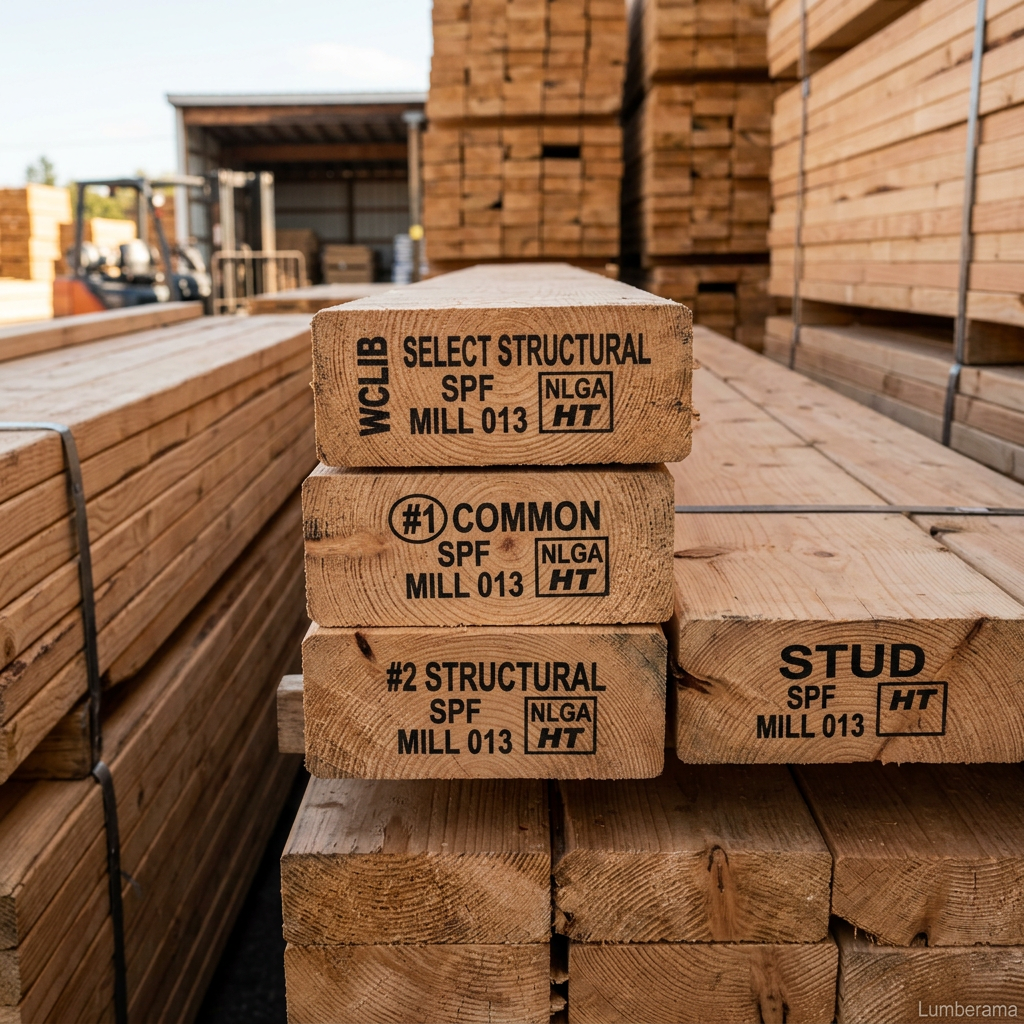
Lumber Grades
Complete reference guide to lumber grading standards for softwood, hardwood, and specialty lumber.
Understanding Lumber Grading
Lumber grading evaluates wood quality based on strength, appearance, and defects. Different grading systems apply to softwoods, hardwoods, and specialty species.
Important: Grading standards vary by species and intended use. Always specify the appropriate grade for your project requirements, whether structural strength or appearance is the priority.
Softwood Grades
Based on strength and appearance. Used for dimensional lumber in construction and framing applications.
Hardwood Grades
Based on percentage of clear face cuttings. Used for furniture, cabinetry, and fine woodworking.
Appearance Grades
Based on appearance and heartwood content. Used for naturally durable species like cedar and redwood.
Softwood Lumber Grades
Grading standards for dimensional lumber (pine, fir, spruce, hemlock) based on strength and appearance.
Select Structural
Highest grade for structural applications
Characteristics:
Minimal defects, high strength
Common Uses:
Critical structural members, exposed beams
No. 1 & Better
High-quality appearance and strength
Characteristics:
Few knots, tight grain
Common Uses:
Structural framing, visible applications
No. 2
Standard construction grade
Characteristics:
Some knots and defects allowed
Common Uses:
General framing, studs, joists
No. 3
Economy grade
Characteristics:
More knots and defects
Common Uses:
Non-structural, blocking, bracing
Stud
Specifically graded for wall framing
Characteristics:
Straight, suitable for vertical use
Common Uses:
Wall studs, vertical framing
Construction
Good strength and serviceability
Characteristics:
Moderate defects
Common Uses:
General construction, blocking
Standard
Suitable for general construction
Characteristics:
More defects than Construction
Common Uses:
Light framing, blocking
Utility
Lowest structural grade
Characteristics:
Significant defects
Common Uses:
Temporary bracing, crating
Hardwood Lumber Grades (NHLA)
National Hardwood Lumber Association grading standards based on the percentage of clear face cuttings.
| Grade | Description | Min. Length | Min. Width | Common Uses |
|---|---|---|---|---|
| FAS (Firsts and Seconds) | Highest grade - 83.3% clear face | 6 feet | 6 inches | Fine furniture, cabinetry, millwork |
| FAS 1-Face (F1F) | FAS on one face, No. 1 Common on reverse | 6 feet | 6 inches | Furniture, cabinetry (one visible side) |
| Select | Similar to FAS but smaller boards allowed | 4 feet | 4 inches | Furniture, millwork, shorter pieces |
| No. 1 Common | 66.7% clear face | 4 feet | 3 inches | Furniture parts, flooring, paneling |
| No. 2A Common | 50% clear face | 4 feet | 3 inches | Rustic furniture, flooring, paneling |
| No. 2B Common | 50% clear face (smaller pieces) | 3 feet | 3 inches | Rustic applications, crafts |
| No. 3A Common | 33.3% clear face | 3 feet | 3 inches | Economy furniture, pallets |
| No. 3B Common | 25% clear face | 2 feet | 2 inches | Industrial, pallets, crating |
Note: Hardwood grading focuses on the amount of clear (defect-free) wood that can be cut from a board, not structural strength. Higher grades yield more usable clear wood for fine woodworking.
Appearance Grades (Cedar, Redwood)
Grading standards for naturally durable softwoods based on appearance and heartwood content.
Clear All Heart
All heartwood, no knots
Characteristics:
Premium appearance, maximum durability
Common Uses:
High-end siding, decking, trim
Clear
Heartwood and sapwood, no knots
Characteristics:
Excellent appearance
Common Uses:
Siding, decking, trim, furniture
B Grade (B Heart)
Small tight knots allowed
Characteristics:
Good appearance, durable
Common Uses:
Siding, decking, fencing
C Grade (C Heart)
Larger knots and some defects
Characteristics:
Rustic appearance
Common Uses:
Fencing, general construction
D Grade
Knots, knotholes, and defects
Characteristics:
Economy grade
Common Uses:
Rough construction, backing
Lumber Grading Agencies
Several organizations establish and enforce lumber grading standards in North America.
NHLA
National Hardwood Lumber Association
Establishes grading standards for hardwood lumber. Focuses on yield of clear face cuttings for furniture and millwork applications.
WWPA
Western Wood Products Association
Grades western softwood species. Provides grading rules for dimensional lumber, boards, and timbers.
SPIB
Southern Pine Inspection Bureau
Grades southern pine lumber. Known for high-strength structural grades used in construction.
NELMA
Northeastern Lumber Manufacturers Association
Grades northeastern softwood species including spruce, pine, and fir.
Key Considerations
Grade Selection
Choose grade based on your needs:
- • Structural: Use appropriate grade for load requirements
- • Appearance: Higher grades for visible applications
- • Economy: Lower grades for hidden framing
- • Specialty: Consider certified or treated options
Grade Stamps
Understanding grade stamps:
- • Mill number: Identifies the manufacturer
- • Grade: Quality designation
- • Species: Wood type or species group
- • Moisture content: KD, S-DRY, or S-GRN
Structural vs Appearance
Different priorities for different uses:
- • Structural: Strength and load-bearing capacity
- • Appearance: Visual quality and clear wood
- • Combination: Some grades balance both
- • Application: Match grade to project needs
Ordering Tips
Best practices for ordering lumber:
- • Specify grade and species clearly
- • Consider moisture content requirements
- • Verify grading agency standards
- • Inspect grade stamps upon delivery